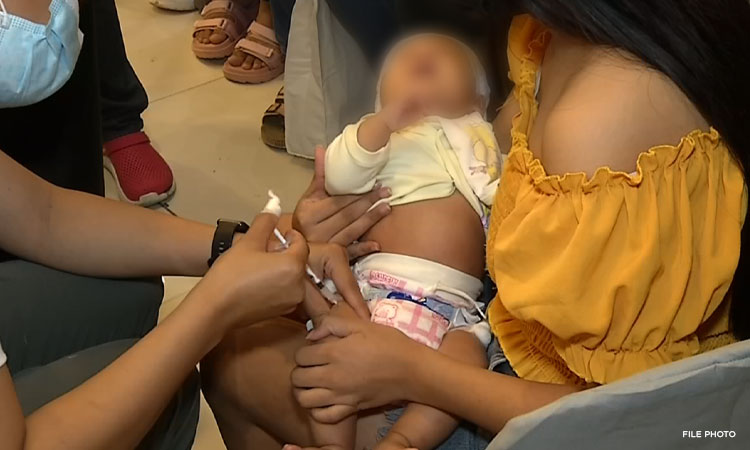

Metro Manila, Philippines – Misinformation undermined the efforts of the Department of Health (DOH) to reach the 95% target coverage for fully immunized children in 2024.
The Philippines reached 61% coverage on fully immunized children, as of Dec. 31, 2024, the DOH reported on Thursday, Jan. 30, during the 2025 National Immunization Summit.
The figure translated to 1.4 million out of 2.3 million Filipino children completing the required doses, according to DOH’s partial data for last year.
Fully immunized children are those that received one dose of Bacillus Calmette-Guerin (BCG) vaccine against tuberculosis; three doses of the pentavalent vaccine targeting diphtheria, tetanus, pertussis, hepatitis B, and Haemophilus influenzae type b; three doses of the oral polio vaccine, and two doses of a measles-containing vaccine before reaching one year of age.
Health Assistant Secretary Farwa Hombre said fear propagated by fake news and other anti-vaccination content are among the main reasons why the agency missed its target.
“Mostly ng ating mga kababayan alam naman na epektibo ito, nagkaroon lang ng fear,” Hombre told reporters. “We want to reeducate again our people na safe and effective po ang ating mga bakuna.”
[Translation: Most of our fellow Filipinos know that vaccines are effective. But fear pervades. We want to reeducate again our people that vaccines are safe and effective.]
Hombre said the DOH disseminate reports and advisories against false information, as well as coordinate with social media platforms to take down fake news. She added health promotion, health education, and health teaching are programs being implemented on the ground.
When asked about the scenario if 95% target is not achieved, Hombre said: “Magkakaroon po tayo ng again, outbreak ng mga sakit na dapat na-eradicate na po natin.”
[Translation: We will have an outbreak again of diseases that we should have eradicated already.]
She cited as an example the long fight against polio. According to the World Health Organization, wild poliovirus type 2 was eradicated in 1999 and wild poliovirus type 3 was eradicated in 2020. Endemic wild poliovirus type 1 remains in Pakistan and Afghanistan as of 2022.
The Philippines was declared “polio-free” in 2021 after a re-emergence in 2019.
“Kung hindi po natin mapapabakunahan ang ating mga anak, muling babalik po ito. Ayaw po natin na magkaroon ulit ng may mga sakit o kapansanan sa ating henerasyon,” the DOH official said, highlighting the importance of parents’ cooperation.
[Translation: If we don’t vaccinate our children, this disease will return. We don’t want our children to contract the disease in this generation.]
In 2023, the Philippines exited the Top 20 list of the highest number of unvaccinated or “zero dose” children, significantly reducing it from around 1 million to around 163,000.
Hombre said the DOH, together with the WHO, United Nations Children’ s Fund, and other private stakeholders are boosting efforts to make vaccines accessible to different parts of the country — another hurdle to immunization efforts.
Other stakeholders also shared steps they have implemented to increase immunization coverage during the 2025 National Immunization Summit.
“It’s an executive ordinance pa lang po sa aming municipality. Lahat ng mababakunahan ng aming midwives or health workers nagbibigay ng small incentive sa FIC (fully immunized children)… May bigas na binibigay,” said Kharin Villanueva from General Mariano Alvarez, Cavite’s Municipal Health Office.
[Translation: It’s an executive ordinance in our municipality for midwives or health workers to give a small incentive, such as rice, to the parents of fully immunized children.]
Shiela Esteban, the National Immunization Program Central Luzon coordinator, said local governments should conduct townhall meetings in barangays with low immunization rates.
“With townhall meetings, nakakapagusap ‘yong health worker and parent. ‘Yong mga agam-agam nila nasasagot at nababakunahan on the spot,” she said.