
To sum up
+ Rowena Tabian and Mary Jane Robles are among two million jobless Filipinos hoping to provide a better life for their families.
+ Job creation and wage increase remain an urgent concern for a number of Filipinos, according to a Pulse Asia Survey.
+ Labor groups have long sought a legislated wage hike to meet basic living standards.
Metro Manila, Philippines – Rowena Tabian has been working overseas as a household helper for more than a decade.
Just like millions of Filipinos, she believed that working abroad would give her four children a better life.
She held on to the dream for some time – long enough for her to work in three countries. But her hopes were dashed because of a traumatic encounter with an employer.
“Iyong employer ko sa Hong Kong nadismaya ako sa ginagawa niya sakin habang nagsasampay ako ng mga damit niya, nagbibiro siya sakin tinulak niya ako sa building. Dahil doon nagbreak contract ako,” an emotional Rowena recalled.
‘ ‘4’: ‘image’: ‘jcr:cb1c13c1-e3ee-41f2-9c29-096379f1e3d2’ ‘imageCaption’: ‘Rowena Tabian recalls her experiences as a household worker

[Translation: I was dismayed by what my employer did to me in Hong Kong. While I was hanging their clothes, she was joking around until she pushed me off the building. So, I broke my contract.]
While Rowena has escaped the horrors of working abroad, she found herself grappling with landing a secure job at home.
Rowena would sometimes get calls for part-time household work, but she said this is inadequate to help her husband finance the needs of their children. Pressed to improve on their lot, Rowena said she is willing to leave home again and work overseas. “Hindi kasi enough sahod ng husband ko. Tapos gusto ko bumawi sa father ko kasi noong nag-abroad ako hindi ako nakatulong sa kanila,” she told NewsWatch Plus.
[Translation: My husband’s income is not enough. I also want to give back to my father because I wasn’t able to help them the first time I went abroad.]
Pursuing dreams at home
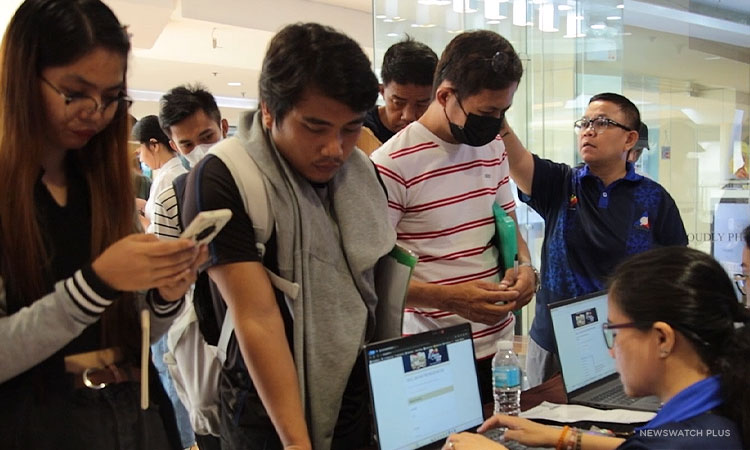
Unlike Rowena, Mary Jane Robles is determined to pursue opportunities at home. She has been into several job fairs, but she said getting hired always comes at a cost. “Nagsubok ako sa ibang job fairs kaya lang na-disappoint ako pero pinaglalabas nila ako ng pera. Wala naman akong ganong pera na kalaki para ibigay,” Mary Jane said.
[Translation: I tried other job fairs but I get disappointed because they want me to shoulder expenses. I don’t have that much money to shell out.]
Mary Jane said she’s hoping to find a stable job as her kids get older.
“Malaki na kasi iyong dalawang anak ko so kailangan ko talaga tumulong sa asawa ko. Kailangan ko ng malaking income para sa dalawang bata,” she told NewsWatch Plus.
‘ ’18’: ‘image’: ‘jcr:7812a878-a832-475f-92fb-d54afa302a45’ ‘imageCaption’: ‘Mary Jane Robles tries her luck at a job fair in Mandaluyong
[Translation: My two children are growing up so I have to help my husband. I need a big income for my children.]
Rowena and Mary Jane are among two million jobless Filipinos looking for stable opportunities and better income.
In the latest report of the Philippine Statistics Authority in May, the country’s unemployment rate rose to 4.1% from 4.0% in the previous month.
A Pulse Asia survey in June also showed that job creation remains an urgent concern for many Filipinos.
“Sobrang hirap kasi kapag once na wala kang madukot, sabay sabay gastos, tubig kuryente, tapos eskwela pa ng mga bata. Hindi mo na alam saan ka kukuha,” Rowena shared.
[Translation: It’s difficult when you have nothing in your pocket. There are electricity and water bills to pay as well as school expenses. You don’t know where you could get resources to settle these.]
Fight for higher wage
Aside from creating jobs, higher wage is also a prevailing concern for Filipinos, according to Pulse Asia. In July 2024, the Regional Regional Tripartite Wages and Productivity Board approved a P35 increase in the minimum wage in Metro Manila. This means, agricultural workers would get P608 from P573, while non-agricultural workers could earn P645 per day.
Metro Manila has the highest minimum wage across all regions. But even this is far from the estimated family living wage by think tank IBON Foundation.
“Ang estimate diyan ‘no, IBON Foundation of course alam natin ‘yan lahat, may P1,200. Pero as early as 2008, no less than the National Wages and Productivity Commission estimated the living wage in 2008 to around P917. Kaya sinasabi namin lahat ng minimum wages this 2024, ay no way near pa rin sa living wage ng NWPC noong 2008,” Trade Union Congress of the Philippines spokesperson (TUCP) Carlos Oñate told NewsWatch Plus.
[Translation: We already know this. The IBON foundation estimated the family living wage at P1,200. But as early as 2008, no less than the National Wages and Productivity Commission estimated the living wage in 2008 to be around P917. That’s why we’re saying that the minimum wage in 2024 is no way near NWPC’s living wage in 2008.]
Labor groups like TUCP have been calling for a legislated wage hike since the last one in 1989.
The Senate approved a P100 increase in February. A counterpart bill in the House seeking a P150 wage hike is still pending in the committee on labor and employment.
The Makabayan bloc also filed a separate bill asking for a P750 across-the-board increase, but it also failed to go beyond committee.
Dreams for the future
While the government is determined to create more jobs for many Filipinos, the dreams of Rowena and Mary Jane seem to be pipe dreams.
“(Gusto kong) makatapos ang anak ko sa pag-aaral. Iyong hindi na kami masyadong hirap,” Mary Jane said.
[Translation: I want my kids to finish their studies. A future where we won’t struggle anymore.]
“Gusto sana magkaroon kami ng sariling bahay kasi wala kaming bahay e… Mabigyan man lang ng magandang kinabukasan ng anak ko,” Rowena said.