
Metro Manila (CNN Philippines, December 23) – Lawmakers this year had their hands full with controversies surrounding both chambers of Congress, on top of their duties of passing the Marcos administration’s urgent bills and crafting the budget.
While rushing to pass the Marcos administration’s priority measures – including the highly contentious Maharlika Fund – alleged destabilization plots, backlash from the comeback of secret funds, and cracks in the UniTeam’s facade made this a standout year for Congress.
CNN Philippines looks back at the legislature’s 2023.
Maharlika, other bills
Despite protests from lawmakers and public scrutiny, President Ferdinand Marcos Jr. enacted the law establishing the Maharlika Investment Fund (MIF) in July, just seven months after it was first proposed in Congress.
Both chambers approved the measure in May, with the House committing to adopt the Senate version even before the bicameral conference committee met.
The Senate, after only seven days of deliberations, swiftly approved its version of the bill, which agreed to ban the use of state pension funds as seed capital for the proposed sovereign wealth account.
Some former and incumbent lawmakers appealed and advised against the rushed passage of the bill, citing reasons ranging from its unconstitutionality to the proposed law’s proper timing.
Despite the minority bloc and some experts cautioning against the law, the chief executive announced that the implementing rules and regulations (IRR) of the MIF were finalized in November, a month after he announced its suspension.
The IRR of the fund was first issued in late August but was suspended pending further review.
Aside from the MIF, other key bills passed into law include increasing military veterans’ disability pension and the measure fixing terms for ranking officials of the Armed Forces of the Philippines (AFP).
For benefits of the people and workers, Congress passed in July the New Agrarian Emancipation Act which writes off loans of more than 600,000 agrarian reform beneficiaries worth over ₱57 billion.
The legislature also passed the Tax Amnesty Act extending the deadline of the estate tax amnesty until 2025; the Trabaho Para sa Bayan Act; the Act institutionalizing the automatic income classification of provinces, cities, and municipalities; and the Act instituting policies for the protection and welfare of caregivers.
Congress also enabled the Act establishing specialty centers in Department of Health hospitals in every region.
On culture and nationalism, the chambers passed the Act institutionalizing the One Town, One Product (OTOP) Philippines Program and the Cultural Mapping law.
For strengthening the economy, the congress enabled priority bills Public-Private Partnership (PPP) Code of the Philippines and the Internet Transactions Act of 2023 which support the administration’s push for a more digital economy.
READ: PBBM’s first year in office: Key measures passed, pending priority bills
The fall of UniTeam?
In May, former President and then House Senior Deputy Speaker Gloria Macapagal-Arroyo was demoted to Deputy Speaker, sparking rumors of a leadership coup for the post of Speaker Martin Romualdez.
Arroyo is seen as an ally of Duterte while Romualdez is the first cousin of President Marcos.
Though Arroyo denied involvement in any plot, a lawmaker said her demotion was a confirmation of a speakership coup. Romualdez himself said that “occasional moves to destabilize the House should be nipped in the bud.”
Tensions between the House and the vice president grew when the lower chamber scrutinized the government’s requests for secret funds, particularly those made by Duterte-led agencies: the Office of the Vice President (OVP) and the Department of Education (DepEd).
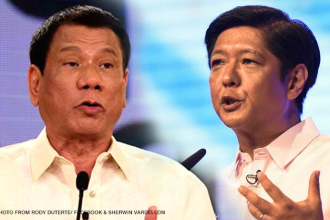
As a result, former president Rodrigo Duterte, father of the vice president, accused the House of corruption and even wished death upon ACT-Teachers Rep. France Castro, further inflaming tensions between lawmakers and the political dynasty.
These threats prompted the House to pass a resolution expressing support for Romualdez. Pampanga Rep. Aurelio Gonzales, who was promoted to Senior Deputy Speaker when Arroyo was demoted, even announced before the plenary his resignation from PDP-Laban, Rodrigo Duterte’s party.
However, despite the apparent tension between the Romualdez-led House and Duterte, the speaker said the UniTeam alliance was still intact.
Confidential funds
This year’s budget season drew more flak from Filipinos due to numerous requests for secret funds to be allocated to government agencies under the 2024 General Appropriations Act.
Early in the budget season, the Marcos administration asked for ₱10.14 billion in secret funds: ₱4.86 billion for confidential expenses, and ₱5.27 billion for intelligence expenses.
The Office of the President sought the bulk of this at ₱4.5 billion.
The OVP and the DepEd, both run by Duterte, asked for ₱500 million and ₱150 million, respectively.
Furthermore, it was revealed during this budget season that the OVP in 2022 had spent ₱125 million worth of confidential funds in just 11 days.
These funds were transferred from the OP’s contingent funds to the OVP’s maintenance and other operating expenses, drawing criticism.
This revelation prompted lawmakers and civil society members to lodge complaints against Duterte, the Department of Budget and Management, and even Malacañang, assailing the legality and constitutionality of the transfer.
The widespread criticism prompted the second-half of the UniTeam alliance to withdraw her request, pointing out the “divisive” nature of the issue.
In mid-December, Congress approved and ratified the Bicameral Conference Committee report on the proposed ₱5.768 trillion national budget for 2024.
On Dec. 20, Marcos signed into law the 2024 General Appropriations Act worth ₱5.768 trillion.
He vetoed two provisions: one seeking a revolving fund for the Department of Justice, and another on the implementation of the National Government’s Career Executive Service Development Program.
READ: Marcos vetoes two items in 2024 budget
The enacted version of the government’s spending plan did not include any confidential funds for civilian departments, such as the OVP or the DepEd. It only kept intelligence funds for military and uniformed agencies.
Senate President Juan Miguel Zubiri, Romualdez, and even oppositon congresswoman Castro hailed the removal of the funds.
However, opposition lawmakers questioned the move to exempt from the Government Procurement Act purchases made in connection with the revised modernization program for the AFP.
They also found disconcerting the executive’s power to allot secret funds for civilian agencies with no mandate to perform security and intelligence-related functions, if the president finds an “extreme necessity” for it.
The vice president, meanwhile, believes she still has the trust of the president.