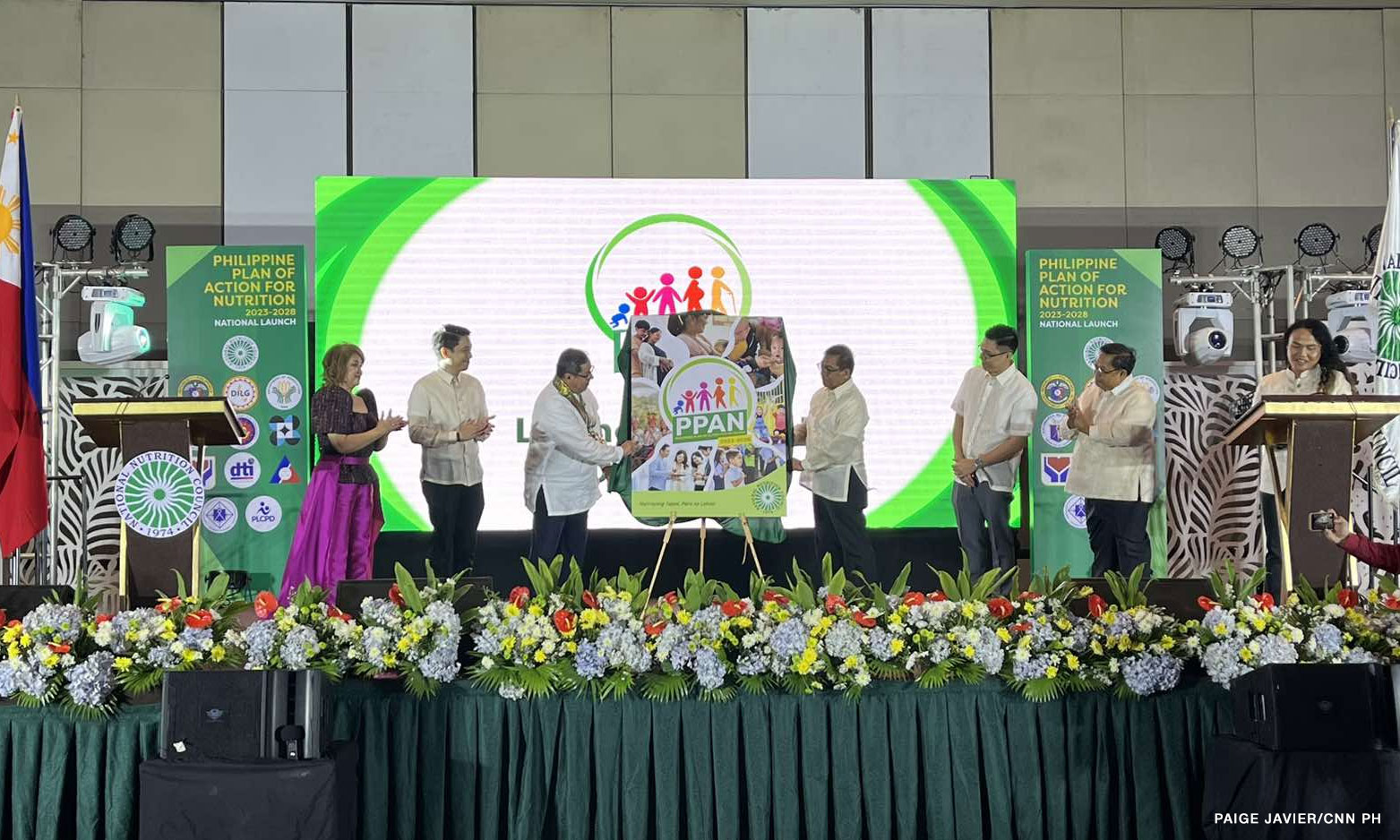

Metro Manila (CNN Philippines, September 4) — In a bid to strengthen its efforts to reduce all forms of malnutrition in the country, the National Nutrition Council (NNC) launched the Philippine Plan of Action for Nutrition (PPAN) 2023 to 2028 — a five-year plan that will serve as a blueprint for the government, national government organizations (NGOs), private sector, and academe to combat malnutrition.
The main thrusts of the PPAN are to make nutritious food accessible and affordable to everyone, change the behavior and mindset of Filipinos on nutrition, and integrate the nutrition programs in local government units (LGU).
The NNC says most of the malnourished children are from the Bangsamoro Autonomous Region of Muslim Mindanao (BARMM), Central Visayas, and Mimaropa.
The council believes the launch of the plan is “timely” since the country still experiences high levels of child stunting. Data shows 26.4% or 1 out of 4 children under the age of five are short for their age.
“Ito ay critical na edad kasi kung nabansot sila sa unang dalawang taon irreversible na yun, ibig sabihin yung utak nila nabansot din, kaya naman hindi na tumatalino o mababa yung school performance ng mga bata pagpasok nila sa school,” NNC Officer-in-Charge Deputy Executive Director Jovita Raval said.
[Translation: This age is critical because if stunting happens in the first two years, the effect is irreversible — this means it affects their brains, their intelligence and school performance.]
The PPAN also aims to address the steady increase of overweight and obese children and adults. Based on 2018 data, an estimated 27 million Filipinos are overweight and obese, mostly from Metro Manila, Central Luzon, Calabarzon, and the Cordillera Administrative Region.
One of the major strategies in the five-year plan is to improve the consumption of a healthy diet with information campaigns and policy reforms through legislation and regulation. It also seeks to improve food systems and make nutritious food affordable and accessible.
“Magkakaroon tayo ng front labeling para alam ng consumers yung titingnan nila kung healthy. Magkakaroon din tayo ng proposal na legislation to protect the children from harmful marketing,” Raval explained.
[Translation: We will have front labeling so consumers will know whether something is healthy. We will also propose legislation to protect children from harmful marketing.]
The PPAN includes nutrition programs for senior citizens and pregnant women.
“Tutukan pa rin natin ang first 1,000 days kasi kung maayos natin ‘yan, mapasuso ang mga bata ano, mas mababa ang risk nila for overweight and obesity later in life. And of course ang ating population mas dumarami yung older person, yung senior citizens,” Raval said.
[Translation: We will still need to focus on the first 1,000 days because if children can nurse properly, they will be at less risk of becoming overweight and obese later on in life. And of course, the number of older people and senior citizens is increasing.]
NNC Executive Director Azucena Dayanghirang says 34 provinces will be the focus of PPAN implementation due to the high magnitude of child stunting, low financial capacity of LGUs, and high level of food insecurity among households.
Department of Health (DOH) secretary Dr. Ted Herbosa recognizes the immediate need to address child stunting, wasting and other forms of malnutrition among children to protect our human capital.
“Very important talaga na ma-address natin yung problem sa nutrition. Alam niyo yung bansa natin nasa high middle income country na tayo,” he said.
“Pero yung statistika natin sa ating nutrition, pang low middle income or low-income country,” Herbosa added.
[Translation: It is very important to address the problem of nutrition as the country is now within the high middle income range. But our nutrition statistics are still that of a low middle income or low-income country.]
The DOH chief is confident the country can eradicate the problem in a year.
“Kaya natin ‘yan kasi meron na tayong food stamp, meron na tayong day care feeding. Meron na tayong school age feeding… And I saw other countries nga like yung kinekwento ko na Costa Rica nga which is not rich pero napakaganda ng nutrition ng kanilang mamamayan,” Herbosa said.
[Translation: This can be done because we have the food stamps, we have day care feeding. There is also school age feeding. And I saw other countries like Costa Rica who has improved the nutrition of their citizens.]
The government and private sector have existing feeding programs for the less fortunate, mostly led by the Department of Social Welfare and Development (DSWD). However, Raval says there should be initiatives specifically for the first 1000 days of a child’s life.
The NNC says the five-year plan for nutrition is in line with the directive of president Ferdinand Marcos Jr. to include nutrition as one of the administration’s priority agenda.