
Metro Manila (CNN Philippines, September 4) — The Senate Committee on Finance has approved the ₱758.6 billion proposed 2024 budget of the Department of Education (DepEd), including ₱150 million for confidential funds which minority senators quizzed during the hearing.
On Monday, Senate Minority Leader Koko Pimentel asked the DepEd if it could live without its request for confidential funds and instead realign the request to priority programs of the agency.
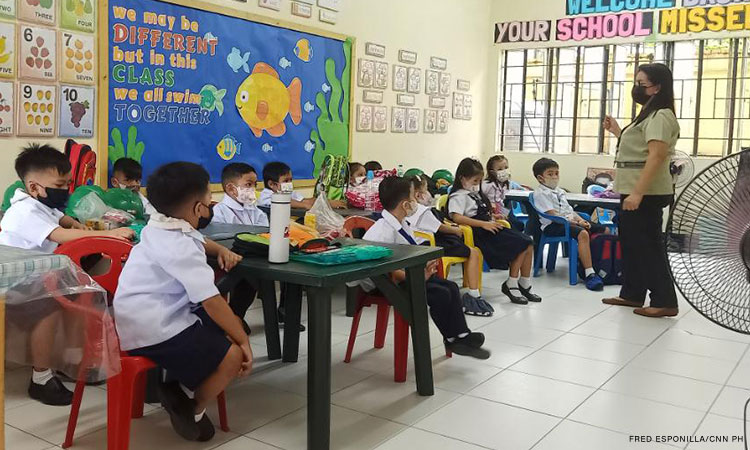
“Logic tells us, if you can live without the ₱150 million in confidential funds, then maybe we can give that amount to these three programs which are sorely lacking in funds,” Pimentel said. “If ₱150 million, ₱2.5 million per classroom, it would actually contribute 60 classrooms, not bad.”
Education officials said an average classroom costs ₱2.5 million.
Undersecretary Michael Poa told senators that the DepEd originally submitted to the Department of Budget and Management a ₱953-billion proposal for the education department.
RELATED: Duterte: Proposed 2024 budget for DepEd not enough to improve basic education
Construction of new school buildings, funding for school furniture, and the implementation of its school-based feeding program were some of the items that saw huge cuts in the recalibrated budget proposal, Poa said.
He, however, reiterated that the allocation of confidential funds will “make our jobs easier in protecting our learners, teachers, and non-teaching personnel.”
Sen. Risa Hontiveros also argued that security agencies have the mandate to conduct intelligence operations even in the context of education, and not the DepEd.
Vice President Sara Duterte, the concurrent education secretary, stood firm that the confidential funds are in line with their mandate to provide a safe and enabling learning environment for learners, and safe spaces for teaching and non-teaching personnel.
‘Voluntary contributions’
Sen. Raffy Tulfo got into an argument with Duterte after raising in the committee hearing alleged “voluntary contributions” for electric fans, chalk, and floor wax, among others, that were collected from students through Parent-Teacher Association (PTA) meetings.
“Ang mga estudyante na walang pang-contribute kung minsan pinapahiya pa, nilalagay pa sa group chats [Students who cannot contribute are shamed in group chats],” Tulfo said, citing complaints he received from parents.
Duterte interjected that Tulfo can help by passing a law to prohibit these contributions and penalize teachers or parents insisting on the collection of voluntary contributions.
“It is a voluntary contribution, ibig sabihin hindi po pinipilit ‘yung mga estudyante o ‘yung mga magulang na mag-contribute, kung ‘yun man ang nadesisyonan na project ng PTA,” she also explained.
[Translation: It is a voluntary contribution, meaning students or parents are not forced to contribute, if the PTA had decided on such a project.]
“Unang-una, wala akong kapangyarihan para ipatigil yan,” Tulfo replied. “However, merong kapangyarihan ang DepEd para ipatigil po ‘yung mga voluntary contributions sa PTA.”
[Translation: I have no power to stop that practice. However, the DepEd has the power to stop the voluntary contributions to the PTA.]
The vice president said she took note of the senator’s advice.
Duterte: We are not ready with the ‘correct’ blended learning program
Hontiveros also flagged the decrease of the DepEd’s computerization program budget for 2024, saying it was some sort of dissonance in its pronouncement for a “heavier dependence and reliance to ICT to improve basic education delivery.”
Poa answered that the agency feels the proposed ₱8 billion for next year’s computerization program is “sufficient,” as they will still utilize all of its 2023 budget, including 2022 continuing funds.
Duterte said the e-learning carts are e-libraries on wheels. She said it’s a cheaper alternative instead of building computer laboratories.
The DepEd is also forming the online and offline platform for learning materials and resources needed for the blended learning program, as well as mapping out schools with zero internet connectivity, among other initiatives, Duterte said.
“We are not ready with the correct blended learning program that we want to implement in the Department of Education,” Duterte told the Senate panel. “We hope to be ready next year in time for the phased implementation of the MATATAG curriculum.”
Duterte earlier told members of the House of Representatives that the agency is eyeing to institutionalize blended learning to address the congestion in classrooms, the lack of classrooms, and the shortage of teachers.
CNN Philippines correspondent Eimor Santos contributed to this report.