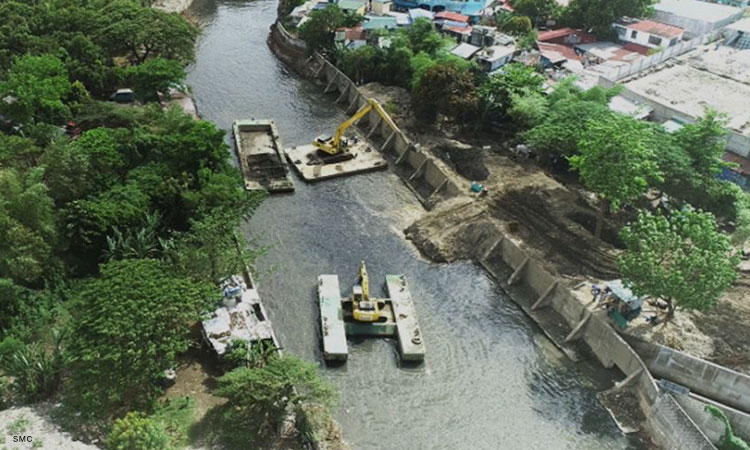

Metro Manila (CNN Philippines, August 9) — San Miguel Corporation (SMC) has vowed to implement an extensive cleanup of polluted river systems and waterways in and around Bulacan – including the Pampanga River – to solve the province’s perennial problem with flooding.
SMC president and CEO Ramon Ang said the cleanup will be implemented using the company’s own resources at no cost to the government and the people of Bulacan.
Ang made this commitment to Department of Environment and Natural Resources (DENR) Secretary Maria Antonia Yulo-Loyzaga in a recent meeting, where he presented the status of SMC’s massive river cleanup initiatives including the Pasig River, Tullahan River, and the San Juan River – and now, the Pampanga River up until Manila Bay.
The firm has already spent some ₱3 billion to desilt and remove solid wastes from polluted waterways.
SMC, which has multiple investments in Bulacan including the MRT-7 project, the Bulacan Bulk Water Supply facility, and the biggest development in the country to date – the ₱740-billion New Manila International Airport – has, in recent years, been a prime mover and advocate for cleaning up major river systems in Metro Manila.
Shifting river rehab efforts to Bulacan
“Our Pasig River cleanup is almost complete. After about two years, we are nearing our target of 1.4 million tons of silt and waste removed. We have also started desilting and waste extraction activities at the Meycauayan River and Maycapiz/Taliptip River. This is part of our plan to clean up rivers in the Bulakan-Obando-Meycauayan-Marilao-Bocaue-Guiguinto River System, which is critical to addressing flooding throughout the southern part of Bulacan,” Ang said.
The province is situated in a low-lying area in Central Luzon and in close proximity to multiple river systems, making it susceptible to flooding.
SMC’s flood mitigation program for Bulacan initially covered rivers surrounding the future site of the New Manila International Airport and later on expanded the program to other tributaries outside of the MMORS (Marilao-Meycauayan-Obando River System) upon the request of local government units in Bulacan.
“I am confident that with this project to extensively clean up our rivers and with the support of our provincial and local governments and the DENR, we can significantly increase the carrying capacity of our rivers and help solve flooding once and for all,” he added.
Airport project not the cause of flooding
Ang also addressed allegations that the airport project caused the flooding in Bulacan, pointing out that floods were already a major problem long before the government approved the airport’s construction in the province.
“There are many contributing factors to flooding. Bulacan has many low-lying areas. Another is land subsidence caused by over-extraction and the depletion of ground water. In fact, that is one of the reasons why we invested in putting up the Bulacan Bulk Water System Project some years back to provide potable water to residents without having to resort to unsustainable use of ground water,” Ang explained.
He also mentioned degradation, siltation, pollution of rivers, and proliferation of fish ponds in coastal areas as other major causes of flooding.
SMC has already started cleaning up rivers around the airport project site as part of the overall design and long-term maintenance of the country’s largest international gateway.
These flood mitigation efforts are seen to also benefit towns near the airport.
“We are deeply invested in the future as well as the well-being of Bulacan and its residents. We would not pour in billions in resources if we didn’t consider all possible risks, including flooding in the province,” Ang said.
Heavily-silted Pampanga river brought floods to Calumpit, other towns
Ang also pointed out that heavily-flooded areas during the last typhoon, particularly Calumpit and Hagonoy, located far from the airport project, were affected by overflow from the heavily-silted Pampanga River aggravated by the release of water from some dams.
SMC is already looking to extend its river desilting and cleanup initiative beyond Bulacan’s rivers, to other critical tributaries throughout Central Luzon.
Pampanga Gov. Dennis Pineda welcomed Ang’s vow to clean up the Pampanga River up until Manila Bay.
Since 2020, the company has been undertaking major river cleanup programs at no cost to the government, to help mitigate flooding in and around Metro Manila.
Apart from its ongoing cleanup of the Pasig River, SMC completed its ₱1-billion Tullahan river cleanup project last year – extracting more than 1.12 million metric tons of silt and solid wastes from the river.
Ang said SMC has so far cleaned up some 4.45 kilometers out of an initial 13-kilometer target along the Taliptip/Maycapiz River and the Meycauayan River. A total of 543,266 metric tons of silt and solid waste have now been removed.
Meycauayan River, one of the tributaries in the MMORS, has been named as one of the world’s top 10 tributaries that emit the highest share of plastics to the oceans.
Others in the list are the Pasig River, Tullahan River, Pampanga River, Libmanan River, Rio Grande de Mindanao, and Agno River.
Many parts of Bulacan are still under water in the aftermath of Super Typhoon Egay, Typhoon Falcon, and the enhanced southwestern monsoon weeks after the storms exited the Philippine Area of Responsibility.
READ: Parts of Bulacan still under water in aftermath of Egay
It was determined during a meeting between SMC, Pineda, and local public works officials that the culprit behind the clogging was the Tulaoc Bridge, which cuts across the Pampanga River.
SMC said it would first commission a bathymetry survey to measure how deep the river is.
With reports from CNN Philippines correspondent Lois Calderon.