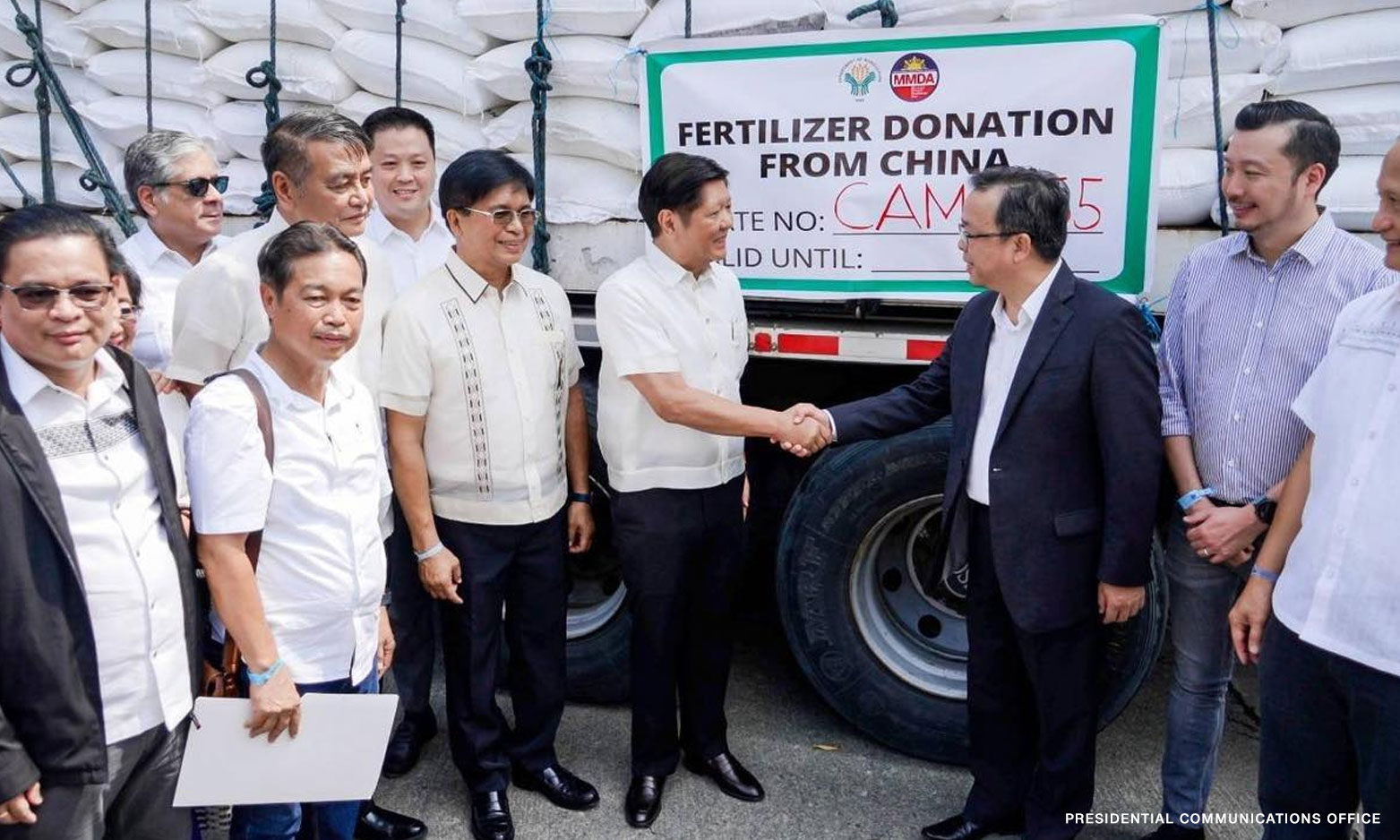

Metro Manila (CNN Philippines, June 16) — The Philippines on Friday received urea fertilizer from China worth around 100 million yuan (around ₱782 million) to help farmers save on production costs, the Palace said.
Malacañang explained the urea — widely used in the country’s agriculture sector as a fertilizer and animal feed additive — will be distributed first to some 160,000 rice and corn farmers in the Ilocos region, Cagayan Valley, Central Luzon, Calabarzon, and Bicol through a voucher system. It added the fertilizers to be received will cover 200,000 hectares at two bags per hectare.
“Isasama na lang natin ‘yong supply ng fertilizer, para kapag mabigyan ‘yong farmers ng kanilang voucher kasama na ito sa kanilang kukunin,” President Ferdinand Marcos Jr. told reporters.
[Translation: We will include the supply of fertilizers so that farmers can already receive it at the same with their vouchers.]
The turnover ceremony of the 20,000 metric tons of urea fertilizers or 400,000 bags was held on Friday at the National Food Authority warehouse in Valenzuela City. Social Welfare Secretary Rex Gatchalian and Ambassador of China to the Philippines Huang Xilian were also present.
Malacañang said the urea donation was “part of the grant provided in the Agreement on Economic and Technical Cooperation between the two Governments on 25 April 2019.”
“This donation that came from China was a product of our request from all our friends around the world during the crisis that we’re still feeling now — when fertilizer prices went up… because of the supply chain problem that we are experiencing with our usual partners — China did not think twice and immediately came up,” Marcos said in his speech.
He also said he had a “good conversation” with Chinese President Xi Jinping when the Philippines requested the assistance and added China “immediately understood the predicament that we were in.”
During Marcos’ visit to Beijing in January, Malacañang said the Philippine government signed a cooperation agreement with two Chinese fertilizer manufacturing firms to “ensure sustainable supply of the much-needed fertilizers at reasonable prices.”
Huang said the “deliverable” has arrived as scheduled.
“It will tremendously aid our efforts to boost agricultural production, our nation’s pursuit of food security,” Marcos said of the donation.
“Soon, these donated goods will find their way to our Filipino farmers,” he added. “They will be able to spend savings gained from production costs on other things that matter to them and their families.”
Reinforcing China-PH ties
Huang said in his speech that the donation speaks of China’s “action and sincerity and demonstrates the friendship of the Chinese people for the people of the Philippines.”
“Looking ahead, we truly believe that as long as the consensus between our two top leaders is implemented in real earnest, with strengthened communication and dialogue, and differences probably managed, China-Philippines relations will maintain a steady momentum of development and enjoy an even brighter future,” he said.
Marcos said the agriculture cooperation between Beijing and Manila is “very promising,” noting that the two nations have the same agriculture priorities and both can learn from one another.
Aside from the urea fertilizers, Marcos said Gatchalian informed him that China also provided ₱4 million worth of rice for relief goods for evacuees affected by Mayon Volcano’s activity.
RELATED: Marcos wants 90-day plan for Mayon response
“These generous acts symbolize the value of the relationship between our two countries,” he said in his speech. “We must continue to nurture, we must continue to care for that through acts of mutual assistance and constant and amicable dialogue.”
“I assure the Chinese government that the Philippines will always work for the strengthening of our ties and the advancement of our mutual interest,” he added.
“Since the RCEP (Regional Comprehensive Economic Partnership) has now taken effect, it’s clear that the volumes should increase,” he also told reporters. “I’m very optimistic that trade between China and the Philippines, not only in agriculture but in other aspects as well, I cannot see it lessening. I can only see it growing.”
EXPLAINER: What is RCEP? Will PH benefit from it?