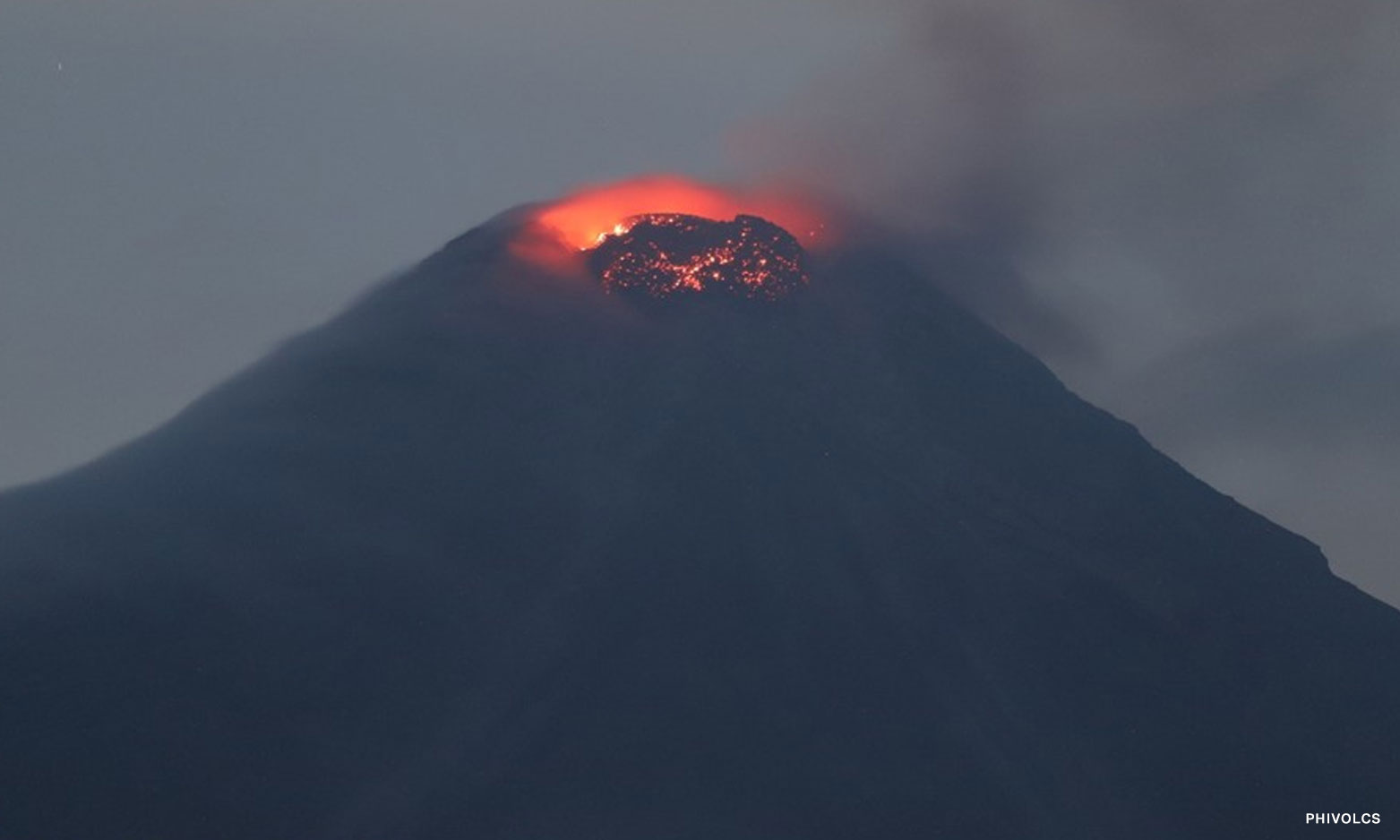

Metro Manila (CNN Philippines, June 10) — The local government of Albay plans to move out this weekend over 10,000 families or 40,000 locals living inside the danger zone of the erupting Mayon Volcano.
As of 7 p.m. on Saturday, the Albay police said 3,007 families or 10,752 individuals were already staying in temporary shelters.
This covers villages in Camalig, Daraga, Guinobatan, Legazpi, Ligao, Malilipot, Sto. Domingo, and Tabaco.
Speaking to CNN Philippines’ The Source on Friday, Albay Gov. Edcel Greco Lagman said preemptive evacuation efforts started in Camalig and Guinobatan as they are the towns most vulnerable to the volcanic activity.
During the briefing, Lagman also told mayors that the province has put up evacuation sites for farmers’ livestock. Agriculture is the main industry of Albay, with farmers also planting crops within the danger zones.
“Pwede tayong mag-adopt, mag-identify tayo ng mga kasamahan natin sa inyong mga respective jurisdictions [We can also adopt, let’s identify partners in our respective jurisdictions] that could actually adopt these livestock,” the governor suggested.
“The province will provide the budget sa pagpapakain ng mga livestock na ‘yan [to feed the livestock]…so that it would be easier for them to comply with the evacuation protocols,” he added.
Social Welfare Secretary Rex Gatchalian also visited the province and joined the briefing to get updates.
He requested local chief executives to specify dates for food pack distribution and to continuously coordinate for sustained efforts. Mayors have appealed for a cash-for-work program to engage displaced residents.
On Thursday noon, the Philippine Institute of Volcanology and Seismology (Phivolcs) raised the alert status of Mayon Volcano to Level 3, meaning the volcano is showing an increased tendency towards a hazardous eruption and potential explosive activity that can occur within weeks or even days.
“Fair crater glow or ‘banaag’ and incandescent rockfall shed from new fluidal lava at the summit of Mayon Volcano was also observed last night,” the agency said in a Saturday report.
Phivolcs also measured sulfur dioxide (SO2) emissions of 1,205 tonnes per day on Saturday, three times higher than Friday’s 417 tonnes per day.
Phivolcs earlier reported that Mayon logged just one volcanic earthquake in the past 24-hour period and 59 rockfall events that placed lava debris on gullies within 1,500 meters from the summit crater.
State volcanologists have advised authorities to be vigilant against pyroclastic density currents, lahars, and sediment-laden streamflows.
The province of Albay is currently under a state of calamity.
Meanwhile, President Ferdinand Marcos Jr. also called on residents to comply with the orders of the local government unit for their safety.
“Pinapaalalahanan ang ating mga kababayang Bikolano na sumunod lamang sa mga rekomendasyon at evacuation instructions ng inyong lokal na pamahalaan upang masiguro ang kaligtasan ng bawat isa,” the president said in a statement on Saturday.
[Translation: We are reminding all Bicolanos to follow the recommendations and evacuation instructions of your local government to ensure everyone’s safety.]
In a briefing in Albay on Saturday, Eugene Escobar, research division chief of the Albay Public Safety and Emergency Management Office, said they plan to evacuate 10,000 families — particularly those living inside the volcano’s 6-kilometer permanent danger zone and the 7-kilometer extended danger zone.
This indicates that the volcano is releasing gas. “Yung worrisome is wala or mababa ang SO2 emission natin at tumaaas yung [What’s worrisome is low to none SO2 emissions alongside increased] volcanic earthquakes,” Phivolcs director Teresito Bacolcol told CNN Philippines’ Newsroom Weekend.