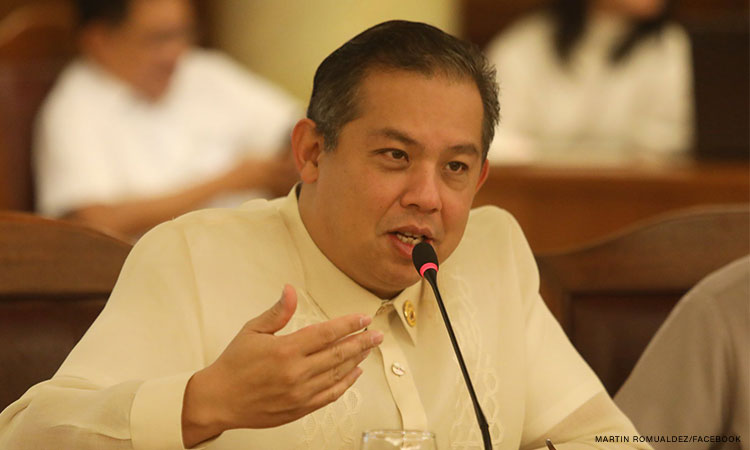

Metro Manila (CNN Philippines, November 28) — Taking cue from Singapore, China, Hong Kong, and South Korea, House Speaker Ferdinand Martin Romualdez and senior deputy majority leader and Ilocos Norte Rep. Sandro Marcos have filed a bill establishing a sovereign wealth fund (SWF) for the Philippines.
SWFs are state-owned investment funds typically financed by a country’s surplus revenues or reserves. The government invests these funds in both financial and real assets with the aim of stabilizing national budgets, creating savings, or promoting economic development.
Under House Bill 6398, funds for the proposed Maharlika Investments Fund (MIF) will be sourced primarily from contributions from the Government Service Insurance System (GSIS), Social Security System (SSS), Land Bank of the Philippines (Land Bank), and Development Bank of the Philippines (DBP).
The bill proposes an initial investment of P250 billion from the four government financial institutions (GFIs), with the breakdown as follows: GSIS, ₱125 billion; SSS, ₱50 billion; Land Bank: ₱50 billion, and DBP: ₱25 billion.
The MIF “will be used to invest on a strategic and commercial basis in a manner designed to promote fiscal stability for economic development, and strengthen the top-performing GFIs through additional investment platforms that will help attain the National Government’s priority plans,” stated HB 6398.
Joining Romualdez and Marcos in proposing the creation of the MIF are: House Majority Leader Mannix Dalipe, Tingog Party-list Reps. Jude Acidre and Yedda Romualdez, and Marikina Rep. Stella Quimbo.
The proposed MIF is patterned after the SWFs of 49 countries, including Singapore, China, Hong Kong, South Korea, Malaysia, Indonesia, Taiwan, Vietnam, and East Timor.
HB 6398’s authors said the MIF would give the GSIS, SSS, Land Bank, and DBP the opportunity “to ensure their respective funds’ optimal asset allocation as well as ensure that resources are efficiently channeled to investments that will provide the most value not only to the participating GFIs, but also to the country.”
“As the Philippines secures its place not only as the Rising Star of Asia but as a real economic leader in the Asia Pacific, the creation of the MIF becomes imperative,” they said.
Bolstering the argument for the MIF’s creation, the lawmakers noted that Singapore’s SWF became a tool for the city-state to manage its foreign reserves, while Indonesia attracted foreign investors to jointly capitalize its SWF to bring in much-needed investments in such sectors as transportation, including airports, supply chains, logistics, digital infrastructure, the green economy, healthcare services, the financial sector, technology, and tourism.
HB 6398 lists the following as among the areas where the MIF can be invested: Cash, foreign currencies, metals and other tradeable commodities; fixed income instruments issued by sovereigns, quasi-sovereigns and supranationals; domestic and foreign bonds; listed or unlisted equities, whether common, preferred or hybrids; financial derivatives, Islamic investments, such as Sukuk bonds; joint ventures or con-investments; mutual and exchange-traded funds; commercial real estate and infrastructure projects, and other investments as may be approved by the board.
The MIF will be managed by the Maharlika Investments Corporation (MIC), which will be governed by a nine-member board of directors composed of the Finance Secretary, nominees of the contributing GFIs, and two independent directors.
To ensure transparency and accountability, authors of the bill said the MIF would adhere to the Santiago Principles, which are 24 generally accepted principles and practices agreed to in October 2008 in Santiago, Chile, among countries with SWFs, investment recipient countries, and international organizations.