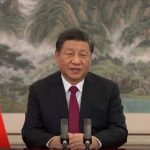

Metro Manila (CNN Philippines, October 17) — Chinese President Xi Jinping said he wants a “world-class” upgrade on China’s military defense capabilities to protect its sovereignty, security and development interests as they enter what they call a “new era” and to fulfill their goal of becoming a modern socialist country.
In his report at the 20th National Congress of the Communist Party of China, Xi said their country should continue to utilize the application of smart technologies to work faster to modernize military theory, organizational forms, personnel and equipment.
The Chinese president also wanted to intensify training troops and combat preparedness so that their armed forces can fight and win.
“We will intensify military training under combat conditions, laying emphasis on joint training, force-on-force training and high-tech training. We will become more adept at deploying our military forces on a regular basis, and in diversified ways, and our military will remain both steadfast and flexible as it carries out its operations. This will enable us to shape our security posture, deter and manage crises and conflicts and win local wars,” Xi said.
“We will speed up development of modern logistics, implement major projects to develop defense-related science and technology, weaponry and equipment and move faster to translate scientific and technological advances into combat capabilities,” he added.
Pursuing an independent foreign policy of peace, opposes hegemonism and power politics
In his report to the party congress, Xi maintained that China’s foreign policy is committed to uphold world peace and common development.
Beijing asserted that it respects the sovereignty and territorial integrity of all countries and vowed that China will never seek hegemony or engage in expansionism.
“China remains firm in pursuing an independent foreign policy of peace. It has always decided its position and policy on issues based on their own merits,” the Chinese president said.
“China stands firmly against all forms of hegemonism and power politics, the Cold War mentality, interference in other countries’ internal affairs, and double standards,” he added.
Manila and Beijing are engaged in a maritime dispute over the South China Sea. The Philippines won an arbitration case in 2016 which rejected China’s nine-dash line claim in the area.
China, however, repeatedly called the arbitral award as illegal, null, and void.
Expert: China will not fire the first shot; PH can be collateral damage if Taiwan situation escalates
Meanwhile, Benjamin Lim, a Filipino and Beijing-based journalist for more than two decades and an expert on China politics, said it’s not contradictory that Beijing is pursuing a policy of peace while at the same time strengthening its military defense capabilities.
“China was a victim of foreign aggression for more than a century, hence, they have to modernize their military. But then what they are saying is that they will not be like the US, they are not going to be a hegemon, they will not become a threat to the world, they will not fire the first shot,” said Lim.
Xi repeatedly mentioned that China will pursue a peaceful reunification with Taiwan but warned against external interference from other countries.
“For us, President Bongbong Marcos is in a very unique position to promote peace in the region,” Lim said.
“We do not want war and nobody wants war, nobody wins a war, only losers. We are so close to Taiwan that if military conflict breaks out between China and Taiwan, or China and the US over Taiwan, then we will become collateral damage, we are in the line of fire, so this is the worst-case scenario,” he added.