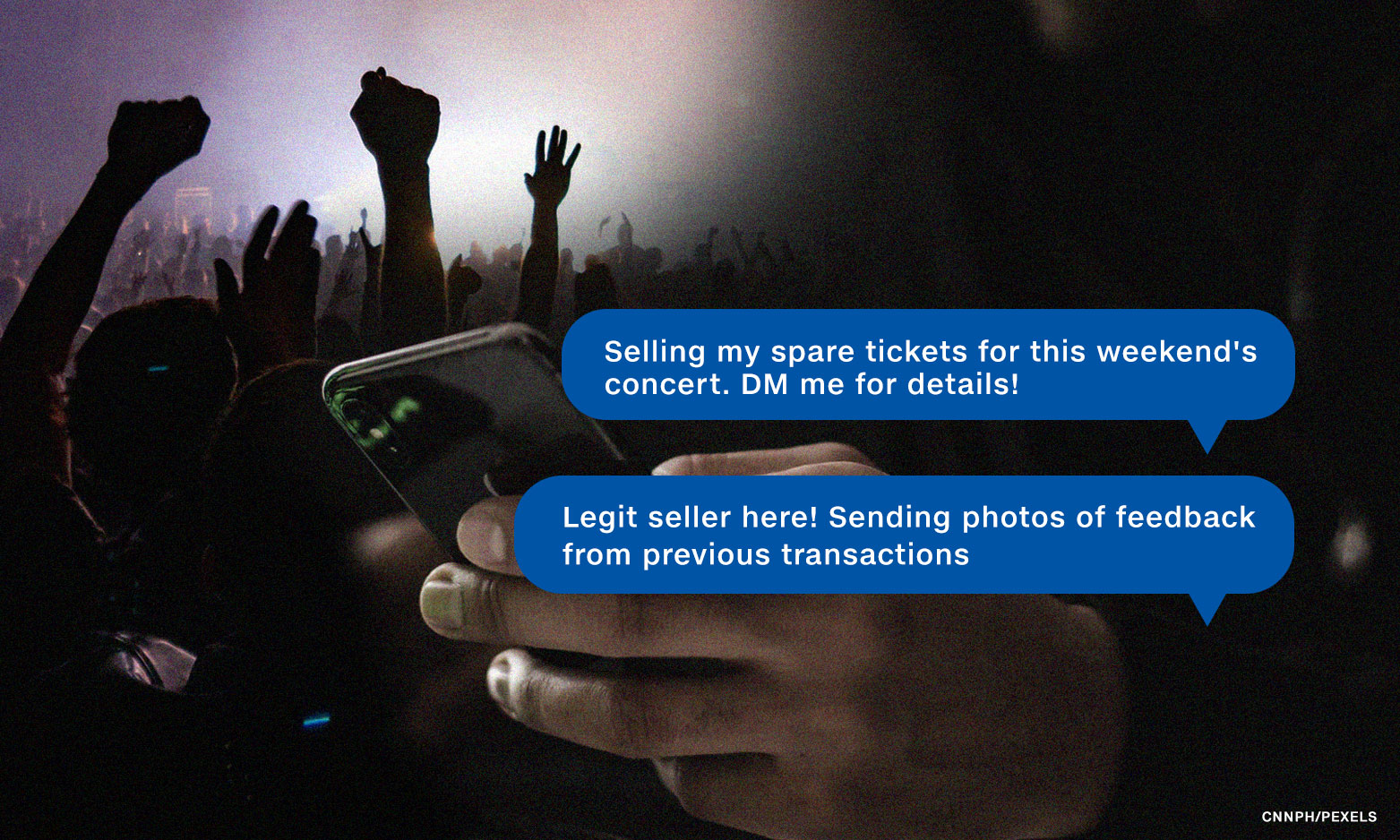


Metro Manila (CNN Philippines, August 4) — On the internet, you can find nearly everything you desire, including the most sought-after concert tickets if you have fast fingers to buy from official sources or if you know how to scour from legitimate resellers.
But how much of the tickets sold by resellers are real? Plenty of netizens comb through social media for passes to the growing number of shows in the Philippines by international artists. What some of them found instead were online fraudsters equipped with stolen screenshots, stories of having connections to event organizers, and even other people’s government IDs.
Early reservations for concert tickets
In messaging platform Telegram, fans of K-pop sensation SEVENTEEN, otherwise known as Carats, built a group chat for those interested in attending the boy band’s shows in Manila in October.
Group members sent updates on the event like ticket selling. At one point, someone sent a comment from a Facebook user, claiming to be able to secure tickets before the official sale opened as an employee of the event’s ticket distributor, SM Tickets. Tricia Borromeo, a Twitter user who chanced upon this message, reached out to the one who posted the comment.
“Wala pong laman ‘yung Facebook. Sobrang private. Doon po, magtataka na po kayo na baka scammer. […] Nag-send na siya ng mga photos na parang feedback na mayroon nang napa-reserve [for the buyer]. ‘Yung sinend niya nga pong picture na lately na-realize na edited is premium po ‘yung seat tas row A pa. Marami ding nag-aaim sa seat na ‘yun so maraming nagalit,” Borromeo said.
[Translation: Their Facebook contained nothing. It was very private. From that, you would begin to wonder if the person was a scammer…They sent photos looking like feedback that tickets were reserved for a buyer. Then the photos they sent— we realized lately that these were edited, and they were for premium seating on row A. Plenty of people are aiming for that seat so a lot of fans got angry.]
Then another netizen informed Borromeo that they had come across the same Facebook user as someone who used their name and passport to pose as a ticket reseller. But this time, it was not even for the SEVENTEEN concerts. As it turns out, it was for tickets for more shows like “2022 K-pop Masterz in Manila,” LANY, and Justin Bieber.
To warn other netizens, Borromeo tweeted about her experience. Her interaction with the Facebook user ultimately ended with the latter’s account being deleted, likely due to other netizens flagging them as a scammer.
What actually drew Borromeo towards messaging the suspicious account was the familiarity of the situation. She wanted to look into what could possibly be another scam to help out fellow fans.
In July, Live Nation Philippines issued a statement against a so-called Shai Solita for “illegal selling of tickets” for the SEVENTEEN: Be The Sun concerts, saying it will take legal action. In a Twitter thread that went viral, netizens shared their experience reserving tickets from Solita who said she had connections with concert organizers.
Solita has since posted an apology on Facebook, saying that she is not directly connected to Live Nation Philippines or any of their organizers. She adds, she has refunded everyone who made early reservations. Neither Solita nor the company clarified if she had real access to tickets ahead of the official sale.
Cybercrime landscape in the Philippines
These stories are not uncommon in this day and age when e-commerce takes up a large space in the market. In 2021 alone, the country’s e-commerce market made $17-billion in sales, according to the International Trade Administration. But the platform for such transactions is also home to several criminal offenses, which have increased over the years.
The Cybercrime Prevention Act of 2012 or Republic Act 10175 covers all crimes in the Revised Penal Code committed using information and communications technologies. This includes computers and other gadgets where we often surf the internet. Article 315 of the Revised Penal Code on swindling defines “using a fictitious name, or falsely pretending to possess power […] property, credit, agency, business or imaginary transactions, or by means of other similar deceits” as a crime.
The number of cybercrime cases filed in trial courts nationwide jumped from 59 in 2016 to over ten times that number at 601 in 2020, based on data from the Department of Justice. There was a consistent upward trend from 2016 to 2019, but cases went down from 659 to 601 in 2020. However, it can also be noted that with the emergence of the COVID-19 pandemic, the number of cases filed for most crimes decreased in 2020.
This does not include the large number of netizens who don’t wish to come forward with their experiences to authorities. This is the case for Melanie de Guzman, who said she was caught on the other side of online fraud as someone whose identity was stolen to carry out the crime.
Stolen identities with government IDs
“They [the scammer] approach users who are looking for concert tickets by messaging them directly. They use my name, passport ID picture, and selfie to verify their identity to the buyer,” De Guzman added.
In June, De Guzman tweeted to let everyone know that she was not the person pretending to sell tickets to “2022 K-Pop Masterz In Manila.” She also asked netizens to report the account, and apologized to everyone who was tricked by the Twitter user @deguzman2022.
The account no longer exists. But De Guzman is hopeful that authorities, and event organizers would do more to prevent cases like this altogether.
“I hope the event organizers and big corporations will release public statements that they do not authorize third-party resellers, and I hope they will also do something to address the prevalence of scalpers and scammers,” De Guzman said.
But according to at least one company, something is already being done to stave off online fraud in ticket selling. It just so happens that they have mostly kept it under wraps, and with the help of some fans in the online community.
“With the people who really love Korean entertainment, their support towards planning legal action against these kinds of behavior is really helpful for us. It’s also a group effort by the audience as well. The promoters, the ticketing venues— we’re only a few people, as much as we try to police everything, we can’t see all of that action. Sometimes when fans do report to us, that’s really a big help for us,” said Aya Villa-Real, managing partner of MakeItLive Asia, which is the marketing partner of DNM Entertainment.
The “bayanihan” among fans does not end there. Borromeo added that she was also able to warn fellow Carats of the scammer she encountered through Twitter Spaces. Social media users often gather on the live audio platform to discuss their experiences, and talk to other netizens about swindle tactics to watch out for.
And so what can Filipinos do to keep their information and money safe in cyberspace?
Tips from netizens on avoiding online scams
Opt to buy event tickets from official sellers if possible
The safest way to make sure that the passes you’re getting can grant you entrance to your desired event is by purchasing from official ticket distributors. The sentiment is echoed by event organizers, themselves.
“With these events, it really is hard to determine who the scammer is, and who these people are, ‘di ba? The best we can do talaga is to keep reminding people to purchase only on official outlets,” Villa-Real said. She added that DNM Entertainment coordinates with the venue and ticketing partners to lessen and discourage the instances of online scamming.
But some fans are hoping for more statements from event organizers to inform them which sellers to avoid. With events like “Starry Caravan in Manila 2022,” tickets to the most in-demand section, SVIP, sold out within hours of pre-selling, and so some fans go for the second option, which is to look for ticket resellers online.
Ask for proof of purchase
Anne Villanueva missed out on grabbing passes to the seat she wanted for Korean star Cha Eunwoo’s fan event in the country “2022 Just One Ten Minute: Starry Caravan in Manila.” And when she did find a reseller offering tickets to the SVIP section, her first instinct was to ask for proof that the ticket had already been bought from the official seller.
“Napansin ko po na parang familiar ‘yung photo [of proof of purchase] na sinend niya kasi po nag-soscroll din ako sa Twitter that time para sa update. After that, na-DM [direct message] ko po ‘yung may-ari ng photo para po malaman if legitimate po ‘yung seller kasi wala pong feedback ‘yung account niya eh, kaya nag-dodoubt po ako baka po scam,” she said.
[Translation: I noticed that the photo [of proof of purchase] they sent was familiar because I was scrolling through Twitter at the time for updates. After that, I DM’d the owner of the photo to find out if the seller was legitimate because their account had no feedback, and so I was thinking it might be a scam.]
She later found out that the person who owned the photo was not selling their tickets.
Get your product through physical meet-up
To make sure that you do end up with an actual ticket, Villanueva added it would be best to exchange the product and payment by meeting face-to-face.
But in case you are unable to meet up with the seller, there are other ways to ensure that the product being sent to you is legitimate. Villanueva says you should ask for a photo of the ticket beside a paper with your Twitter handle, the date and the time beside it. This way, you can be sure the photo was taken in real time, and not stolen from other social media users.
Lessen your digital footprint
As someone whose says her information was used to cover up someone else’s cybercrime trail, De Guzman advises fellow netizens to be careful with the content they post online. She says it would be best to keep your Facebook profile private, and to never make your IDs available to the public.
“Never send your ID pictures for online transactions, especially if the platform is unreliable. Never sell your verified e-wallet accounts as they can be used by scammers to receive money while protecting their identity,” De Guzman added.
Get a second opinion
For Borromeo, dealing with the online marketplace largely boils down to being aware and responsible on the internet. She says that especially for minors, it is important to ask for guidance from parents before purchasing a ticket. Borromeo also hopes online ticketing platforms would require a waiver from minors before availing of passes.
For many netizens after all, buying live event tickets online is the more convenient and safe option. This is especially the case for those who live outside Metro Manila where there are less physical ticket outlets. Fans like Villanueva and Borromeo hope that event organizers would put up more regulations around ticket selling so that netizens would not have to opt for resellers.