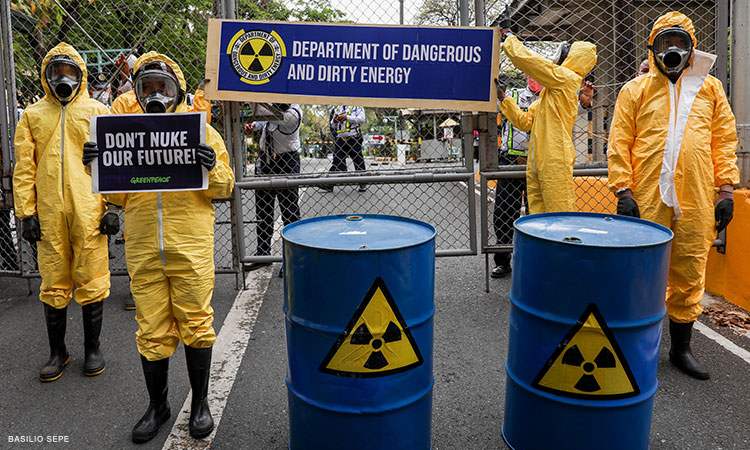

Metro Manila (CNN Philippines, March 11) — Environment advocates staged a protest on Friday calling on the government to abandon its nuclear plans after President Rodrigo Duterte issued an executive order to include nuclear power in the country’s energy mix.
“It’s abhorrent how [Energy Secretary Alfonso Cusi], and his principal, President Duterte, have relentlessly pursued nuclear deals even up to their last few months in power,” Greenpeace Campaigner Khevin Yu said in a statement. “When they could have doubled their efforts to ensure renewable energy gets a better foothold in the country’s future energy direction.”
Greenpeace urged the President to revoke Executive Order 164 which allowed the adoption of a National Position for a Nuclear Energy Program.
The activists wore hazmat suits, carried barrels, and waved a banner which nicknamed the Department of Energy, the “Department of Dangerous and Dirty Energy.”
The protest took place on the anniversary of the 2011 Fukushima disaster in Japan, where an earthquake and tsunami killed thousands and pushed the Fukushima Daiichi nuclear plant into a meltdown.
Nuclear power
Nuclear power — as used in other countries — is regarded as a low-emitting energy source compared to burning fossil fuels.
In fact, electricity from nuclear power “does not contribute to direct GHG (greenhouse gas) emissions,” according to the Intergovernmental Panel on Climate Change (IPCC) Fifth Assessment Report in 2014, which studied energy systems.
But the concern is the emissions that will result from the building of infrastructure needed to churn out nuclear energy.
These emissions will stem from the mining of uranium, and the exhaustion of resources in the construction of reactors using steel and concrete.
“The entire nuclear power plant life cycle contributes significantly to climate change, and these facilities take an average of 10 years to build,” Greenpeace said.
The group cited the IPCC report which said global temperatures will rise by 1.5C by 2030.
However, the same IPCC pointed out that the lifecycle or overall emissions for nuclear plants are more or less similar to that of facilities for renewables such as solar power. Their potential yields in reducing greenhouse gas emissions are also similar.
“Renewable heat and power generation and nuclear energy can bring more significant reductions in GHG emissions,” the IPCC said.
“Nuclear power has been in use for several decades. With low levels of lifecycle GHG emissions…nuclear power contributes to emissions reduction today and potentially in the future,” the report added.
The DOE has conducted a feasibility study on the viability of introducing nuclear power in the country’s energy mix.
Senate Committee on Energy chairman Sherwin Gatchalian said the government should make this study public to see how the benefits of the energy source were weighed against the risks.