
Metro Manila (CNN Philippines, February 23, 2022) — Based on the rules of the Philippine National Police (PNP), it is the PNP chief himself who has the power to approve the administrative flights of its air assets.
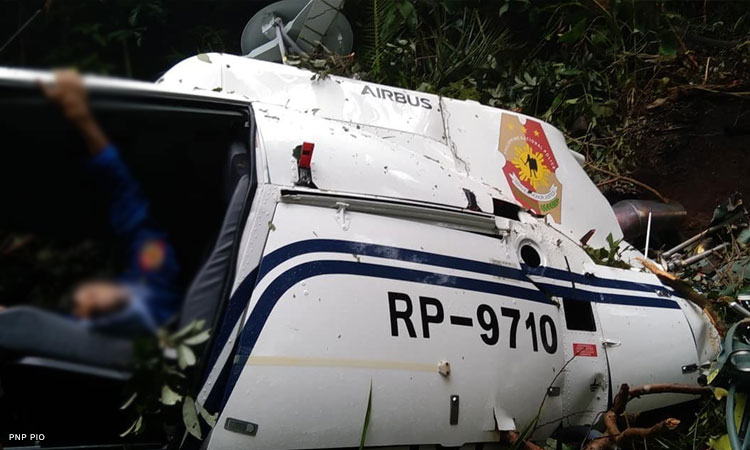
The PNP chopper that was supposed to pick up Carlos crashed in Real, Quezon early Monday morning, killing one police officer and injuring the pilot and co-pilot.
In an earlier statement, Carlos said a private transport was supposed to bring him back from Balesin but because of “unforeseen circumstances,” the flight was moved to Monday night, prompting him to request for an administrative flight.
Carlos said his request was approved based on PNP rules and regulations.
A memorandum circular dated April 13, 2020 states that the movement of troops for operations purposes and medical evacuation will be top priority in the use of their aircraft.
Meanwhile, the use of choppers for administrative functions is deemed a secondary priority, which the PNP chief has the power to approve.
“For the first priority utilization of the PNP rotary-wing aircraft, PNP offices/units and other government agencies shall course their request to the TDO (The Directorate for Operations). For second priority utilization of the PNP rotary-wing aircraft, request shall be coursed to the Office of the Chief, PNP for his approval,” the guidelines stated.
If the request is approved, the PNP Command Center under the Directorate for Operations shall issue the flight directive addressed to the air unit.
A pre-flight inspection must be done by the maintenance supervisor of the air unit to determine if the aircraft is ready for flight.
“After the completion of the mission, the PNP rotary-wing aircraft shall immediately return to its base. The Air Unit shall submit all the required documents such as After Flight Operation Report and Post Flight Inspection Report to DO within 24 hours,” the guidelines further stated.
The PNP has launched an investigation on the chopper crash but Interior Secretary Eduardo Año in an interview already said that there was nothing irregular with what Carlos had done.
Upon clarification, PNP Spokesperson PCol. Jean Fajardo said the Civil Aviation Authority of the Philippines (CAAP) is the agency investigating the crash, while the PNP Criminal Investigation and Detection Group (CIDG) is tasked to look into adherence to the internal policies of the police force.
“It is within the mandate and authority of CAAP to investigate incidents/accidentals involving aircraft. Sila po ang may [They have the] technical expertise to determine the cause of the accident. The PNP will provide CAAP the necessary assistance in conducting the investigation. The PNP investigation thru CIDG will focus on policy review po,” Fajardo told CNN Philippines.
Critics said there was abuse in power when Carlos used a government aircraft to go to work from his personal vacation trip.
Section 4 of the Code of Conduct and Ethical Standards for Public Officials and Employees states that public interest must be upheld over and above personal interest.
Administrative Order No. 239 Series of 2008 also prohibits the use of government vehicles for purposes other than official business.
Former PNP chiefs, retired high-ranking officers weighed in
Former PNP chief now Senator Ronald Dela Rosa echoed the stand of Año, saying that a PNP chief is on call 24/7 and it is fitting that he is accorded with 24/7 logistical and security coverage.
“His situation is very unique. He needs to respond at any point in time. There is almost no demarcation between official time and personal time when you are C(hief) PNP,” Dela Rosa, chairperson of the Senate Committee on Public Order and Dangerous Drugs, said in a text message.
Presidential candidate Senator Panfilo Lacson, a former PNP chief, said there is a gray area regarding Carlos’ situation, given that he admitted that he was in Balesin for a personal reason.
“Simple lang naman ‘yan, official function ba ‘yung pagpunta o ‘yung pag-ferry sa kanya, pag-pick up sa kanya ng helicopter. Kung official function walang problema ‘yun. Pero kung persona o pribadong sabihin nating situation, meron talagang mali. Ako nag-Chief PNP ako. I never used PNP resources, choppers for my personal matters,” Lacson said in an ambush interview in Batangas.
[Translation: It’s simple. Was he supposed to be fetched for an official function? If so, there’s no problem. But if it’s for personal reasons, something is really wrong there. When I was Chief PNP, I never used PNP resources, choppers for my personal matters. ]
A former PNP chief, who refused to be named, said if he were in Carlos’ situation, he would explore other options first before using a PNP chopper to fetch him from a personal trip.
“I will ask the management of Balesin first if they can transport me the soonest time possible… If there’s none, I will ask for a PNP chopper. Magastos kasi ang chopper sa gasoline [The chopper consumes a lot of fuel],” he said.
A retired high-ranking police officer shared the same thought, adding that using a PNP chopper is warranted under extreme circumstances.
“If extreme need nga, uutusan ko ang [If it is extremely needed, I will ask the] chopper to pick me up. It’s regular and within my sound prerogative. Regulations gave me discretion, so I will just use it,” he said.
If the protocols were followed, it meant PNP Chief General Dionardo Carlos had the sole prerogative to allow the flight that would fetch him from Balesin, an exclusive vacation spot in Quezon province, going to Camp Crame in Quezon City.