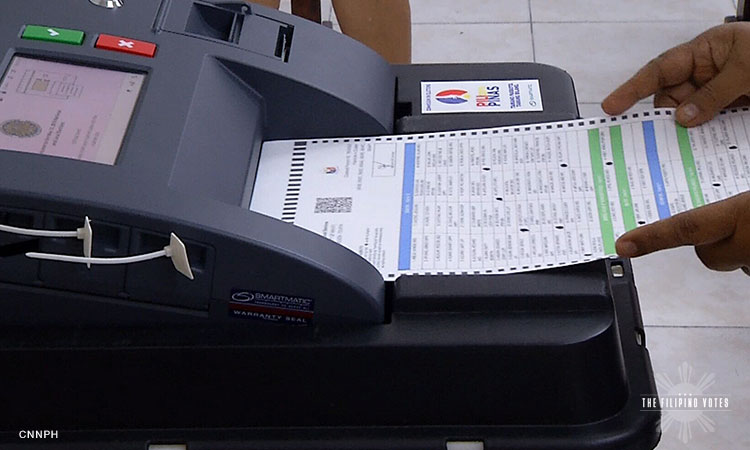

Metro Manila (CNN Philippines, October 19) — Election watchdog Parish Pastoral Council for Responsible Voting (PPCRV) said the automated election system may be trusted, but the public should remain vigilant to keep the sanctity of the votes.
In a meeting with the Kapisanan ng mga Brodkaster sa Pilipinas (KBP) on Tuesday, PPCRV chairperson Myla Villanueva said the automated election system is imperfect but it is still a better option compared with the manual one.
“At PPCRV, we do believe that the automated system is probably the best thing for us today. We have seen it answer some of the shortcomings of a manual system. It’s not perfect but I think it is still far better from what we had in the past,” said Villanueva, an IT expert.
The Philippines had its first automated polls in 2010. The Commission on Elections (Comelec) will use the automated election system for the fifth time in the 2022 polls.
PPCRV debunks ‘automated election myths’
The PPCRV also debunked some “automated election myths” like the seven-hour glitch during the canvassing in 2019 when election returns (ERs) failed to enter the transparency server.
“We screen-scraped the results from the central server through the Comelec public access website and we compared the results with the results that we got from the transparency server after seven hours. After doing that comparison, we were able to see that the results matched,” said PPCRV information technology director William Yu.
The election watchdog said upon validation, the system got choked with the overwhelming number of ERs entering the system.
The organization also debunked the early transmission, secret rooms, and missing transmission of ERs.
Yu said the supposed early transmissions are part of regular and allowed activities such as final testing and sealing. Network monitoring and testing are also being carried out but no results are being transmitted to the servers.
Villanueva said “secret rooms” or “secret handshakes” in between vote-counting machines (VCMs) and the transparency server may be put to rest.
PPCRV explained ERs coming from a VCM pass through a transmission server before entering the central, backup, and transparency servers. The transmission server only queues the ERs.
Numbers entering the Comelec and transparency servers may easily be validated through printed ERs, something that the PPCRV audits.
PPCRV’s volunteers secure the fourth copy of the ERs per clustered precincts and send these to the PPCRV headquarters for the unofficial parallel count.
“Sana wag na lang dagdagan ng pangamba (I hope there will be no worry) that there’s something happening in between because we do take a physical piece of paper; very difficult to pick up 87,000 pieces of paper on election night. Last 2019, I think we were able to pick up 77,000 and we were able to match 99.99 of it,” Villanueva explained.
Meanwhile, missing transmissions happen when a vote-counting machine fails to transmit the ER to one of the servers due to various reasons. But Yu said this may also be verified by checking physical ERs.
Shading of ballots is another issue. But PPCRV is confident that Comelec will retain the 25-percent shading threshold for a vote to be counted.
To prevent similar incidents from happening, the PPCRV said aside from the source code review, Comelec promised to put the source code to a stress test to ensure that it has the capability receive massive data at a given period.
“Together with Comelec, other NGOs try to constantly address questions of a past election,” Villanueva said.
“Kagaya nga ng seven-hour glitch. Ngayon, talagang pine-pressure natin (Like the seven-hour glitch. Now, we are pressuring them,) please do not make it happen again. Talagang sobra na po ang pagdududang mangyayari (There really will be many suspicions) if it happens again,” she added.
While there is no concrete evidence yet that it happened in the country, Villanueva said the public should also be alert for possible foreign interventions in the 2022 automated polls just like what happened in the United States in 2016.
She also warned of cheating incidents outside the automation system like vote buying and pre-shading of ballots.
“We keep on criticizing the automated system. Sure, go ahead! It’s important in a democracy. But please don’t forget, a lot of cheating is happening outside of the automated system,” she said.
The PPCRV also hopes that more bidders and new technologies would be available soon.
Villanueva said some provisions in the procurement law automatically disqualify some local bidders due to failure to meet the requirements. She is suggesting that possible amendments to the procurement law be discussed after the elections in 2022, so that more companies may participate in the bidding and the Comelec may find new technologies for the automated elections in the future.