
Metro Manila (CNN Philippines, August 28) – The Philippines will send two more cube satellites into space.
Maya-3 and Maya-4 will be launched off to the International Space Station (ISS) aboard a SpaceX Falcon 9 rocket in a Dragon C208 cargo on Sunday at 3:14 p.m., Philippine time.
The two cube satellites were supposed to be launched Saturday afternoon, but the rocket cargo’s liftoff at the Kennedy Space Center in Florida was aborted.
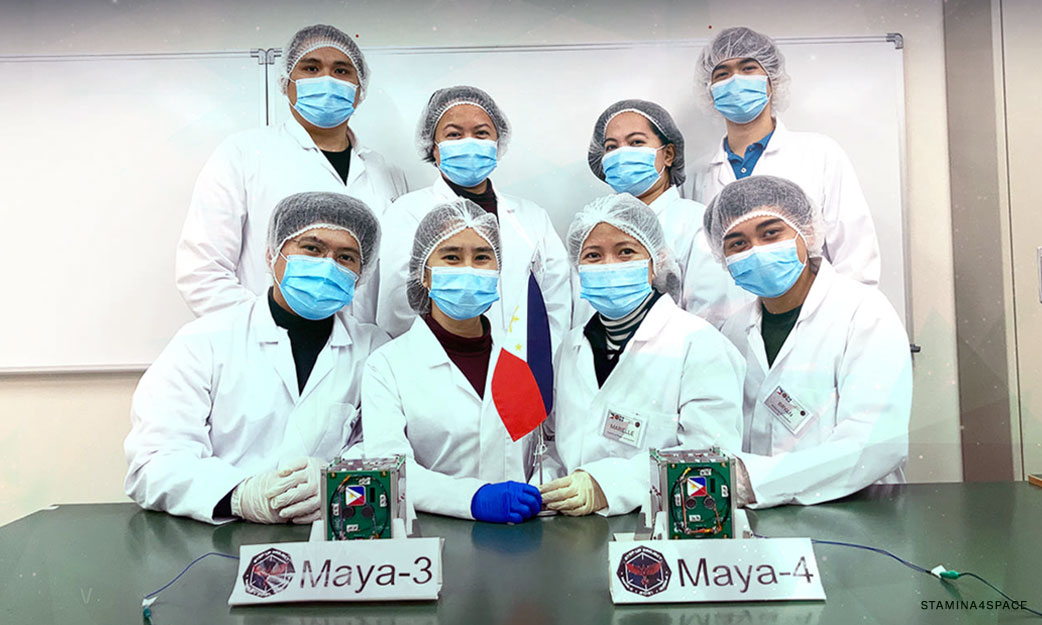
Maya-3 and Maya-4 were designed and developed by scholars of the Department of Science and Technology’s (DOST) Space Technology and Applications Mastery, Innovation, and Advancement (STAMINA4Space) Program.
Philippine Space Agency (PhilSA) director-general Joel Marciano, Jr. said the two cube satellites will help improve the data gathering of Filipino experts in agriculture, weather monitoring, and disaster management, particularly in getting information from rural areas.
Both satellites are made with the same specifications – measuring 10 x 10 x 11.35 centimeters with a mass of 1.15 kilograms.
The Filipino-made cube satellites also have two deployable UHF and VHF antennas, solar array panels, global positioning system (GPS) patch antenna, lever switch, and five-megapixel visual cameras for capturing images of the country from space, and visual assessment of landmass and bodies of water.
Maya-4 has an additional feature of a near-infrared camera for technology demonstration.
The date of the two cube satellites’ deployment into orbit has yet to be announced.
Maya-2 is currently in space after being launched into the ISS in February and deployed into orbit in March.
Maya-1, the predecessor of the three cube satellites, was launched into space in June 2018 and was deployed into the orbit two months after. It returned to earth in December 2020.
The country also launched its first two microsatellites, Diwata-1 in 2016 and Diwata-2 in 2018. Diwata-1 was decommissioned in March 2020 while Diwata-2 remains in space.
“Habang sila nago-orbit, ire-relay nila ang mga signals or data na galing sa mga remote areas papunta sa mga laboratories natin sa Metro Manila or sa ibang urban places para mapag-aralan ng ating mga scientists at ibang concerned groups,” Marciano told CNN Philippines’ Newsroom Weekend on Saturday.
[Translation: While they (Maya-3 and Maya-4) are orbiting (in space), they will relay signals or data from remote areas going to our laboratories in Metro Manila or other urban places so that scientists and concerned groups can study those information.]
Marciano said the satellites’ data sensor collection will also contribute in strengthening government policies on food security, disaster risk management, maritime domain awareness, and environmental monitoring.
The PhilSA chief added that the satellite technology will be useful in the mining sector, which he said will be a source of income for the country post-pandemic.
“The space technology and satellites will help ensure concerned groups to comply with environmental protection measures by looking at the data from the mining sites obtained by our satellites,” he noted.