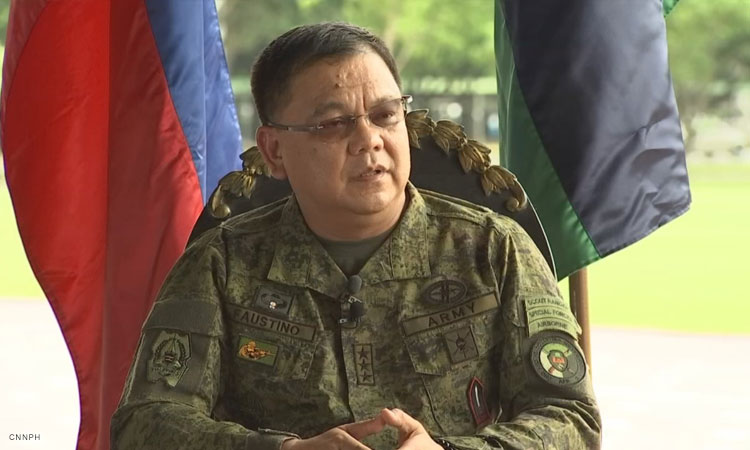

Metro Manila (CNN Philippines, August 4) — The country will have stronger military capability, including against external aggressions, by the time the Duterte administration ends, newly installed Armed Forces of the Philippines Chief of Staff Lt. Gen. Jose Faustino, Jr. said.
The modernization of the army, although gradual, has come a long way, Faustino told CNN Philippines in an interview aired Wednesday.
From beefing up internal security, the military is now moving to ensure it can protect Philippine territory.
“I am very positive that within the term of President Rodrigo Duterte, we will be able to transition, little by little, to territorial defense,” Faustino said.
The AFP’s 15-year modernization program is divided into three horizons. It is now in the second phase, which runs from 2018 to 2022, and enjoys a ₱300-billion funding.
Faustino said they are now “heavily” purchasing hardware concentrated on developing territorial defense, such as ships, planes, and helicopters.
Before this, in line with the first horizon, they have also acquired more equipment to address internal security threats.
“Unti-unti, nararating natin ‘yung tinatawag natin na credible defense [We’re gradually developing what we call credible defense],” the AFP chief said.
“Whatever kind of threat, be it terrorism, be it external aggression, that’s what we’re preparing for,” he added.
But this doesn’t necessarily mean the country is preparing for combat with other nations, according to Faustino.
Asked about asserting the country’s rights over the West Philippine Sea and why military vessels have not been deployed amid recent Chinese incursions, he said the challenge is “to protect our sovereignty without going to war.”
“Tama ang ginagawa ng National Task Force on the West Philippine Sea [The NTF-WPS is doing the right thing], that it is a law enforcement issue,” Faustino said. “That’s why we have the coast guard, the Philippine National Police, you have the Bureau of Fisheries and Aquatic Resources.”
What the AFP does besides visibility patrols, he said, is “supporting the law enforcement agencies with the proper doctrine when it comes to maritime.”
Duterte has repeatedly said the Philippine military cannot yet take on Chinese soldiers should a war erupt over the disputed resource-rich waterway.
RELATED: Duterte told: No need for war to assert maritime rights in South China Sea
Meanwhile, Faustino welcomed the renewal of the Visiting Forces of Agreement with the United States, saying this will help improve the training of Filipino soldiers.
“Remember that we have the biggest military exercise with the US, ito nga ‘yung Balikatan [the Balikatan Exercise], and all the other things like ‘yung exchange sa [of] students program,” he said.
He called the near-abrogation of the decades-long military pact “a small bump,” adding the Philippines has always had a “very good relationship” with the US.
Last week, Duterte decided to recall the termination of the VFA after his meeting with US Defense Secretary Lloyd Austin III in Malacañang.
READ: EXPLAINER: The Visiting Forces Agreement