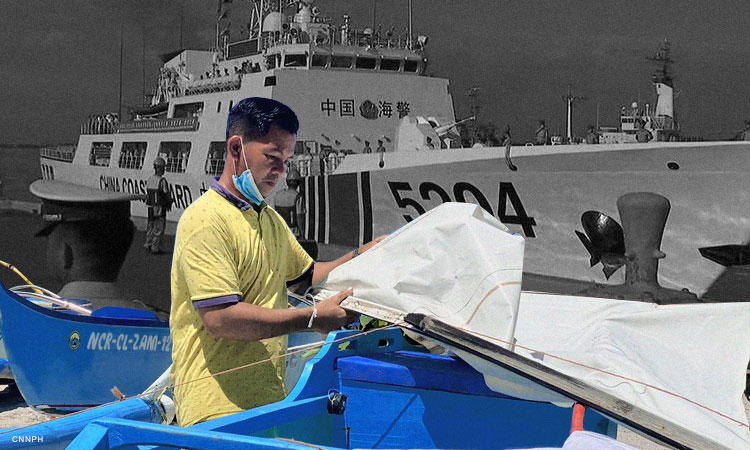

Metro Manila (CNN Philippines, July 11) — Fishing trips in waters off Zambales used to be an exciting journey and a productive source of living for 42-year-old fisherman Noli Cocjin.
But gone are the days when every trip is met with excitement since he knows the challenges fishermen have to go through to bring home enough catch to earn for their families.
Foreign vessels equipped with more modern capabilities prevent small fishing boats like Cocjin’s from getting enough fish during each trip.
Cocjin said some fishermen try to avoid conflict with foreign fishing vessels by trying to go as far as Palawan and Mindoro.
“Dati po talaga dito lang po nahuhuli na malalaking isda—barilyete, Tuna, Blue Marlin. Kaya lang po sa katagalan ang dami nang nangingisda. Hindi lang po tayo, maski foreigner nandito rin po naubos po ng naubos,” he said.
[Translation: We used to catch big fishes like tuna, blue marlin. But now, we have so many competition including foreigners. We can no longer catch these big fishes.]
Cocjin has been a fisherman in Zambales for 15 years. As much as possible he tries not to go to Scarborough Shoal, some 124 nautical miles west of his home province.
China seized the shoal in 2012 after a tense sea standoff with the Philippines. Beijing continues to defy an international tribunal’s ruling on July 12, 2016 that invalidated its claims to the area and nearly the entire South China Sea.
But some of Cocjin’s fellow fishermen brave the waters off Scarborough Shoal to make ends meet.
“Mas madali ka makahuli ng isda roon, kaso ngayon limitado na ang galaw mo doon. Even though pwede ka pa rin mangisda doon pero may control na po hindi kagaya ng dati,” he said.
[Translation: It’s easier to catch fish in Scarborough but your movement there is limited. They will allow you to fish in certain areas but it feels like you are being controlled.]
2016 Arbitral Award: enforceable or not?
A month after President Rodrigo Duterte took office in 2016, an arbitral tribunal in The Hague handed down the Philippines’ victory in its case against China.
The landmark arbitration ruling rejected China’s nine-dash claim to almost the entire South China Sea. It said there was no legal basis for the claim that Beijing said was based on historical rights. It also recognized the Philippines’ sovereign rights in areas within its 200-nautical mile exclusive economic zone and continental shelf that are being claimed by China.
The 479-page award by the tribunal — created under the United Nations Convention on the Law of the Sea — also found that China had caused severe harm to the marine environment.
But five years on, there seems to be differing views on how the Philippines can enforce the ruling.
“We don’t have a consistent China policy and a strong West Philippine Sea policy right now because there are contradictions and inconsistencies coming from the government,” international foreign policy expert Chester Cabalza told CNN Philippines.
Beijing repeatedly called the ruling baseless and Cabalza said China is emboldened to continue its activities in the South China Sea due to the Philippines’ failure to enforce the arbitral award.
“We fail because of our derecognition of the Hague ruling. We thought that the Duterte administration will fulfill its promise which we won in 2016,” Cabalza said.
Experts: war is not only option vs. China
Throughout his presidency, Duterte has also repeatedly said that he cannot go to war against China in asserting the country’s rights in the West Philippine Sea.
“I cannot afford at this time to go to a war,” Duterte said in a speech in May 2018.
“I’m walking on a tightrope actually. I cannot afford to be brave in the mouth against China,” Duterte also said in a speech early this year.
Former Foreign Affairs Secretary Albert Del Rosario said that standing up for the nation’s rights against China does not mean going to war.
“We urge our people to reject this Chinese narrative of war because it is only intended to sow fear which is the trademark of a bully,” Del Rosario said in a statement in April 2021.
He also enumerated some options the Philippines can take, including reiterating the Philippine position at the next United Nations General Assembly in September 2021.
Del Rosario added the Philippines should welcome the positions of the United States, Japan, EU, France, Germany, the United Kingdom, Australia and Indonesia against China’s claims in the South China Sea.
The former DFA chief also wants Chinese officials to be criminally liable for destroying maritime resources.
The Philippines should also strengthen its defense capabilities, he said, urging Duterte to appoint retired Supreme Court Justice Antonio Carpio as advisor on the South China Sea issue.
DFA: 2016 Arbitral Ruling is final
Despite President’s changing tune when it comes to the importance of the arbitral award, the Department of Foreign Affairs made it clear that the country’s foreign policy on the West Philippine Sea is what Duterte articulated before the UN General Assembly in 2020 – that the ruling “is now part of international law, beyond compromise and beyond the reach of passing governments to dilute, diminish or abandon.”
“The Award is final,” Foreign Affairs Secretary Teodoro Locsin Jr. said. “We firmly reject attempts to undermine it; nay, even erase it from law, history and our collective memories. “
He said anniversaries are an occasion to take stock of the past, mark the gains of the present, look to the future and find ways to work together for mutual benefit since no singular advantage can be gained by violating it.
“We are also celebrating this, our gift to all countries without exception. It is a gift from a country that’s not a power except for right in law. In 2012 we were David all alone, up against Goliath, amid hosts of indifferent spectators,” he added.
Filipino fishermen like Cocjin, however, continue to wait for the benefits from that gift.