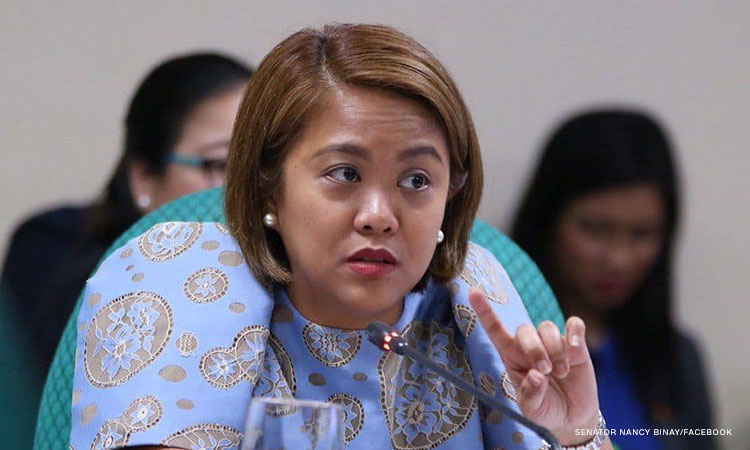

Metro Manila (CNN Philippines, June 11) — Senator Nancy Binay is pushing the Department of Health to hasten the distribution of COVID-19 vaccines as demand increases with the start of the inoculation of economic frontliners.
In a statement, Binay said that closure of some vaccination centers in Metro Manila is unacceptable due to the DOH’s failure to efficiently distribute the coronavirus shots.
“As of this week, marami pang bakunang nakaimbak sa storage facilities ng DOH kaya parang ang hirap tanggapin na walang maibigay sa mga vaccination centers sa Maynila, Marikina at Antipolo,” she stated.
[Translation: There are still many vaccines in storage facilities of the DOH that is why it is hard to accept that no supply can be given to vaccination centers in Manila, Marikina, and Antipolo.]
She also noted that there are other local chief executives who claim they have yet to receive vaccine allocation from the national government, especially in densely populated cities and far-flung municipalities.
To date, the country has received over 9 million vaccine doses, of which some 8 million have been deployed and 6 million administered. On top of around 1 million doses still in government facilities, the country also received 3.2 million Pfizer and Sinovac vaccines on Thursday.
Binay emphasized the need for these doses to be immediately released to serve their purpose of protecting the Filipinos from the virus and helping the country recover from the pandemic-induced economic slump.
“Lahat naman tayo gustong maging maayos na at manumbalik na ang ekonomiya (We all want our economy to improve and rebound),” the senator said.
“If these vaccines remain stored in warehouses and do not reach the LGUs on time, not only will we be seeing a lot of empty tents and chairs–we are exposing a big percentage of our workforce to more contagious variants,” she added.
Earlier, vaccine czar Carlito Galvez Jr. apologized to local governments after delivery of vaccine doses got delayed due to supply issues.
He also assured that more allocations will be given to them as more shots come in and supply stabilizes by June 14.
The country started its immunization program in March by inoculating healthcare workers. They were followed by senior citizens and people with comorbidity, while vaccination of economic frontliners only started this month.
The government hopes to inoculate 50% to 60% of the entire population, giving more focus on Metro Manila, to reach immediate protection.
Latest data, however, shows only 1.6 million individuals have been fully vaccinated against the deadly virus.