
Metro Manila (CNN Philippines, April 27) – Lawmakers on Tuesday struggled to find a middle ground with the Department of Agriculture and President Rodrigo Duterte’s economic team on new policies allowing more pork imports.
The Department of Finance insisted during the third hearing of the Senate Committee of the Whole that additional pork imports at lower duties is the only way to immediately bring down meat prices after surging to nearly ₱400 per kilogram amid limited local supply.
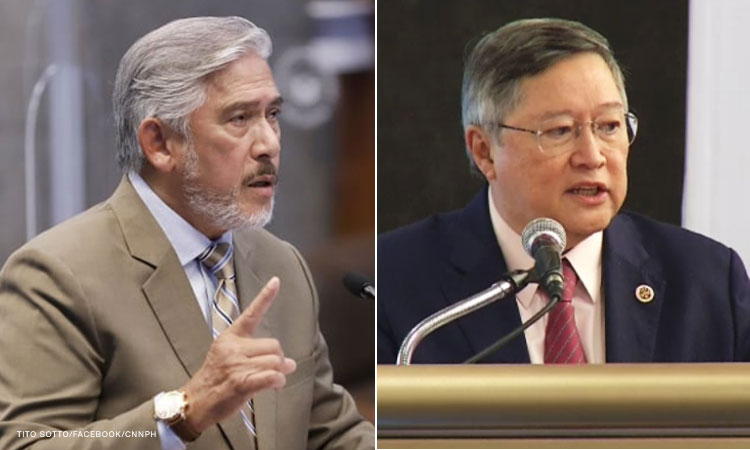
DOF Secretary Carlos Dominguez III said allowing the entry of up to 400 million kg of cheap frozen pork from abroad at a 5% tariff — down from the previous 30% — will benefit consumers directly and bring back the market price of pork to the ₱220/kg level.
The government’s price monitoring showed kasim (pork ham) being sold between ₱330-₱390/kg, while liempo (belly) retailed for ₱350-₱420/kg on Tuesday.
This “emergency situation” justifies forgoing ₱13.7 billion in taxes, Dominguez added.
“I don’t mind increasing the MAV (minimum access volume), but why reduce the taxes? If the consumer does not get that reduced price, then what was the ₱13 billion for?” Senator Ralph Recto asked.
He added that the previous tariff of 30% for imports worth 54 million kg and 40% for excess volumes also stood as protection for local hog raisers against a surge in cheap frozen meat.
“I’m trying to figure out a compromise with the Department of Finance and the Senate but apparently, that doesn’t work insofar as Secretary Dominguez is concerned,” Sen. Franklin Drilon added.
For his part, Dominguez said he is open to hearing “better ideas” that may come out of the hearings.
Sotto called for a closed-door caucus with fellow senators after the hearing as they seek to strike a balance between slower inflation and reviving the local hog industry.
Senators sided with local hog raisers who said the supply deficit is only 150 million kg, not 400 million kilos as claimed by the Department of Agriculture. Nicanor Briones, vice president of the Pork Producers Federation of the Philippines, said people are not eating as much meat with parties, fiesta gatherings, and weddings not allowed in the “new normal.”
Socioeconomic Planning Secretary Karl Kendrick Chua clarified that local pork production dropped 26% in the first three months of 2021, against a lower per capita consumption to 14.3 kg from last year’s 15.9 kg average consumption yearly.
“Mahirap ‘yung hindi rin natin kinukonsulta ‘yung ground. Yung mga nakaupo sa likod ng mesa at gagawa ng figures, napakadali pero yung may putik sa paa na nandodoon sa babuyan, iba,” Senate President Tito Sotto said, giving a scolding to members of the economic team.
[Translation: It’s difficult when we don’t consult the people on the ground. It’s very easy to sit behind a desk and compute the figures, but it’s different when we’re talking to the people with mud on their feet working hard in the piggeries.]
Senator Cynthia Villar also warned about a supposed “cartel of importers” that will surely make big bucks out of the scheme while backyard raisers are pushed out of business. However, the DA said it has not yet received import permit applications for bigger volumes from businessmen.
The chamber earlier passed resolutions telling the President to disregard the DA’s recommendations, but these fell on deaf ears. Instead, they want a state of national calamity declared over the African Swine Fever outbreak since 2019 that forced hog raisers to cull millions of pigs to contain its spread.
Meanwhile, the DA’s Bureau of Animal Industry is being blamed for the ASF contagion, with the agency’s Compliance and Regulatory Enforcement for Security and Trade Office saying its former head Ronnie Domingo violated three orders and laws in the issuance of import permits.
Villar doubted if BAI is ready to man the country’s borders against the entry of tons of meat and check if any of these are infected with the hog disease.
READ: Senators doubt imports surge can pull down pork prices
RELATED: Duterte recommends raising pork imports to Congress
RELATED: Pork imports may hit 600M kilos this year as traders take advantage of cheap duties