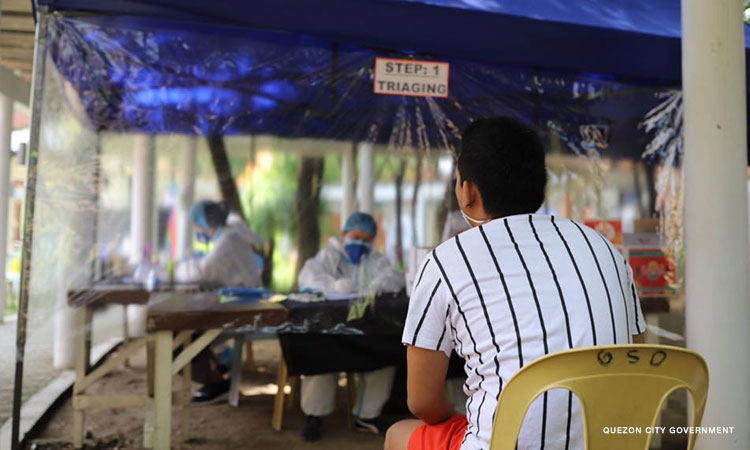

The department said only qualified licensed healthcare professionals in local health offices, health facilities, accredited quarantine and isolation centers, and certified COVID-19 confirmatory laboratories are authorized to administer antigen tests and interpret their results. The test kits should be registered with the Food and Drug Administration and validated by the Research Institute for Tropical Medicine or other designated institutions.
Metro Manila (CNN Philippines)— Government officials have announced antigen tests will be used in areas with high COVID-19 transmission, in a bid to speed up detection and isolation of virus-positive patients.
The kits, in particular, will be deployed to Metro Manila, the current epicenter of the local coronavirus outbreak, as well as the provinces of Cavite, Laguna, Bulacan, and Rizal.
EXPLAINER: What you need to know about the NCR Plus bubble
Here’s what we know so far about the COVID-19 antigen tests, and how the government plans to use them in parts of the country.
What is an antigen test?
The test detects the presence of a specific viral antigen, which implies current infection, according to the US Centers for Disease Control and Prevention. Such test can use nasal or nasopharyngeal samples, with results available in around 15 minutes.
However, those who will test negative using antigen tests will still have to undergo a confirmatory RT-PCR test or a repeat antigen test after 48 hours. False negatives or tests that say you do not have the virus when you actually do, are more likely to occur with antigen tests than false positives, according to Harvard University.
In a separate advisory, the World Health Organization said the relatively inexpensive test can provide early detection of the “most infectious COVID-19 cases in appropriate settings.”
Can it be used as a confirmatory test?
Health Undersecretary Maria Rosario Vergeire explained the antigen test can be used as a stand-alone test if it will be used in areas with outbreaks.
“Kapag may mga (If there are) outbreaks, we can use the rapid antigen test as our confirmatory test. And this is backed up by evidence and the WHO,” Vergeire told a media forum on Wednesday.
In line with this, the DOH has announced those who will test positive in antigen tests will be included in the agency’s official COVID-19 tally. Prior to this, the country only used for confirmatory test the RT-PCR (real-time reverse transcription polymerase chain reaction), considered as the gold standard.
Which areas will be prioritized for deployment?
Testing czar Vince Dizon told CNN Philippines the antigen tests will be rolled out in areas with high risk of COVID-19 transmission, including hospitals and densely populated communities.
Who can be tested?
Vergeire said among those who may be tested using the antigen tests are:
– those with symptoms
– those who were exposed
– those who are contacts of identified positive individuals
“Ito ay gagamitin para sa mga komunidad, para pag ginawa natin yung house-to-house, mas mabilis po nating mae-extract ang mga pasyente or individuals at makakapagtulong sa pagputol ng transmisyon dito sa NCR Plus bubble,” she said.
[Translation: It will be used in communities, so when we do house-to-house, we can quickly isolate patients and individuals in order to stem the transmission here in the NCR Plus bubble.]
Vergeire clarified the test cannot be used for screening employees heading back to work, or when allowing people to enter establishments. Nor should it be used for border control, pre-travel testing, or testing general contacts that have no symptoms, the DOH said in a later advisory.
Can we expect higher COVID numbers in the future with its inclusion in the tally?
Vergeire said a rise in COVID-19 numbers can be expected after officials decided to list it as another confirmatory test.
“Ang objective ng paggamit ng antigen test natin sa ngayon dito sa NCR Plus bubble is for us to speed up our response. And therefore, when you do that, we expect, tataas po talaga ‘no,” she said.
[Translation: Our objective in using the antigen test in the NCR Plus bubble is for us to speed up our response. And therefore, when you do that, the numbers will really rise.]
Vergeire said the tally of those who tested positive via RT-PCR will be separated from those who used antigen tests. But the DOH later added that cases who tested positive but do not fit the definition of suspect and probable case or close contact would have to be retested using an RT-PCR before they are tagged as a confirmed case.
Vergeire also assured the public the DOH will continue to be transparent with its daily COVID-19 data.
This story will be updated as more information comes in.