


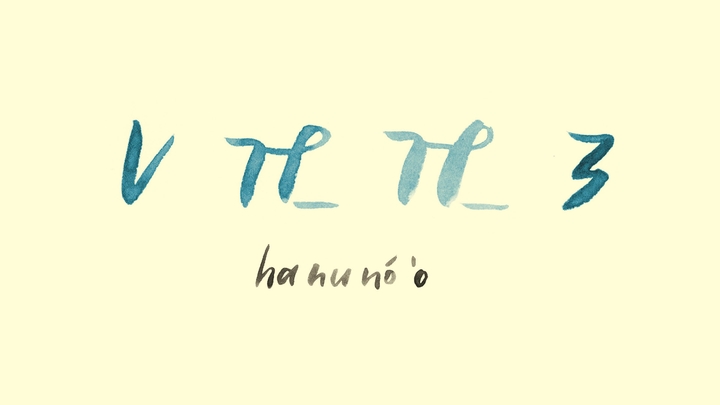

To the Mangyan community of Mindoro, specifically the Hanunuo tribe, their indigenous verse called “ambahan” is infused with story and metaphor, a multi-purpose form of messaging written on the skin of bamboo trees in their native script — more akin to utilitarian Post-Its or writings on furniture, rather than the Western concept of the poem as purely artistic format.
It is the form that poet Quintin V. Pastrana took in, “Ambahan, A Love Story.” Released by Far Eastern University Press, it gathers 50 poems the Oxford- and Cambridge-educated author originally wrote in English, as well as translations of those poems into Filipino by award-winning poet Danton Remoto, and transpositions of those Filipino translations into the original Mangyan script by Mangyan, Filipino, and civic worker, Uyan Daay. “Essentially a trilingual volume of poetry,” Pastrana said.
Pastrana can still recall the first time he encountered the poetry of the Mangyans. He was on a trip to Mindoro in 2013 on a project to build a local library and also when he’d been trying to string together poems, keeping in mind advice to find a more authentic voice and form than what he’d been taught at the English universities.
“During one of the library projects I was involved with in the indigenous community of Bulalacao, I learned more of that beautiful poetic treasure of the Mangyans,” said Pastrana. “The experience was truly transformative — having a beautiful labyrinth of form to weave my verses and voice into, being led by my Muse to complete the narrative arc of the book.”
It was because of this deep dive into the culture of the tribe that eventually led to co-editing the 2017 anthology “Bamboo Whispers,” a volume of Mangyan-written ambahans that won a National Book Award. That success emboldened Pastrana so much that he “hasn’t looked back since, and I can’t write in anything but ambahan now.”
When it came to translating to Filipino, Remoto was inspired by musicality.
“Since Filipino is fundamentally a musical language, I chose to translate in the manner the late and great National Artist Rolando S. Tinio would have done it: with music and intensity of emotions,” continued Remoto. “Rolando… then he showed me how he would do it? Let the words sing and the feelings float, these are the things that Rolando Tinio taught me. I tried to do that in the poems of Quintin.”
Daay, who then transposed the Tagalog letters into their local script — known as Surat Mangyan — shared how ambahan is traditionally chanted. “From Grade 1, I always won the ambahan chanting competitions among Hanunuo pupils,” said the research assistant at the Mangyan Heritage Center who also weaves ramit, the beautiful handwoven cloth of the tribe. “When I was a little girl growing up with my lola grandmother, she and my aunts would chant ambahans while they were roasting camote for our dinner. In elementary, I stayed with Sister Maggiorina Arenas, a missionary who made me memorize ambahans.”
Emily Lorenzo Catapang, Mangyan Heritage Center’s Executive Director noted the integrity of form: each line with seven syllables each is what makes the ambahan. “Each of Quintin’s original poems in English are unquestionably ambahan because he strictly follows the per line requirement,” Catapang said. But continued: “Quintin’s ambahan are an expression of his 21st century insights of his life experiences in an urban setting.”
Lolita Delgado Fansler, who co-edited “Bamboo Whispers” with Pastrana is ecstatic about the possibilities that this has created.
“A Filipino-American abroad attended Quintin’s virtual book launch because she wanted to learn more about the Mangyans and to hear a Mangyan chant an ambahan,” said Delgado Fansler. “A few days later she wrote her first ambahan. Like Quintin, she now finds it easy to express herself in seven syllables per line.”
It’s a practical kind of poetry. By which I mean that while it’s a means of expression, the verses usually contain educational aphormisms, warnings, and meditations on birth, family, coming of age, the agricultural seasons, and of course death. It’s also a document of the community’s history, as poems are written to record catastrophes like typhoons, when strangers or tourists came to immerse in the culture (some did stay and took brides), when disputes among neighbors reach a breaking point, or when those same feuds are soothed into truce.
Because of its nature, there are traditionally no “authors” as we might know them in today’s literature. Nobody signs their name. The poem is thus owned by the community, not the individual.
Yet the primary utility of the ambahan isn’t to educate, it’s really to woo and court a prospective partner. Love poems, praises, adulation, flattery, and marriage vows make up a big piece of the rhymes carved on the Hanunuo’s trees and the household objects they’ve made from the bark of the bamboo.
Take this traditional poem (taken from the “Bamboo Whispers” anthology), that dovetails as both a declaration of unfaltering love and as a purview into the Mangyan’s animistic hereafter.
AMBAHAN 237
Sa sandaling karimlan
Kahit kita magtipan
A banig na higaan
Pagpusyaw nitong araw
Tala’y magihiwalay
Buklod nati’y bibigyan
Pagkita’y daratal
Paningi’y mapawi man
Bago n’ang kaanyuan!
[English translation]
At this hour of the dark night
We two are together still
On this woven sleeping mat
But soon when the sun rises
And the stars may fall apart
Even we might break our bonds
If ever we meet again
We won’t see with mortal eyes
But with vision of the soul
Contrast the above with Pastrana’s own “After Midnight” below, where he poses an awkwardness in approaching the beloved his persona is courting. Very modern in setting and sentiment, yet certainly inspired by not just the amabahan’s form but also the theme of shy petition.
My heart is full and empty
All at the same time it takes
To tie my laces on the
Escalator lest I trip
On my gait, uncertain as
The path I take towards you
For Pastrana, the limitations of the ambahan’s structure were an aid to his creativity, rather than a crutch. It’s led him to discover not just a means of expression he previously thought inaccessible, but also to explore themes he might otherwise have left as journal entries or prose, like his short fiction in magazines like “The Grief Diaries” and UST’s “Tomas” literary journal.
“Ambahan is a way of life,” said Pastrana. “The span of a breath, the sacred ordinary, and the silken thread of narrative. It’s a natural and yet disciplined way to go about life — turning the prosaic into pure poetry. It’s reinforced my belief that poetry isn’t just a way of seeing or communicating.”
For someone who has pursued a Lannan Poetry Fellowship in Washington, DC, Pastrana’s poetry retains a very emotive core that is usually absent in European and Western verse. His ambahans are something that the British writers may even deem mawkish or oversentimental.
In truth, Pastrana does write the things that he loves. Sure there’s women and erotic love, as in “Now ‘Til Us” — where he muses on a smooth rock taken from the sea and compares it to a girl…
It is piebald like the moon
Smooth, familiar to the touch
Like the grain of your pubis—
But there’s also music (“Symphony”), provincial landscapes (“Batanes”), and even gin and tonic (“Gin as Tonic”), where the poet declares alcohol the only constant balm to relationships ending badly.
You’re the last marriage after
A coven of bad judgement
It makes for a collection that is eclectically modern, but wrapped in Mangyan traditions. Pastrana himself views the form as an authentic Filipino art that he hopes, with his own contribution to the tradition, is something that “honors and introduces this cultural gift to the world,” while expanding it beyond Mangyan life and culture in the mountains.
“Such an immersive, visceral experience transforms you because of the warmth of the community,” mused Pastrana, looking back on the years writing his ambahans.
Daay connected with this. “Quintin’s ambahan is quite modern, a good way to promote the ambahan to Mangyan and non-Mangyan youth,” she said.
***
“Ambahan: A Love Story” can be purchased at Lazada, Shopee, Manila House, Ayala Museum and Art Books, or the FEU Publications TAMS Store.

