
Metro Manila (CNN Philippines, November 16) — The Philippines can officially tap a wider market for its exports with greater ease as it joined on Sunday the world’s biggest trading bloc that many hope will help in the recovery of economies devastated by the coronavirus pandemic.
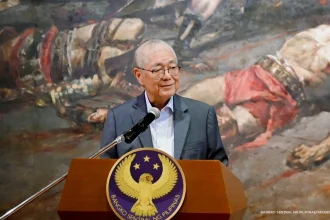
Trade Secretary Ramon Lopez signed on behalf of the country the Regional Comprehensive Economic Partnership Agreement or RCEP, a deal with 14 other states that allows simpler cross-border trade covering a fourth of global output.
All the 10 member states of ASEAN signed the deal, which will make it easier for the Philippines to import and export to and from Brunei Darussalam, Cambodia, Indonesia, Laos, Malaysia, Myanmar, Singapore, Thailand and Vietnam. Neighboring Australia, China, Japan, South Korea and New Zealand also joined the free trade arrangement, which was inked Sunday in a virtual signing ceremony.
The RCEP, the product of eight years of negotiations among parties, provides guidelines on the trade of goods and services, investments, intellectual property, e-commerce, government procurement, and competition. It was concluded at a time of a global recession amid a pandemic, when economies are reeling from lockdowns that stifled tourism, jobs, and earnings.
Gains expected
Lopez said the Philippines will benefit by way of “improved trade and investment, enhanced transparency, integrated regional supply chains, and strengthened economic cooperation” with RCEP signatories.
The deal has to be ratified by the member-states. For the Philippines, Lopez said the RCEP must be adopted by President Rodrigo Duterte and concurred in by the Senate – a process he hopes to be finished by 2021.
The RCEP will provide “open, inclusive, rules-based trade and investment” across member-states. The rules make it simpler and cheaper to import and export through the reduction of customs duties, tariff liberalization, and import licensing, to name a few.
The RCEP agreement, spanning 20 chapters, also provides broad guidelines on financial services, telecommunications, professional services, and movement of travelers.
Lopez said the deal will enhance market access for locally-made garments, automotive parts, and agricultural products like canned food and preserved fruits. He explained that RCEP will provide leeway to safeguard local farmers through an “exclusion list” that will limit the entry of cheaper variants of agricultural products and other “sensitive” items from abroad.
The RCEP also carries provisions to boost small-scale firms and their entry into the regional value chain, which should support growth.
The Philippines is seen to benefit greatly from the RCEP, a market which receives half of the country’s exports and provides 61% of imports. It’s also the source of 11.4% of foreign direct investments.
Regional boost
The trade deal is seen to unlock faster growth in the region, which has now grown to $23.9 trillion, accounting for 28.2% of the global economy.
“RCEP will boost global trade and economic growth, especially among Asian countries reeling from the adverse effects of the US-China trade war lingering over the past 1-2 years,” RCBC economist Michael Ricafort said in a report.
In a separate commentary, HSBC Global Research said the trade deal will boost the bloc’s share to 50% of global output by 2030.
India has bowed out of the RCEP – a potential market of more than a billion people – but it can always join the bloc at a later date, according to the framework.