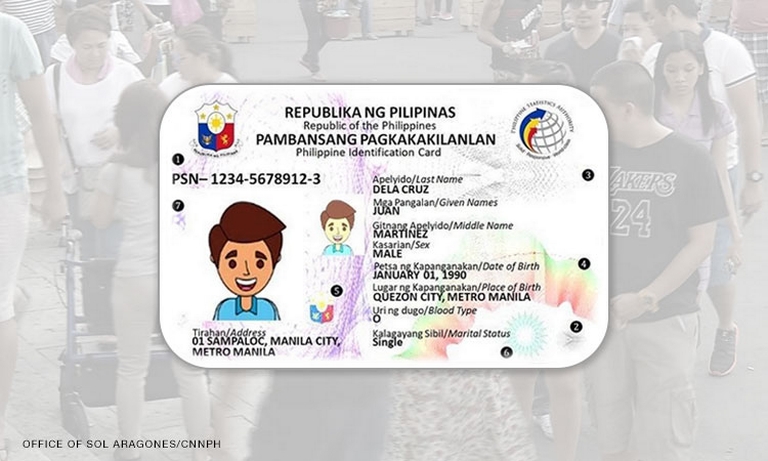

Metro Manila (CNN Philippines, October 9) — It’s all systems go for the government’s national ID system on Monday, putting it on course to give at least 92 million Filipinos a “legal identity” by the end of President Rodrigo Duterte’s term, the country’s national statistician said on Friday.
On Oct. 12, enumerators hired by the Philippine Statistics Authority (PSA) will begin making the rounds of households in 664 cities and municipalities in 32 provinces identified as “low-risk” areas to collect demographic information including gender, date of birth, blood type and address.
It’s the first in a three-phase approach the PSA has adopted to protect both the enumerators and the target individuals against the transmission of the coronavirus. That first step allows households to set up an appointment for the capture of biometrics – fingerprint, iris scan and photograph – which is the second phase that runs from end-November until Dec. 30.
National ID cards with the Philippine Identification System (PhilSys) number will be issued starting 2021, which is the last step, according to the PSA.
The target is to have five million heads of the family registered this year, but up to nine million are expected to complete at least the first phase.
“By January 2021, the registration for PhilSys will be nationwide,” national statistician Claire Dennis Mapa told a virtual press briefing on Friday during a kick-off ceremony for the PhilSys ID.
“The target of the government remains… complete registration and issuance of PhilSys numbers at the end of June 2022,” Mapa said. “Our target is 92 million despite the challenges posed the COVID-19 pandemic.”
Monday’s rollout signifies gains for a government struggling to meet a United Nations Sustainable Development Goals of providing “legal identity to all by 2030.”
The national initiative has merits: It gives the underserved population – the indigents, the tribes, the elderly and other vulnerable groups – access to financial and state-funded welfare services.
But the past two years since 2018 — when the PhilSys Act was passed — had been an uphill climb for the Duterte administration as his bid for a national ID system has been met with criticisms, allegations of questionable procurement and cybersecurity issues.
Asked on whether the government is open to proposals for the national ID data to be saved on Cloud to facilitate easier banking transactions, Department of Information and Communications Technology (DICT) Undersecretary Denis Villorente said the agency intends to “harness” the strength of Cloud technology, “while maintaining safeguards.”
“With this unique number, the DSWD (Department of Social Welfare and Development) can create a master list for its beneficiaries,” Villorente added.
Compounding concerns over privacy issues is the coronavirus pandemic.
“That is why the registration is done in three steps simply to reduce exposure while following the health protocols,” Mapa said, adding that PSA personnel tapped for the registration will go through regular checks for COVID-19 symptoms.
Mapa puts the entire PhilSys budget at P27.8 billion, a proposal submitted to the National Economic and Development Authority (NEDA) Investment Coordination Committee in May.
“We have sufficient budget for registration this year… The budget is sufficient to get us started and continue until early next year,” Socioeconomic Planning Secretary Karl Kendrick Chua said.