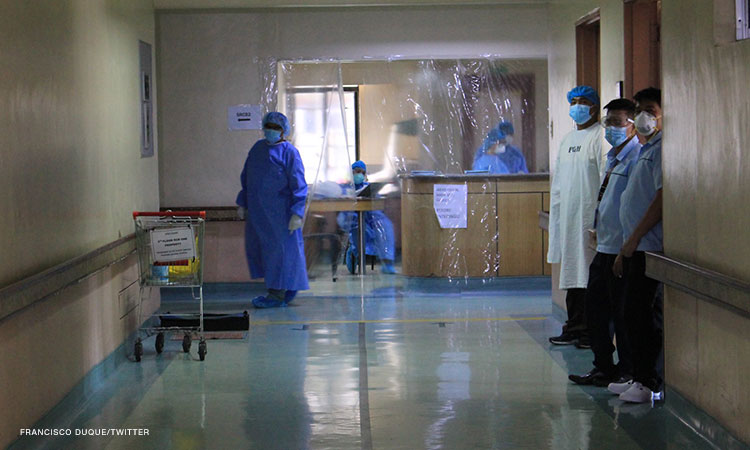

Metro Manila (CNN Philippines, July 14) — As the country continues to deal with the COVID-19 pandemic, some professionals offered suggestions on how to improve the health system for the future.
Among the ideas raised during a hearing of the Senate Committee on Sustainable Development Goals, Innovation and Futures Thinking, was a “one ward” system for hospitals.
Dr. Gap Legaspi, Philippine General Hospital director, said the concept requires hospitals to cooperate and share resources to fill each other’s gaps in services. A command center will also aid in streamlining information, he added.
“All of these data have to be constantly streamed to each other so that there’s real-time knowledge of what’s happening in each hospital,” said Legaspi. “So the command center can actually tell a patient in an ambulance to proceed to hospital B because hospital A is already full.”
He stressed that training in cooperation may also begin in medical schools.
“[T]he medical education should emphasize that we really need to work with each other and the curriculum can be redesigned,” he said.
However, committee chairman Senator Pia Cayetano raised that it would have to address behavior such as hospital preferences among patients.
“Filipinos want to go to the mega hospitals,” she mentioned.
Dr. Michael Tee, Vice-Chancellor for Planning and Development in UP Manila, said data collecting must also be refined.
“Our healthcare system is so devolved and data gathering is fragmented that there is really nothing we can get that is valuable information to use for forecasting,” he lamented.
Tee suggested a team of experts such as mathematicians and planners be tasked to interpret data to guide budget and policy. He noted three building blocks for this: the community as a patient, clinical face-to-face services, and education.
“With these three building blocks addressed by concrete data sharing then maybe we can have a future that is appropriate and more responsive to the needs of the Filipino,” said Tee.
He also suggested a law that would mandate data sharing while being protected by data privacy law.
This comes as the Department of Health continues to report surges in COVID-19 cases that are part recently detected infections and late cases from backed up records.