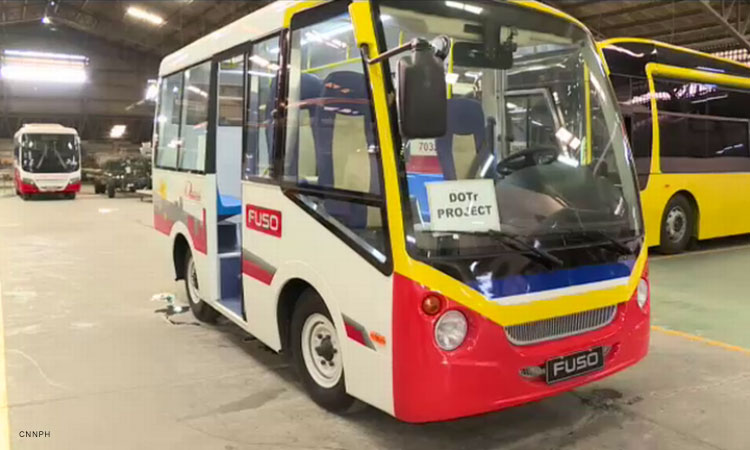

Metro Manila (CNN Philippines, June 21) — The Land Transportation Franchising and Regulatory Board has approved over 30 routes for modern jeepneys in the capital region starting next week, 15 of which will be rolled out on Monday.
The gradual opening of these routes is in line with partial and calibrated resumption of public transport in Metro Manila, which aims to “to balance the need for mobility with the need to ensure public health in the midst of the pandemic,” explained LTFRB Chairman Martin Delgra III in a virtual briefing on Sunday.
Around 308 units compliant with requirements set by the Omnibus Franchising Guidelines (OFG) have been permitted by the agency to ply the 15 routes, which are:
– Novaliches – Malinta via Paso de Blas
– Bagumbayan Taguig – Pasig via San Joaquin
– Fort Bonifacio Gate 3 – Guadalupe-Market Market-ABC Loop Service
– Pandacan – Leon Guinto
– Quezon Avenue – LRT 5th Avenue Station
– Cubao (Diamond) – Roces Super Palengke
– EDSA Buendia-Mandaluyong City Hall via Jupiter, Rockwell
– Divisoria-Gasak via H. Lopez
– Punta-Quiapo via Sta. Ana
– Boni Pinatubo – Stop and Shop, vice versa
– Boni Robinson’s Complex-Kalentong/JRC vice versa
– Nichols-Vito Cruz
– Filinvest City Loop
– Alabang Town Center (ATC)-Ayala Alabang Village
– Vito Cruz Taft Avenue-PITX Loop Service
Meanwhile, there will be 10 more routes to be opened on June 24, while the remaining nine will be allowed on June 26.
LTFRB PUV Modernization Program Project Manager Hussain says 15 Metro Manila routes will be allowed tomorrow 9 on June 24, and 10 on June 26. pic.twitter.com/pda8xPt4eL
— CNN Philippines (@cnnphilippines) June 21, 2020
The minimum fare for both non-air-conditioned and air-conditioned public utility jeepneys (PUJs) remains ₱11 for the first four kilometers. However, non-air-conditioned units shall collect ₱1.50 for every succeeding kilometer, while air-conditioned jeeps will charge ₱1.80 instead.
Jeepneys must strictly observe health and safety protocols such as physical distancing, or passengers being one seat apart and wearing of face masks, said the LTFRB. Units may only accommodate 50 percent of their full passenger capacity, excluding the driver and conductor.
Jeepney operators must also provide their vehicles means for cashless fare payments such as electronic systems like GCash, Paymaya and Squidpay, particularly if these don’t have machines where passengers can tap their beep cards, added Delgra.
“Alam po natin na yung cash transaction runs the risk or increases the risk of the transmission of the virus, kaya pinu-push talaga natin itong cashless transaction,” he explained.
[Translation: We already know that cash transactions increase the risk of transmitting the virus, and that’s why we are pushing for cashless transactions.]
Modern jeepneys must also be equipped with GNSS (global navigation satellite system) or GPS (global positioning system), which Delgra said will aid in the country’s contact tracing efforts.
Modern PUV operators and drivers who fail to observe the measures imposed by the LTFRB will be meted with penalties and/or cancellation or suspension of their certificate of public convenience or provisional authority, said the agency.