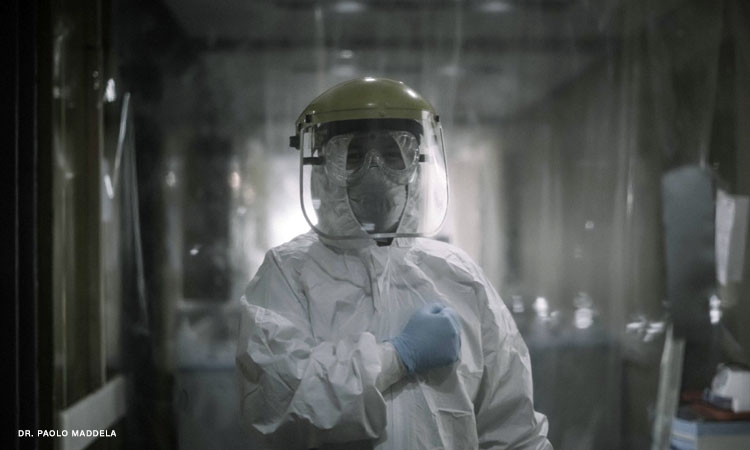


Metro Manila (CNN Philippines, May 12) – In one of the rooms at East Avenue Medical Center in Quezon City, a doctor prepares for another day of battle against an unseen and deadly enemy.
Like a warrior, he dons layers of protective gear — an N-95 mask, a head cap, coveralls, gloves, booties and a face shield.
They are uncomfortable, but a necessary protection against the coronavirus.
Healthcare workers have to change suits every time they do their rounds at COVID-19 wards. For some, that means changing twice or even more during their shift.
The government hospital is already at capacity with COVID-19 patients, and has limited beds for non-COVID patients.
Internal medicine resident Dr. Paolo Maddela tells CNN Philippines in a video call interview that his colleagues are also getting sick.
“Just the other day, three of our residents tested positive for COVID,” he said. “Some of the nurses at (Emergency Room) have been infected due to improper donning and doffing, especially when we doff the (personal protective equipment). We usually have instructions on what to take out first. What we lack is proper instructions. Some of the nurses and residents…iba nagmamadali, iba hindi nagcheck instructions properly, sa instructions may priority na tanggalin muna like booties then gloves and overalls. (Some of the nurses and residents are rushing. Others are not checking instructions properly. In the instructions, there is a priority to remove booties then gloves and overalls.)”
As of May 11, the Department of Health reported that 1,991 healthcare workers have been infected. That’s one of every six COVID-19 patients nationwide since January.
Dr. Madella says that when one doctor, nurse or medical technologist is placed under quarantine or hospitalized their whole operations would be affected.
“It’s very difficult when a colleague of mine is positive because we have to adjust the schedule of the whole department. It’s possible I would be taking care of 20 patients today, the next day I would be taking care of 40 patients,” Dr. Maddela said.
RELATED: WHO works with PH on ‘worrisome’ COVID-19 infection rate of frontliners
RELATED: DOH: Community exposure, long shifts led to high infection rate of healthcare workers
Healing needs Humanity
Like most healthcare workers, Dr. Madella hardly sees his family. Both of his parents are hypertensive, at high-risk of contracting the virus, which he says he might accidentally take home from the hospital.
“I have these fear of transmitting these days,” he said.
“We know what this disease is capable of, so I’m willing to make the necessary sacrifice.”
He takes on a 36-hour shift for seven days straight before going on a break. He gets a week off, and then it’s back to work again.
And every time he steps inside the hospital, Dr. Maddela finds himself walking the extra mile for his patients—they are alone and away from their loved ones, too.
Although the hospital allows relatives to visit, subject to protocols, the young doctor said many are still afraid to step foot at the hospital.
In the absence of family and friends, he gives his patients food and comfort, taking the time to talk with them.
Sometimes, their answers to a simple question on how they are doing would break his heart.
“Some of the responses nakakalungkot, hinahanap nila ang anak nila, or apo nila and that saddens me. It’s hard for relatives to go inside kasi baka mahawa din sila but at the same time, naakaawa rin ang patients, no one would take care of them, no one would give them a drink pa kailangan nila. So umaasa lang sila sa food pag may nurse na pumapasok o doctor na pumapasok,” he said.
[Translation: Some of the responses are disheartening, like they are longing for their children or their grandchildren and that saddens me. It’s hard for relatives to go inside because they can be infected but at the same time, the patients feel sorry because no one would take care of them, no one would give them a drink they need. So they are depending on their food if a nurse or a doctor go inside.]
He remembers a conversation with an old lady last week. She is 80 years old who suffered from a stroke, and is a probable COVID patient. Neither her husband nor her son is at her side.
“When I went inside sabi nya di siya nakakain buong araw, gutom na gutom sya and she was looking for her son. As a doctor, usually I would console her lang, kausapin mabuti. I would tell pupunta rin anak nyo,” he recalled.
[Translation: When I went inside, she said that she did not eat the whole day. She was so hungry and she was looking for her son. As a doctor, usually I would console her, talk to her, and I would tell that her children will visit her.]
“But, I remembered my lola. Pinakain ko siya, pinainom ko ng (medicines), just like what a normal person or apo would to to a lola.”
[Translation: But, I remembered my grandmother. I fed her, gave here medicines, just like what a normal person or grandson would do to a grandmother.]
Dr. Maddela eventually convinced her son to visit her.
For him, the healing process for COVID-19 or any other diseases extends beyond prescribing medicine. It is about offering kindness and care, too.
But with all the attendant risks, sacrifices and fatigue, the most difficult is still delivering the bad news.
He couldn’t but remember that day in April. One of his coronavirus patients was dying. He was 54 years old with a chronic kidney disease. He’ll leave behind a 19-year-old daughter alone in this world.
“At that time it was very hard for me to explain to the daughter that her father was dying,” the doctor said.
“Wala sya nanay and the father was dying, wala syang relatives so it was hard to explain.”
[Translation: She doesn’t have a mother anymore and the father was dying, she didn’t have any relatives so it was hard to explain.]
While the hospital recorded a number of deaths in the past two months, it is now seeing more recoveries.
Patients who survive give satisfaction to doctors and nurses.
Dr. Maddela says this is the best of times to be a doctor or to be any other type of healthcare worker.
“No amount of joy this time when a patient was admitted with a bad prognosis, was then later intubated, now is awake, oriented and discharged stable,” he said.
There are also other things that motivate them to keep on pushing in a seemingly thankless job— smiles from co-workers, donations, prayers, and any show of support in their continuing effort to save lives amid the pandemic.