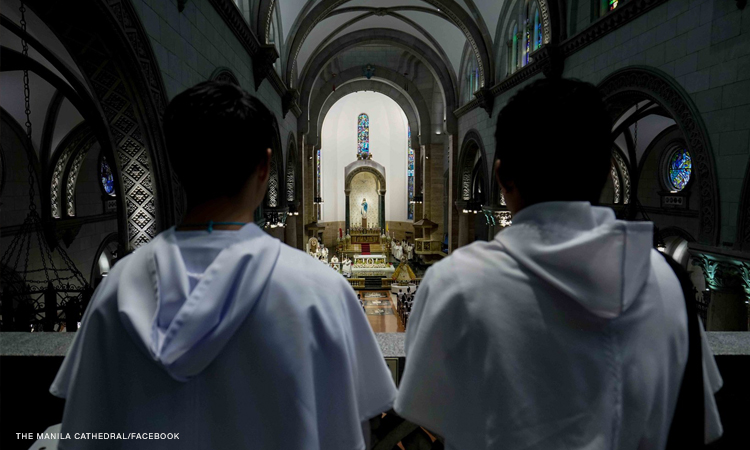

Metro Manila (CNN Philippines, May 6) — The Archdiocese of Manila has made a list of safety precautions it will take once the government allows religious activities, such as masses in churches, to resume.
Here are the protocols released Thursday by Bishop Broderick Pabillo, apostolic administrator of Manila:
Half-hour gap, weekday and Saturday masses
Pabillo said churches must allot at least a half-hour gap between masses to disinfect the worship place.
The prelate also asked the faithful to attend the weekday masses to reduce the number of people who come to church all at once.
“The presence of difficulty, and in some cases impossibility, of fulfilling the Sunday obligation renders the obligation suspended during these extraordinary circumstances,” Pabillo said.
The bishop said if there are enough priests, they could celebrate mass outside of Church like in gymnasiums.
Pabillo advised the children and the elderly to stay at home and join in the online Masses.
He called on the ministries to recruit volunteer collectors, lay ministers, and ushers “to lessen possibilities of infections among the elderly.”
No offertory, choir, hand-holding
During holy masses, some mass rituals will temporarily be prohibited.
For one, faithful will not walk to the altar with gifts such as bread and wine.
In the meantime, offerings can be placed in a basket or box at the back part of the church and a person or two will bring these to the altar.
Money collection boxes will also not be passed around. Instead, “collection will be done through bags attached to sticks.”
Meanwhile, Pabillo said that there will be no choirs temporarily. The church will request for song leader and an instrumentalist so church-goers could be guided.
He also offered one more option: There can be less singing in the Mass.
Pabillo added that hand-holding during the “Our Father” is disallowed. People cannot offer handshakes during the giving of peace. Instead of shaking hands with one another, mass-goers could bow as a sign of peace.
Communion is only recommended if a congregration is small enough, he said, without giving an exact number.
Other social distancing measures
All churches should hold masses in accordance with health guidelines.
People attending mass must wear face masks.
There will also be mandatory body temperature checks for people entering the parish or church.
“A thermal body scan will be a standard equipment in all parishes,” Pabillo said.
Pabillo said there are indicated spaces in the church and once those are filled, people can no longer be allowed to enter the Church.
He added they can stay outside but must maintain distance from one another.
Other religious rites
In holding a baptism, only the parents and one set of godparents will be allowed per child for the baptism. If there are many to be baptized, the children to be baptized can be organized by smaller batches.
Pabillo also wants parishes to hold this liturgical rite on weekdays to avoid decongestion on Sundays.
The Holy oils should be applied using cotton on the one who will be baptized. The cotton with holy oils should then be burned after the celebration.
For funerals, only the immediate family is allowed to attend. Meanwhile, only one set of sponsors and the immediate family of the bride and groom are allowed to witness nuptials this year.
The Manila archdiocese, which is comprised of churches in the cities of Manila, Makati, San Juan, Mandaluyong, and Pasay (except Villamor Air Base and Newport City), said the guidelines may be temporary since the country is under an “extraordinary situation.”
On April 30, the government said it was allowing church and other religious activities to resume in areas with low-to moderate risk of COVID-19 spread and are under general community quarantine or GCQ. A day later, it reversed the decision, following complaints from local officials.
GCQ is implemented in all parts of the country except in the National Capital Region, Calabarzon, Central Luzon (excluding Aurora), Pangasinan, Benguet, Iloilo, Cebu, Bacolod City, Davao City, Albay and Zamboanga City which are under stricter enhanced community quarantine. This will last until May 15, unless extended or modified by the government.