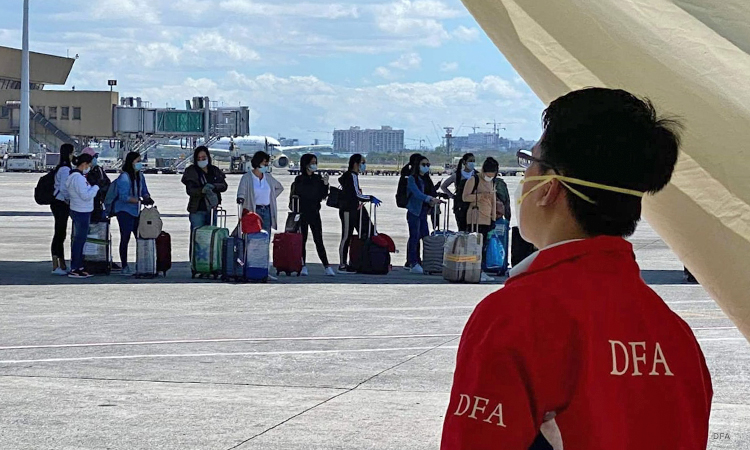

Metro Manila (CNN Philippines, April 21) — Filipino workers returning home should now take the rapid test for coronavirus, the Inter-Agency Task Force for the Management of Emerging Infectious Diseases said Tuesday.
Task force spokesperson Karlo Nograles said the OFWs will also go through a 14-day quarantine in facilities designated as isolation sites, upon arriving in the Philippines.
“All arriving overseas Filipino workers or OFWs, whether land-based or sea-based shall be required to undergo a 14-day facility-based quarantine and shall be subject to rapid testing for COVID-19 in accordance with Memorandum 2020-0180 issued by the Department of Health,” said Nograles as he read a portion of IATF-EID Resolution 26 during a televised briefing.
The official said seafarers who have been issued with a ‘clean bill of health,’ which is given when a person is free of sickness, are exempted from mandatory quarantine. But Nograles adds that they still need to undergo rapid testing,
“Sea-based OFWs … upon presentation of a certificate of completion of 14-day quarantine issued at the point of origin immediately before departure, will also be subjected to a rapid antibody testing.”
Citing a Foreign Affairs report, Nograles said, to date, 16,682 OFWs, of which 13,213 are seafarers and 3,469 are land-based, have been evacuated. It is not clear if all of them are have completed or undergoing quarantine at home or at quarantine centers.
Rapid test results are available within an hour, while polymerase chain reaction-based tests may take 24 to 48 hours, sometimes longer due to backlogs.
However, the DOH and local infectious disease experts have cautioned against rapid antibody tests, saying they do not give definitive diagnosis. A PCR test is considered the “gold standard test.”
The health department have pointed out that rapid test results still have to validated using a PCR test afterwards.
The Philippines has turned to rapid testing after President Rodrigo Duterte ordered the purchase of rapid test kits amid the long turnaround time of PCR tests.