
“For the resumption of the Congress, they should create an epidemic law and then you need to have a lot of checklists, a manual for this,” said Leachon in a virtual media briefing on Thursday.
“You need a lot of measures to be done like social distancing measures, you educate people from grade school to high school regarding epidemics,” he added.
The country does not have any law that would provide protocols and measures on how to manage outbreaks of viruses or diseases.
In 2013, former Senator Miriam Defensor-Santiago filed Senate Bill No. 1573 or the “Pandemic and All-Hazards Preparedness Act.” It called for the creation of a national health strategy during pandemics, as most parts of the world then grappled with the Middle East Respiratory Syndrome (MERS) outbreak.
Unfortunately, the bill remained pending at committee level in the 16th Congress.
The closest the country has to such a law is the recently approved Republic Act No. 11469 or “Bayanihan We Heal As One Act”, which mainly reallocates the budget and other government resources to address the COVID-19 crisis.
Along with the proposed law, Leachon called for an increase in the budget of the Department of Health (DOH).
The DOH’s budget for 2020 was cut by around ₱10 billion, while the proposed fund for disease surveillance this year has been slashed by ₱80 million.
Aside from the increased allocation, Leachon stressed the need to invest in research and development to create vaccines for such diseases and the necessary production infrastructure.
“I think they need to invest in research and development so that we can have the vaccine with us…and then we need to improvise the supply chain and then produce a lot of drugs, particularly on coronavirus,” he said.
Decentralized healthcare system
The national task force adviser said the country’s healthcare system must be decentralized, citing that the best healthcare services are only available in Metro Manila.
“If the National Capital Region is in a brink of collapse, then how would you imagine the other areas in the country if there is an epidemic? When 50% of your best doctors are in the National Capital Region,” said Leachon.
He proposed the setting up of satellite facilities of the UP-Philippine General Hospital (UP-PGH) in every region in the country.
“My dream is to have 14 PGH for every region, so you don’t only depend on the Philippine General Hospital and a tie up with the academic institutions,” he added.
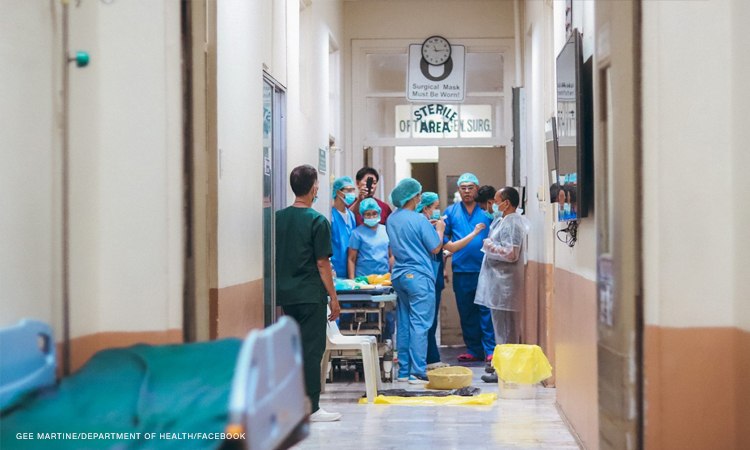
Aside from the UP-PGH, the two other referral hospitals for COVID-19 patients are the Lung Center of the Philippines and the Dr. Jose N. Rodriguez Memorial Hospital, both of which are also situated in Metro Manila.
Metro Manila (CNN Philippines, April 9) — With the COVID-19 pandemic catching the government flat-footed, national task force special adviser Dr. Anthony Leachon has suggested the crafting of a new law to address future health emergencies of such magnitude.