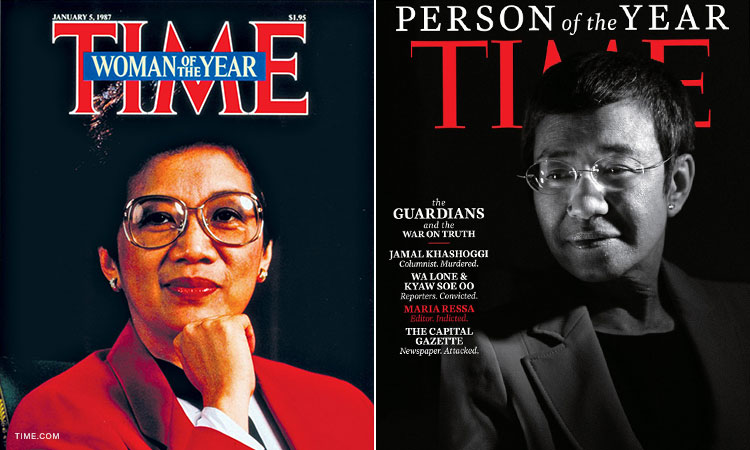

Metro Manila (CNN Philippines, March 5) — Former President Corazon Aquino and Rappler CEO Maria Ressa have been included in Time magazine’ss Most Influential Women of the century.
“With this 100 Women of the Year project, we’re spotlighting influential women who were often overshadowed. This includes women who occupied positions from which the men were often chosen, like world leaders Golda Meir and Corazon Aquino, but far more who found their influence through activism or culture,” Time stated.
Aquino was named Woman of the Year in 1986 after the democracy icon won the presidency and ended the nearly 21-year dictatorship of Ferdinand Marcos.
“That democracy has endured on the archipelago. So have its power structures: a tradition of elite rule helped her son Benigno Aquino III to a widely admired term as President. And his coarse, swaggering successor, Rodrigo Duterte, daily demonstrates both the machismo Corazon Aquino overcame, and the value of the principled civility she modeled,” Karl Vick wrote in his piece of Aquino.
Veteran journalist Maria Ressa, on the other hand was Time’s Woman of the Year in 2018. Ressa already had an established career in journalism when she started news organization Rappler with three other women.
“But the news site turned into a global bellwether for free, accurate information at the vortex of two malign forces: one was the angry populism of an elected President with authoritarian inclinations, Rodrigo Duterte; the other was social media,” Vick wrote.
Aquino and Ressa join the ranks of women all around the world who were recognized as Time magazine’s Woman of the Year like British Prime Minister Margaret Thatcher, Princess Diana of Wales, athlete Serena Williams, and entertainment personalities Madonna and Oprah Winfrey to name a few.
Time’s former editor-in-chief Nancy Gibbs said the project looks at the ways in which women held power due to systemic inequality. “Women,” Gibbs wrote, “were wielding soft power long before the concept was defined.”