
CNN Philippines (Metro Manila, January 30) — Now that the government has shifted to the rehabilitation phase in the aftermath of the eruption of Taal Volcano, some affected victims have cast doubts on the recommendation to shift to a new location which may not be applicable to their usual means of livelihood.
This was raised with government officials at a Senate hearing on Wednesday by some of the town mayors of Batangas who will be covered by the government’s resettlement program. The hearing was conducted by the Senate Committee on Urban Planning, Housing and Resettlement.
For one, Laurel Mayor Joan Amo said that while they are ready to relocate some residents to the town of Ibaan, she voiced her group’s worry of not being able to find any alternative means of income in the area.
“Ako po ay naghahanda na, kausap ko po ang municipal engineer [para mag-provide] ng bahay that will cost ₱50,000 or ₱60,000 para sa pag-uumpisahan ng aking mga kababayan kasi po sila ay fishermen. Hindi ko po pwedeng sabihin na dalhin sila sa Ibaan, wala naman pong dagat doon at talagang babalik at babalik po sila sa aming bayan,” Amo told the panel.
[Translation: I am already preparing, I am coordinating with our municipal engineer to provide houses that will cost ₱50,000 or ₱60,000 in order for our residents to get back on their feet because they are fishermen. We cannot say that they should just be brought to Ibaan because there is no sea in that area and for sure, they will just keep on coming back to our town.]
Ibaan Mayor Joy Salvame echoed this concern, and said that the resettlers in their town have not yet fully adjusted, as some have shown “signs of resistance” to change.
“[Putting up] shelters is a good idea, but…we need to consider the nature of the livelihood of the constituents. Ang mga tao, hindi naman laging adaptive to change eh, laging may resistance (People are not always adaptive to change, there is always resistance),” she said.
“We will be the resettlement area ng mga nasa lawa, hindi po talaga sila papayag kasi ang area po ay patag,” Salvame added.
[Translation: We will be the resettlement area of those who live by the lake, but they certainly will not allow this because our area is a lowland.]
Salvame previously said that Ibaan, which hosted up to over 8,000 evacuees from various municipalities within the 14-kilometer danger zone, has a ₱10-million calamity fund.
Of this amount, ₱3 million came from the Office of the President.
Philippine Institute of Volcanology and Seismology (Phivolcs) chief Renato Solidum also advised the Department of Human Settlements and Urban Development (DHSUD) to consider both volcanic and landslide hazards in finalizing the potential sites which will serve as resettlement areas of the affected victims.
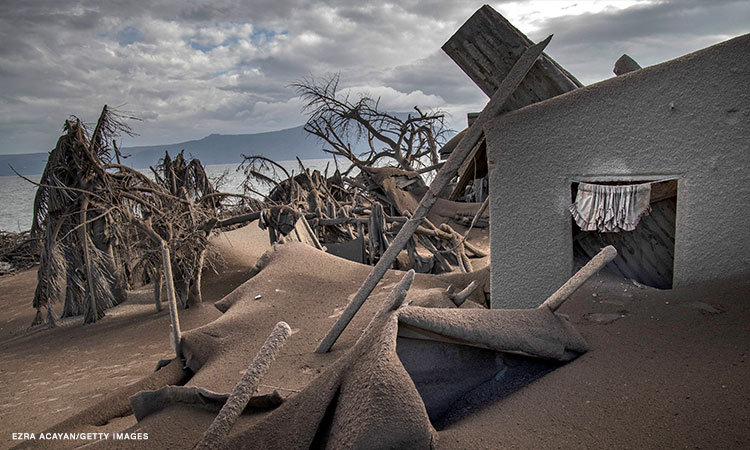
Batangas provincial government initially estimated around 22,000 houses within the danger zone could have been “totally damaged” by the eruption of Taal.
This meant that these shelters will not be liveable anymore even if residents in some of the affected areas go back to their respective areas.
DHSUD Director Rowena Dineros said during the hearing that Ibaan town is among the 11 potential sites being considered by the government in relocating the eruption victims, but Batangas provincial administrator Librado Dimaunahan recommended setting up multiple sites for the victims, depending on their environmental background and means of livelihood.
There are a total of 521,395 individuals, equivalent to 88,647 families who were affected by the eruption, Dimaunahan added.
As of Thursday, Alert Level 3 remains hoisted over Taal, indicating a “decreased tendency towards hazardous explosive eruption,” two weeks after it spewed ash and smoke to parts of Luzon.