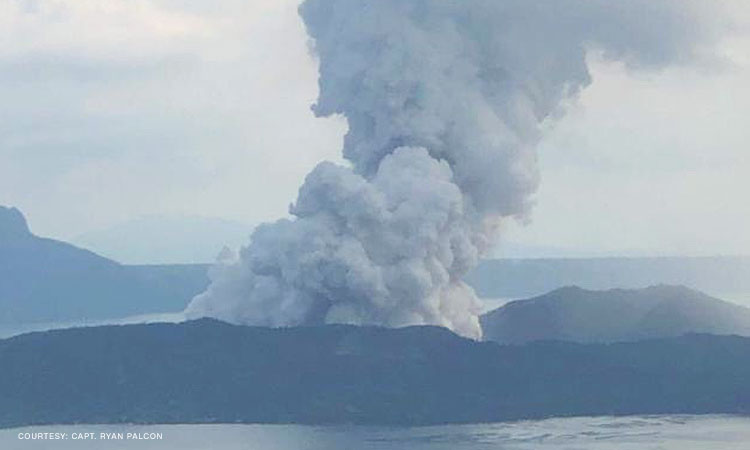

With the entire Taal Volcano Island marked as a permanent danger zone, Phivolcs reiterated that it should be evacuated at all times.
Metro Manila (CNN Philippines, January 19) – While Alert Level 4 remains raised over Taal Volcano, state volcanologists report that the number of volcanic quakes near the area reached 787 in the 24 hour period to 5 a.m. of Sunday.
The Philippine Institute of Volcanology and Seismology (Phivolcs) said in its 8 a.m. advisory on Sunday that the Taal Volcano Network tallied this number, including 15 low-frequency earthquakes which signify “continuous magmatic intrusion beneath the Taal edifice, which may lead to further eruptive activity.”
Meanwhile, the Philippine Seismic Network (PSN) plotted 691 volcanic earthquakes since the volcano spewed ash and smoke on January 12. Of these tremors, 175 were registered between magnitudes 1.2 to 4.1 and were felt at intensities 1 to 5.
With Alert Level 4 still in effect, hazardous explosive eruption may still occur within hours or days, Phivolcs said, adding that it was conducting further assessment of the probability of all scenarios considering the volcano’s behavior.
“We are looking at all of the scenarios and lagi po nating ina-assess hourly, daily ‘yung monitoring ng data at applicability ng alert level. At kami na po ang magsasabi kung kailangan na tayong magbaba,” Phivolcs Volcano Monitoring and Eruption Prediction Division Chief Mariton Bornas told the media on Sunday’s briefing.
[Translation: We are looking at all of the scenarios and we keep on assessing our monitoring data hourly, daily as well as the applicability of the alert level. We are the ones who will say when we will lower the alert level.]
“Nagkakaroon pa rin po tayo ng minor eruptions, walang sign na malakas as of the moment. Maaaring magkaroon pa rin ng phreatomagmatic eruptions, and then meron of course malakas na expulsion ng gas. Mapanganib yung mga ‘to,” Bornas added.
[Translation: We are still having minor eruptions, there are no signs of major eruptions as of the moment. But it is still possible for us to have phreatomagmatic eruptions, and then of course, the strong expulsion of gas. These are all dangerous.]
Phreatomagmatic eruptions are brought about by the interaction between magma and water, Phivolcs earlier noted.
Phivolcs tells public: don’t relax just yet, keep off Taal danger zone
The agency added that it is also “bothered” by the increased number of volcanic earthquakes especially now that Taal’s magmatic chamber has opened up, allowing space for movement of magma underneath.
“Medyo nababagabag kami sa aming nakalap na monitoring data. Kapag nag-umpisa ulit [ang eruption], napakaliit ng lead time lalo na ngayong nabuklat na ang bulkan kasi nung una, closed system pa siya na hindi pumuputok…so mas lala na po ngyon na open na ang bulkan, mabilis na po ang pagsampa ng magma, wala nang pumipigil sa kanya na pressure,” Bornas noted.
[Translation: We are a little bothered by the data that we have been monitoring. Because if it erupts once again, our lead time is so little especially now that the volcano has opened up, when it was a closed system that hasn’t erupted before, what more now that it’s open, it’s easier for the magma to enter the chamber now because there is no pressure preventing it.]
CNN Philippines’ Crissy Dimatulac contributed to this report.
READ: Weak explosions, quakes signal Taal Volcano is still dangerous – Phivolcs
Residents of nearby areas, particularly the affected towns of Agoncillo, Talisay, Laurel, and San Nicolas in Batangas are still expected to follow the government’s strict evacuation protocol until the alert level is lowered.
The National Disaster Risk Reduction and Management Council has so far recorded a total of 96,061 individuals who were affected by the eruption in Batangas, Laguna and Cavite. Of this number, 70, 413 are taking temporary shelter in evacuation centers.
Phivolcs explains the Taal Volcano Network “can record small earthquakes undetectable by the PSN.”
“We stand firm on our recommendation na dapat totally evacuated, hindi po dapat pumapasok sa loob ng defined na danger zone,” said Bornas.
[Translation: We stand firm on our recommendation that the whole island should be totally evacuated and people should not be entering the areas which were defined as danger zones.]
Professor Carlo Arcilla of the University of the Philippines National Institute of Geological Sciences previously told CNN Philippines that anyone found within Taal’s 14-kilometer danger zone will meet an instant death for inhaling the hot gases due to the magma’s hot temperature which could be at least 600 degrees Celsius to 1,000 degrees Celsius.
Local government units have previously given a four-hour window period for residents to enter the danger zone around Taal from 6am to 10am.
Even in Tagaytay, which serves as an iconic tourist destination to many, businesses have been returning to normal operations, after Mayor Agnes Delgado-Tolentino approved a resolution granting the request of the city tourism council to allow its establishments to open.
After Taal’s eruption which sent ash into parts of Metro Manila on Sunday, Phivolcs noted a quieter volcano with frequently continuing earthquakes since Thursday.