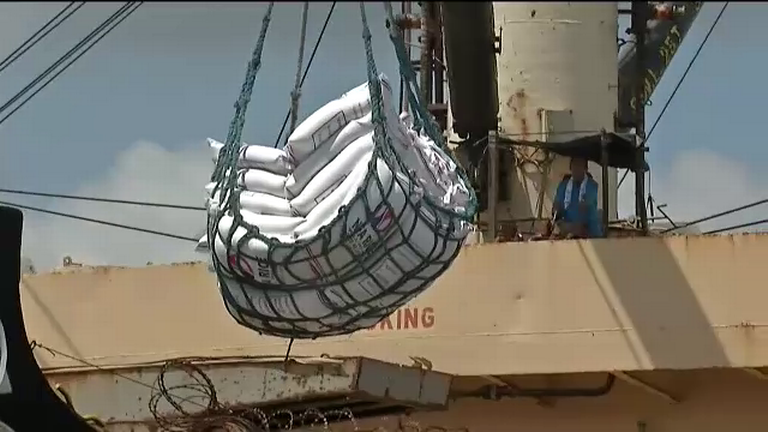

Metro Manila (CNN Philippines, November 13)— Despite supposed flaws in a policy that allows unlimited rice imports, the government is firm on carrying out the Rice Tariffication Act, saying its benefits outweigh perceived disadvantages.
“The government is not inclined to revise, repeal or suspend the Rice Tariffication law,” Finance Secretary Carlos Dominguez III told rice traders and stakeholders at the 11th Rice Trader World Rice Conference in Makati City on Wednesday.
Dominguez said the law has benefited low-income households that usually set aside a fifth of their budget for the staple. Rice prices have gone down by an average of ₱8 per kilogram since the rice tariffication policy.
He also said the law caused the inflation rate to go down. “We are now well within the government’s target range of two to four percent,” Dominguez said.
The Philippine Statistics Authority said rice was the primary driver of high inflation in September 2018.
While the government acknowledges that the law has also resulted in lower average farm gate prices of unmilled rice (palay) in some provinces to the detriment of farmers, Dominguez said these are just one of the “temporary transition challenges.”
He said the law has built-in mechanisms that allow authorities to help farmers suffering from more affordable imported rice. These include distributing modern farm equipment and high quality seed, providing training on farming practices as well as interest-free loans.
These would be funded from the rice farmer support fund under the law. The fund will come from rice tariff proceeds.
Dominguez said repealing the rice tariffication law is a step backward for the agriculture industry, possibly resulting in unstable rice supply, high retail prices, profiteering and low productivity.
“It took nearly three decades of long standing resistance to open up the importation process of our stable crop. As a consequence our rice industry stagnated, trapping millions of rice farmers in outdated farming practices and inflicting the cost of inefficiency on our consumers and taxpayers as a whole,” he said.
“This is not the future of our agriculture. We should let the rice tariff do its work and give it time to adjust further,” he added.
Agriculture Secretary William Dar and Trade Secretary Ramon Lopez echoed their Cabinet colleague..
Dar said critics should “give the law a chance to be implemented properly.”
However, he said he is open to “adjustments,” and that revisiting the law is not off the table.
Farmers ‘not affected by the rice tariffication law’
Lopez, meanwhile, said farmers are “not affected by the rice tariffication law itself,” referring to the data presented by Dar in the forum.
But he added that it is “too early to tell what the impact really is on the farmers.”
He said “productivity and competitiveness” must be addressed.
Lopez also rejected calls to impose higher tariffs on imported rice, amid the United States’ Department of Agriculture-Foreign Agricultural Services’ forecast that the Philippines might be the top importer of the staple by yearend. This is primarily due to the law that opened the country to rice imports. The report also said it could dislodge usual top global rice importer, China.
The Agriculture chief previously noted that there is an oversupply of rice in the country in light of the rice tariffication law.
In January to October this year, private traders have imported 2.99 million metric tons of rice, according to government data.
This prompted the Agriculture department to consider higher rice import taxes in September. The current law provides that tariffs on imported rice should be between 35 and 40 percent. But Dar said Cabinet members rejected the idea.
Another round of cash aid worth ₱3-billion would be provided to rice farmers instead, Dar said.