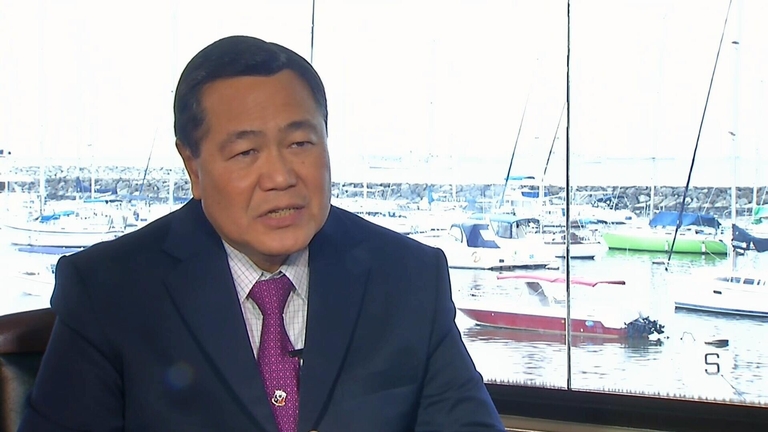

CNN Philippines (Metro Manila, October 29) – Retired Supreme Court Associate Justice Antonio Carpio urged five other claimants in the South China Sea to sign a convention to address China’s intimidation to secure ownership of the waters.
In this covenant, Carpio said that Philippines, Vietnam, Malaysia, Brunei, and Taiwan should agree that disputes shall be settled peacefully through negotiations and special agreements of parties or through arbitration in accordance with international law. The former justice argued that this will leave China “as the only disputant state resorting to grey zone tactics and refusing to maintain the status quo.”
Carpio, a fierce defender of the Philippines’ sovereign rights in its exclusive economic zone, said in a forum on Monday, “In the meantime, the status quo shall be maintained and no force, threat of force, or intimidating grey zone tactics, shall be used by the parties.”
The claimants should also clarify in the convention that high-tide geologic features are only territorial markers and not EEZs, Carpio suggested.
The EEZ is the 200-nautical mile sea zone from a coastline within which a country has the exclusive rights to use and explore natural resources, such as oil and natural gas, according to United Nations Convention on the Law of the Sea.
Read: What you need to know about the arbitral tribunal’s ruling
The covenant must also declare the Spratly Islands, over which Philippines and Malaysia have claims, an international marine protected area due to its significance as a spawning ground for fish, adding that without it, the fish stock there will collapse.
This means that no military facility should be in the area, Carpio said.
China since 2013 has been expanding its military footprint in the area. It dredged sand and built artificial islands where it is believed to have installed weapons systems.
Carpio said that these bases can be converted into marine research or tourism facilities. Other states could access the written agreement, he said, and added that China will be the number one beneficiary of such a convention because it now takes more than half of the annual fish catch in the South China Sea.
He also suggested conducting joint naval patrols beyond the territorial seas in the Spratlys. This is to enforce the arbitral ruling by state practice and improve peace and maritime security and stability in the disputed territory.
In the upcoming Association of Southeast Asian Summit — member countries are expected to talk about the proposed Code of Conduct in the disputed waters.
Carpio said, if signed, the Code should not legitimize claims and activities that are illegal under international law.
An international tribunal in the Hague, supported by the Permanent Court of Arbitration, in 2016 largely sided with the Philippines and rejected Beijing’s sweeping claims over most of the South China Sea, known as the “nine-dash line.” China refuses to acknowledge the international tribunal’s decision.