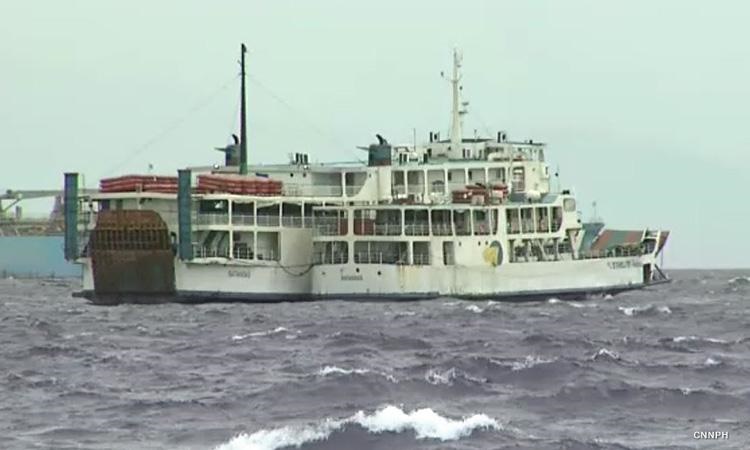

Metro Manila (CNN Philippines) — The Philippines is no stranger to maritime accidents. Philippine Maritime Authority records show at least 47 major ferry accidents from 1980-2008 — all of which left thousands of people dead.
Transport officials and some lawmakers say one of the major factors for these accidents is the age of passenger vessels in the country.
“Maiiwasan natin ito kung bago ang ating mga RORO.” says Congressman Cesar Sarmiento, Chairman of the House Transportation Committee.
[Translation: These can be prevented if we just have new RoRos.]
The Roll on-Roll off or RoRo, is an inter-island system of transportation which allows the driving of a motorized land vehicle in and out of a ferry or cargo ship.
It connects major points in Luzon, Visayas and Mindanao via the Philippine Nautical Highway- a network of roads and ports — which was opened in 2003. It became one of the most popular forms of inter-sea travel and shipping as it offered lower rates compared to purely sea and air options.
Figures from the Asian Development Bank in 2012 peg the number of RoRos at 42.
Most of the ships currently in operation are bought second hand from countries like China, Japan, Korea and Europe to name a few. Only 2 companies have so far begun modernizing their fleets with new vessels: Archipelago Philippine Ferries Corporation and Starlite Ferries.
Starlite Ferries President Francis Cusi said on Monday, August 8 that they wanted to raise the maritime industry standards.
“We need an elevated sense of comfort and security of passengers”
Maritime Sector Undersecretary Felipe Judan says the transportation department has created a roadmap for the gradual phaseout of older vessels — but gives no specific age of vessels to be phased out, nor a time frame for its implementation.
“Sana sa mga susunod na mga araw o susunod na panahon, wala nang hihigit sa 30 o 40 taon ang ating mga barko.”
[Translation: We hope there will be no more ships over 30 years old in the near future.]
Stephen Tagud of the 2GO group, one of the biggest players in the shipping industry, says this is a difficult proposition as most of the passenger ships including RoRo vessels would not pass this requirement.
“A lot of the ships here in the Philippines will not pass, especially passenger vessels.”
April 2016 figures from the Transportation Department show 152 of 254 domestic passenger vessels in the country are over 30 years old.
These are responsible for moving people and goods all over the country.
In 2015, Philippine Ports Authority statistics show 62,762,732 people and 89,051,156 metric tons of goods traveled by sea domestically.
Tagud says phasing out such a large number of vessels would possibly create monopolies in the shipping industry, as not everyone can afford to buy new vessels. He says this is especially true for long haul passenger and cargo vessels — as one of these can cost tens of millions of U.S. dollars if brand new.
“The long haul that serves manila to visas to Mindanao. It’s impossible to buy brand new ships that would cost more than around 40 million dollars so how do you get a return on that investment? so that already limits the whole industry in general.”
“That would mean significantly higher costs as far as shipping is concerned, and as far as passengers are concerned.”
Industry players agree that safety should be the primary concern. But they say transport officials should also consider other factors like safety and maintenance records of individual shipping operators, before implementing a blanket ban on vessels based simply on age.
They suggest setting a uniform maintenance and safety standard that has nothing to do with age.