




Manila (CNN Philippines Life) — It’s not enough that a video game looks good, or that it sounds fantastic, or that it keeps the player engaged with ever-mounting challenges and wide-ranging scenarios. Ideally, it does all of those — at once — and a lot more, besides. And for it to arrive at that synergy of key elements (visuals, audio, and gameplay), it has to have been designed not just well, but really well.
This is one of the core principles behind the Apple Design Award, arguably the most prestigious prize that can be won by a developer. Handed out by Apple during its annual Worldwide Developers Conference in a special event that’s something like the Oscars for products independently produced for the Cupertino-based company’s software platforms, the Apple Design Awards pay tribute to the best apps of the year.
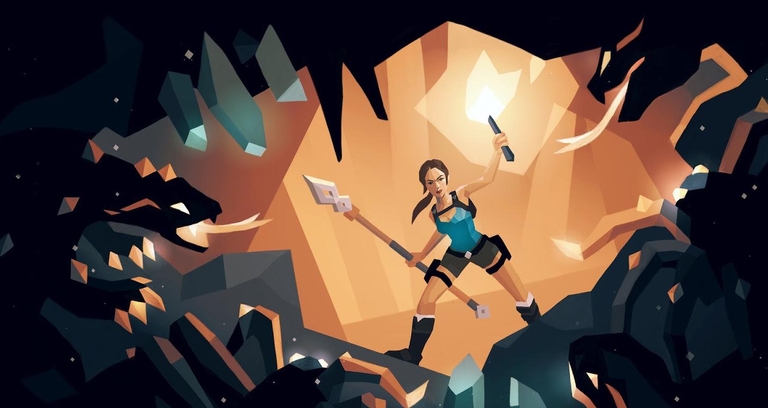
Yesterday, the 2016 Apple Design Awards were given to 12 apps. Five of those are games: the turn-based puzzle adventure Lara Croft Go, the auto runner Chameleon Run, the pinball-meets-paint game Inks, the node-connecting puzzler Linum, and the 2-D arcade game Dividr.
In honor of those games’ commendation, and in line with the ongoing Electronic Entertainment Expo in Los Angeles, CNN Philippines Life looks back at the last several years of the Apple Design Awards to recommend the most notable winning iOS game from each.
Infinity Blade (2011)
Co-developed by Epic Games, Infinity Blade is widely considered the first truly epic mobile game in the grand sense of the word. It was the first iOS game to run on the Unreal Engine, which, around the time of its release in late 2010, was already tantamount to saying it boasted graphics comparable to those of console games. Indeed, to play Infinity Blade is to be immersed in a cinematic world of fighting fantasy, where you must tap and swipe and hack and slash to defeat an immortal adversary and become the worthy wielder of the titular weapon. That the game spawned a couple of increasingly impressive sequels is a testament to its standard-setting and myth-making greatness.
Available for iPhone, iPod touch, and iPad for $5.99.
Where’s My Water? (2012)
According to the urban legend, some alligators live in the sewer. What the legend fails to mention is that one such alligator is named Swampy, and he’s rather fastidious. The first original character created by Disney for a mobile game, Swampy is the star of Where’s My Water?, a colorful and cartoony game that challenges players to swipe to guide water to his broken subterranean shower. As with many puzzlers, it’s not as simple as it sounds: You no sooner get the hang of Where’s My Water? than challenges start popping up in the form of steam, toxic water, and ooze, each with its unique physics-based behavior. The popularity of Where’s My Water? led to the sequel Where’s My Water? 2 and several spinoffs featuring different characters.
Available for iPhone, iPod touch, and iPad for $1.99.
Badland (2013)
The now-defunct Flappy Bird, for better or worse, might have been the breakout mobile game of 2013. But that year’s one-tap side-scrolling game actually worthy of world renown, if not exactly a reputation for being a phenomenon, would have to be Badland. In the game, you control a little flying creature as it tries to traverse the game’s sylvan world, which happens to be, for want of a more succinct description, dark and full of terrors. But it’s also full of surprises of the more agreeable sort, including power-ups and clones that could help get you through the game’s internal day, which spans the appropriately atmospheric stages of dawn, noon, dusk, and night. There’s a sequel, Badland 2, should you end up wanting more — which you probably will.
Available for iPhone, iPod touch, and iPad for $2.99.
Monument Valley (2014)
If there’s only one iOS game that you ought to show your friends if you simply want to wow them, it’s none other than Monument Valley. Combining inspirations from minimalist sculpture, Japanese woodblock printing, and the infinitely fascinating drawings of M.C. Escher, Monument Valley is a gorgeously mind-bending puzzle adventure characterized primarily by its extensive use of visual illusion. In the game, you must tap and swipe to manipulate objects and thereby guide a princess through her cryptic journey across various impossible structures like the famous Penrose triangle featured in “Inception” — all while evading the mysteriously menacing Crow People. In Monument Valley, everything is not what it seems. And it’s all a matter of perspective.
Available for iPhone, iPod touch, and iPad for $3.99.
Crossy Road (2015)
Why did the chicken cross the road? No matter the answer, it’s thanks to this riddle that Crossy Road came into existence. A kind of modernized Frogger rendered in blocky voxel graphics à la Minecraft, Crossy Road is an endless arcade game that lets you control a chicken to get it to hop as far as possible across roads, rivers, and train tracks. Without getting run over, getting taken by the current, or otherwise getting killed, of course. Along the way, you can collect coins that you can use to unlock new characters, including other kinds of animals and avatars based on popular figures. Don’t be surprised to find a character inspired by Mickey Mouse: There’s a spinoff called Disney Crossy Road featuring him and other Disney characters in different settings from Disney movies — all trying to remain unscathed in their recurrent attempts to get to the other side.
Available for iPhone, iPod touch, and iPad for free.