


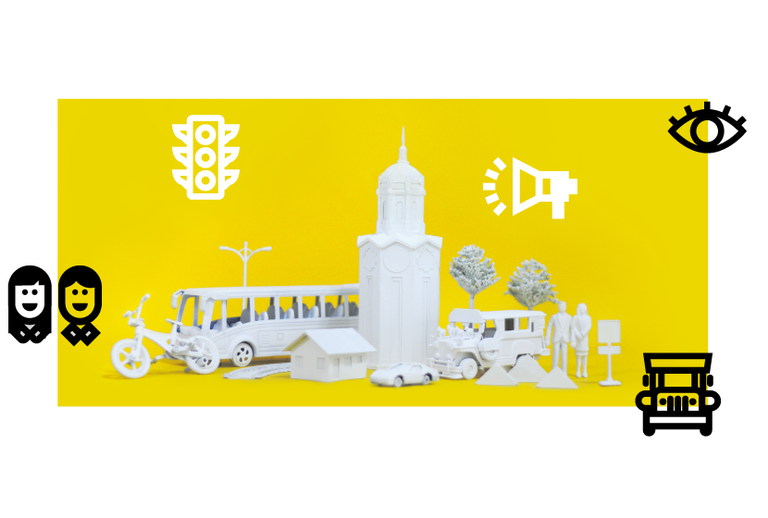
Manila (CNN Philippines Life) — When Julia Nebrija talks or writes about Manila, you can feel an intense love for the city radiate off of her. This love manifests itself on her blog, Project Manila, and more so on Viva Manila, a nonprofit organization dedicated to the revitalization of Manila through arts- and culture-related partnerships and programs that bring light to the city’s heritage and forgotten areas and help support local businesses.
A Filipino-American urban planner, Nebrija is also passionate about biking and walking around the city. She first came to the country in 2008 as a Fulbright scholar, and returned for good in 2012. Now, she serves as the executive director of Viva Manila, which has enabled her to become the festival director for the upcoming MNL Urban Design Festival.
A week-long event that will take place across Metro Manila, the festival follows Viva Manila’s goals through a series of activities and sub-events under the theme “People Make Cities!” These include Carlos Celdran’s Love Parade, a tour of Escolta and Old Manila; talks on mobility, public art, and maps by architecture experts; the First United Building Open House Tour; and a traveling mural and live art show. Nebrija is mounting the festival with Pamela Cajilg of Curiosity Design Research and Mark Evidente of Two Eco, Inc.
Below are edited excerpts from CNN Philippines Life’s interview with Nebrija, in which she talks about what’s to come during the festival, the aspects of Manila’s culture that she hopes to highlight, and how to appreciate and embrace one’s city more in day-to-day occurrences.

This is the second annual edition of MNL Urban Design Festival. What were last year’s highlights and learning curves that you’ve kept in mind for this year, and what efforts have you taken to make this new one different?
I think it worked to take the conversation on urban issues out of the conference room and engage a wider audience in a less formal way. I think last year people really appreciated that there were events on a range of topics at design studios, coworking spaces, and public places open (and mostly free!) to everyone with a range of speakers — from veterans like the architect Paulo Alcazaren to street photographers. We don’t try to get too technical, so it’s interesting to people whether they are in an urban design profession or not. At the end of the day, we all use and experience this city, so we are all experts in some way. You don’t need a degree to understand what you love about your city and what you’d like to see change. That said, it’s nice to have the opportunity to introduce people who are working to change the city to the everyday urban citizen.
What should people expect with the lineup of talks and activities?
This year we have events around Metro Manila: the College of Saint Benilde, Escolta, and Intramuros in Manila; Bonifacio Global City near Makati; and Maginhawa St. in Quezon City. We have talks, tours, workshops, exhibits, live art, and opportunities to meet fellow passionate urbanists. Expect to learn something, be inspired, and have fun.
Physical design only goes so far. You can design the same street, the same building in New York City, Berlin, and Tokyo, and none of them will become the same place. People give energy, give love, give meaning to a place through their interactions with each other and the way they participate in a city.
Escolta is marked by a rich history that was once something grand; today it slowly seems to be building up to that once more. What do you think Escolta stands for in terms of urban design these days?
Escolta today is an important story for our city. With heritage, you don’t want to preserve the past — you want to use the past to give the present meaning and allow it to take a form that will represent a time and place and create new meaning in the future. That starts with people, the people who bring their passion and energy to that place and make it something special. I think we are seeing that today in Escolta, with the partnerships between creatives, the local business association, and heritage groups. If we can crack that code in Escolta, it will be an inspiring example for other neighborhoods.
What was your process behind the curation of the lineup?
Urban design is the intersection of urban planning, architecture, engineering, sociology, anthropology, art, business, everyday perspectives — at its simplest, it’s anything that shapes the way people live in cities. Last year and this year again, we reached out to the people who are helping to shape our cities in some way, whether through built or unbuilt ideas, research, advocacy, or art, and then we design the festival days around the work that’s out there at this point in time. We want to do an annual festival so that over the years our program becomes almost like a stocktaking of our urban progression.
What aspects and areas of Manila’s culture do you hope to bring out through your collective and this festival?
We want to highlight that there are a lot of people exploring our urban culture, what it means to be the megacity that is Metro Manila, in a lot of interesting ways. The way we respond to our urban issues is as much the challenge as what we plan. Every city around the world changes every day; a city is never finished, so the work of urban development is an ongoing conversation for every city. We want to show that Manila is taking its own approach to the way we want to live in cities now and in the future.
My favorite mode of transportation is the Pasig River Ferry. I’ve read three books since I started taking the ferry regularly from Makati to Intramuros or Escolta several times a week. It doesn’t always smell great, but it’s nothing compared to inhaling car exhaust.
What’s the best way to experience and appreciate your own city in day-to-day occurrences?
For me, mobility plays a huge role in the way I appreciate where I live, work, play. Transportation shouldn’t just be a means to efficiently get from point A to B; it should also be enjoyable, it should add something positive to your day. Of course, sitting in six hours of traffic is not that. When I can walk and bike around the city, I’m the most happy. I feel more energized and positive, I feel healthy (minus pollution inhalation), and I get to discover things about the city I wouldn’t behind the shield of a car. If I can’t walk or bike, I try to commute. My favorite mode is the Pasig River Ferry. I’ve read three books since I started taking the ferry regularly from Makati to Intramuros or Escolta several times a week. It doesn’t always smell great, but it’s nothing compared to inhaling car exhaust. The journey is quiet and pleasant, and there’s no traffic. I see huge trees, birds, and sweeping open views of the city — you don’t get that sitting on EDSA.
Other than my commute, I try to get involved in like-minded communities as much as possible to always meet new people and learn new things. The best part of being in a city is being around a lot of people who challenge you to think, act, discover differently. The festival is a manifestation of that desire, I guess.
It is your belief that people make cities. Would you say that cities, then, are arbitrary in definition? What makes a city a city?
Physical design only goes so far. You can design the same street, the same building in New York City, Berlin, and Tokyo, and none of them will become the same place. People give energy, give love, give meaning to a place through their interactions with each other and the way they participate in a city — it’s something culturally specific. The things you like most about your city probably extend to the relationship you have with a person, with a local business, with a place — things you won’t find in another city. So in one sense, people make cities, because people make them unique.
The way we make cities professionally is also specific to us. The architecture, urban planning responses, and design interventions here have their own approach and should be celebrated while also being critically analyzed. Urban design is a constant conversation as to whether the design of a city reflects and supports the needs, desires, dreams of its people; the festival is one way to make sure that we have that open conversation every year.
Every city around the world changes every day; a city is never finished, so the work of urban development is an ongoing conversation for every city.
Are there any more areas in Manila that can have potential for revitalization such as what’s happening right now in Escolta?
In each city there are emerging streets or areas which are having their own revitalization movements such as Maginhawa St. and Cubao X in Quezon City, Lilac Street in Marikina, Aguirre Street in Parañaque, Kapitolyo in Pasig, Poblacion in Makati, Intramuros, parts of Malate/Ermita, etc. Neighborhoods are one of the most special parts of a city; it’s extremely valuable urban fabric. As of now our concept of “center” is the central business district. These “fringe” areas are challenging the concept of what it means to be a desirable urban environment for living, working, and playing.
How do you guys work with the government in terms of implementing the ideas behind the festival? How has the government’s support been, if any?
We do not work directly with the government for the MNL Urban Design Festival, but they are invited to participate. This year we have the Quezon City Memorial Circle (QCMC) District Design-Thinking Workshop, which will directly engage government stakeholders. This is the first step in a series of efforts we hope to launch over the coming months in developing a vision and plan for highlighting the cultural assets in this area, including the heritage, public spaces, and creative communities, all of which can be found in the QCMC surrounding areas.
What do you hope the impact of the Urban Design Festival will be after it wraps up?
I hope people feel that despite all the challenges we face, our city is something to celebrate.
***
The 2nd MNL Urban Design Festival will be held from June 18 to 25 all over Metro Manila and is curated by Viva Manila, Curiosity Design Research, and Two Eco, Inc., and presented by ULI Philippines in partnership with the numerous festival hosts, speakers, and exhibitors. Visit the event’s Facebook page for more details including complete schedules.