
Metro Manila (CNN Philippines, July 14) — Defense ministers of Association of Southeast Asian Nations (ASEAN) member-countries tackled issues surrounding the South China Sea during a meeting last week in Thailand, with the Philippines asking fellow members to finally agree on standard protocol for maritime incidents.
Defense Secretary Delfin Lorenzana brought up the Recto Bank incident and pushed for the adoption of regional rules on maritime encounters at last week’s ASEAN Defense Ministers’ Meeting (ADMM). Lorenzana specifically raised the June 9 incident that involved a Chinese vessel ramming into Filipino fishing boat Gem-Ver near Recto Bank (international name: Reed Bank), and then leaving 22 Filipino crew swimming for their lives in the open sea until they were rescued by a Vietnamese boat that they managed to contact.
Lorenzana took the opportunity to “extend our nation’s gratitude” to the Vietnamese crew that brought the 22 Filipinos to safety as he stressed the need for binding rules across ASEAN member-states, DND said in a statement on Sunday.
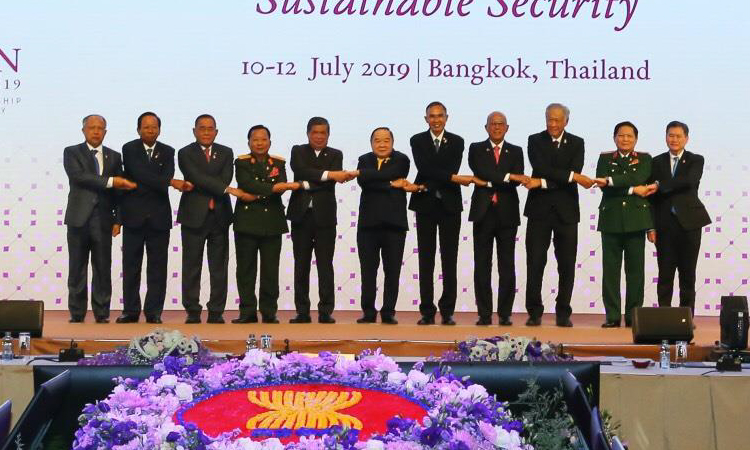
During the July 11 meeting in Bangkok, Lorenzana called upon fellow Defense chiefs to adopt Guidelines for Maritime Interaction, which he said will “prevent similar incidents from occurring again.”
It was Lorenzana who first reported the ramming incident at Recto Bank on June 12, which he quickly denounced in the “strongest terms.”
READ: Coast Guard-Marina report: China vessel ‘failed’ to take action to avoid Recto Bank collision
At the end of the ASEAN defense chiefs’ meeting, the body came out with a joint statement on sustainable security for the region and adopted six concept papers that included the one on maritime interaction guidelines.
Other papers covered the Guidelines for the Assessment of the ADMM Initiatives, the Role of ASEAN Defence Establishments in Supporting Border Management, the Establishment of ASEAN Military Medicine Conference, the Expansion of the ASEAN Direct Communications Infrastructure and the Terms of Reference of the ASEAN Our Eyes.
Also discussed were approaches to security implications of illegal, unreported and unregulated fishing activities.
These are meant to improve coordination among the member-states to improve regional peace and order, which are meant to tackle “traditional and non-traditional security challenges.”
But defense analyst Jose Antonio Custodio thinks Lorenzana’s gesture will only do little to forward discussions on the sea dispute.
“Lorenzana is just one aspect of the Philippine government. He did that, but the problem is: is the DFA (Department of Foreign Affairs) going to follow suit? We’re looking at a whole of government approach here… This is just going to be walked back by Duterte in a few days,” Custodio told CNN Philippines in an interview.
“What is needed at this time is Philippine presence, not this timid thing we’re doing where we’re allowing our fishermen to fish there at their own risk,” he added, stressing the need to have a more robust presence in the West Philippine Sea and for the Coast Guard to actively monitor and assist fishermen plying these waters.
Last month, President Rodrigo Duterte expressed disappointment with the slow progress in finalizing the Code of Conduct in the South China Sea, which would bind claimant countries on what they can and cannot do in the global waterway. Once approved, the rules will cover claimants such as the Philippines, Vietnam, Brunei, Indonesia, Taiwan, and China.
Duterte’s statement before the regional bloc came even as he called the Recto Bank collision a “very small” incident, as nobody died from it.
The President has long been criticized for his warm ties with China, despite the latter’s aggressive moves in the South China Sea and encroachment on contested areas there. Independent think tank Asia Maritime Transparency Initiative has pointed out that Duterte’s soft stance against China’s territorial claims may be to blame for Beijing’s “non-compliance” with the landmark ruling of the arbitral tribunal three years ago. Duterte’s downplaying of the country’s victory before The Hague in the Netherlands in fear of China’s retaliation caused international pressure for Beijing’s compliance to “evaporate,” the group said.
READ: Think tank flags China’s ‘non-compliance’ with arbitral ruling on sea dispute
The 22 fishermen had earlier called for making Recto Bank — which is within the Philippines’ exclusive economic zone in the West Philippine Sea — exclusive to Filipinos, in keeping with the ruling of an international arbitral tribunal that dismissed Beijing’s sweeping claims to the South China Sea in 2016. However, Duterte said in June that the Chinese will keep on fishing within Philippine waters, as he revealed a verbal agreement he struck with President Xi Jinping that allows Mainland fishermen to cast their nets there.