
Metro Manila (CNN Philippines, July 10) — A modest improvement in the country’s exports sector has led to a narrower trade gap in May.
According to latest data from the Philippine Statistics Authority (PSA), the country’s trade deficit decreased to $3.28 billion in May from a $3.88-billion deficit in the same month last year.
This is also an improvement from the $3.5 billion trade deficit in April.
A trade deficit happens when a country imports more than it exports.
Total export sales in May was $6.16 billion, a one percent improvement from the $6.09 billion registered in May 2018.
This was due to higher sales in eight of the country’s top ten major commodities: copper concentrates, ignition wiring sets, fresh bananas, chemicals, metal components, gold, other mineral products, and electric products.
Electronic products remain top export, raking in $3.45 billion, or 56.1 percent of the total May revenue.
The top ten export destinations are the U.S., China, Japan, Hong Kong, Singapore, Thailand, Germany, South Korea, Netherlands, and Taiwan.
Meanwhile imports decreased to $9.43 billion, 5.4 percent less than the $9.97 billion registered in the same month last year.
The country imported less iron and steel, transport equipment, mineral fuels, lubricants, plastic, industrial machinery and equipment, food and live animals in May.
China continues to be the main source of imported goods, amounting to 22.8 percent of all import spending. This was followed by imports from Japan, South Korea, the U.S., Singapore, Indonesia, Thailand, Malaysia, Taiwan, and Vietnam.
This is the second month in a row that imports contracted.
The National Economic and Development Authority is pushing for new laws and reforms that would improve the export industry.
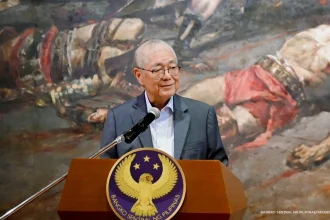
“To further drive exports up, we are looking at continuously increasing market access for Philippine products and reforms to improve productivity and lower production costs,” Socioeconomic Planning Secretary Ernesto M. Pernia said in a statement Wednesday.
These legislation are the Public Service Act, the Foreign Investment Act, the Retail Trade Act and the Tax Reform for Attracting Better and High-Quality Opportunities (TRABAHO) bill, which is also known as the second package of the administration’s tax reform program.