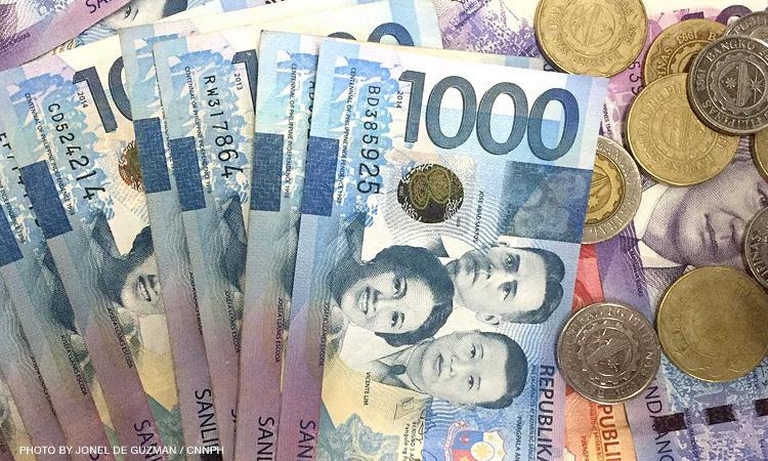

Metro Manila (CNN Philippines, April 15) — President Rodrigo Duterte has yet to approve the proposed 2019 national budget, but the government already plans an even higher appropriation for next year.
According to the National Budget Memorandum 132 issued by the Department of Budget and Management on April 12, the government is considering a 9.1 percent or ₱343 billion increase in 2020 from the proposed ₱3.76-trillion spending in 2019.
With the percentage increase, the Cabinet-level Development Budget Coordination Committee has set a ₱4.1-trillion outlay for 2020.
READ: Congress passes 2019 budget after 2-month delay
Of the amount, 44.9 percent or ₱1.8 trillion will be allotted for Tier 1 or ongoing programs, activities, and projects of different agencies.
A total of ₱911.7 billion or 22.2 percent of the budget, meanwhile, will cover Tier 2 or expanded and new programs and projects.
Automatic appropriations such as debt serviving, and special purpose funds will account for 32.8 percent or ₱1.34 trillion.
Cash-based system
Based on the memorandum, the 2020 budget will follow a cash-based budgeting scheme, the same system that then Budget Secretary Benjamin Diokno proposed for 2019. Diokno is now Bangko Sentral governor replacing Nestor Espenilla who succumbed to cancer in February.
In a cash-based set-up, agencies are required to spend their entire budget within a year. This is different from the previous system that allowed spending to be extended to two years.
“This system (cash-based) promotes efficiency of expenditure planning and public service delivery by shifting the performance metrics to actual delivery of goods and services rather than obligations made or contracts awarded,” the memorandum says.
In line with the system, the DBM said “only implementation-ready programs and projects shall be considered in the national budget.”
Priorities
Under the Budget circular, the administration will prioritize infrastructure, anti-poverty, and pro-employment initiatives.
The government will shell out P1.044 trillion for infrastructure projects, equivalent to 4.9 percent of the country’s economic growth as measure in gross domestic product.
This will include transport infrastructure, agriculture development, tourism development, and social infrastructure programs.
The Budget Department also cited new critical programs such as the implementation of the Universal Health Care Act and Rice Tarriffication Act; transition to the Bangsamoro Autonomous Region in Muslim Mindanao; institutionalization of the Pantawid Pamilyang Pilipino Program; and operation of the Department of Human Settlements and Urban Development.
The planned budget will also cover other priority initiatives such as the implementation of K-12 and technical and vocational programs; Universal Access to Quality Tertiary Education Act; unconditional cash transfer; Risk Resiliency Programs; as well as coastal resources management.
READ: The struggle for the 2019 national budget