


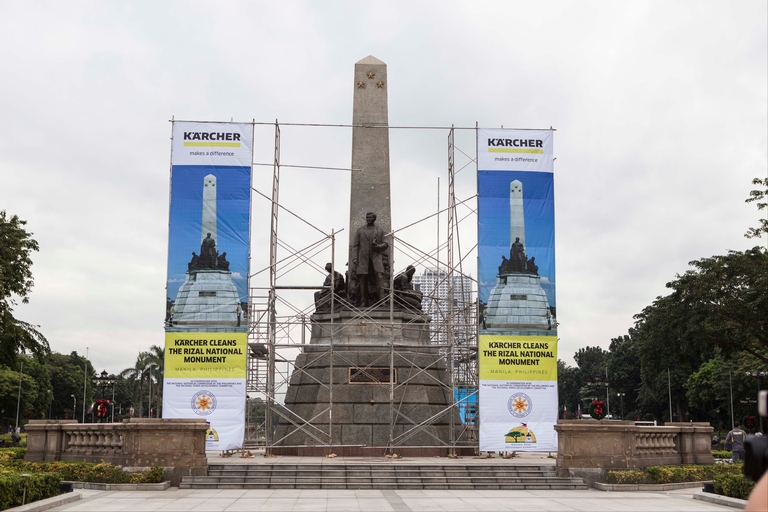
Manila (CNN Philippines Life) — Under the heat of the sun stands the Rizal Monument, a structure consisting of a bronze statue of Jose Rizal, an obelisk, and metallic stars coated with gold leaf. Designed by Swiss sculptor Richard Kissling in 1913, the monument’s base is made of granite, in which the national hero’s remains are placed.
In 2013, the monument was declared a National Cultural Treasure by the National Museum. Because of its political, cultural, and historical significance in the Philippines, Kärcher, a Germany-based manufacturer of cleaning technologies, handpicked the monument to be its first restorative project in the country.
“It’s our national monument and this actually represents our Filipino heritage,” says Zurich Fernandez, country manager of Kärcher in the Philippines, during the launch of the restoration project.
The initiative is part of the brand’s Kärcher Cleans The World clean-up project, where they employ their pressurised cleaning techniques in over 100 historic monuments across the globe, including Mount Rushmore in the U.S., Christ the Redeemer in Brazil, the London Eye in the U.K., and the Merlion in Singapore, among others. The company has been doing this initiative for 35 years now.


“It’s actually more of a project for us in contributing to the cultural preservation and we provide this one for free,” Fernandez adds. “We will also be donating the machine that we’ll be using to the National Parks Development Committee (NPDC), so that they can also use the machines in case they want to clean the monument by themselves.”
Fernandez also says that their collaboration with the NPDC and the National Historical Commission of the Philippines (NHCP) is crucial in making the project come intro fruition. Kärcher usually takes over a year to prepare and test for a restorative project, but Fernandez says that because of their close cooperation with the NHCP, they were able to fast track the process, as they only started planning to execute the Rizal Monument clean-up on May.
The NHCP does the cleaning of the monument twice a year: before Independence Day (June 12) and before Rizal Day (Dec. 30). “Mostly, surface cleaning lang and application of protective coating,” says Jim Kalaw, materials engineer of the NHCP. He says that they typically use a chemical called Varsol for the bronze structure and then use beeswax as protective coating. The obelisk of the monument has three metallic stars, and NHCP also coats these with gold leaf every four years.

“[Kärcher’s technique] is a new approach because we [do] mechanical and surface cleaning only, so medyo delicate ang ginagawa natin, saka brushing lang. Ngayon kasi more pressurized,” explains Kalaw.
For this clean-up, Kärcher is using a steam cleaning machine, which has a rubber handle, a long metallic stem, and a nozzle that emits high-pressure hot water and steam.
“The soiling here is just emission dirt from the cars and from industry, and biological growth like bacteria and fungi and algae, so steam cleaning is the best method,” says Thorsten Möwes, Kärcher’s specialist for cleaning and hygiene technology and restorative cleaning projects.
While the monument is only cleaned twice a year, Möwes says that upon testing, he can confirm that the NHCP has maintained the structure well. “The monument is in very good condition. It’s made of granite and granite is a solid stone, and I’m not facing any trouble with our machines, so we’re just supporting the good work that they have done in the past,” he says.
As NHCP has been cleaning the monument manually using only chemicals and brush, the use of this new machine would remove the visible dirt marks that manual cleaning could not. After the Rizal Monument cleaning, Kärcher is also testing the San Agustin church for its second project in the country.