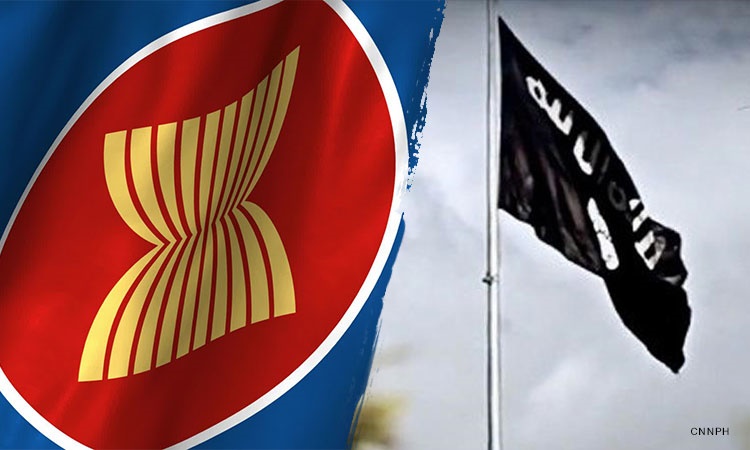

Metro Manila (CNN Philippines, August 3) — Further integration of security measures in the Association of Southeast Asian Nations (ASEAN) will help address the threat of ISIS in the region, a security expert said.
Amy Searight, senior adviser for the Washington-based Center of Strategic and International Studies said despite a drop in piracy incidents in the Sulu and Sulawesi Seas, transnational threats have increased with the presence of violent extremists and jihadists.
“These waters have long been a hotbed of piracy, kidnapping and other international crimes. But the threat posed to countries in the neighborhood has risen dramatically with the rise of ISIS-inspired terrorist groups in the region,” Searight said.
Last July, the Philippines and Indonesia launched coordinated maritime patrols in Celebes Sea as part of the June trilateral arrangement with Malaysia to combat piracy, terrorism, and the illegal drug trade.
This was made urgent after the attack of ISIS-inspired Maute group in Marawi City last May, which prompted President Rodrigo Duterte to declare martial law in Mindanao. Some of the rebel fighters were discovered to be foreign nationals.
“The presence of Malaysian, Indonesian and foreign fighters among Philippine rebels has underscored the very real danger posed by a situation like Marawi, which could serve as a foothold for ISIS that could seek to recruit aspiring jihadists in the region,” she said.
She clarified, however, that maritime patrols in the ASEAN region have been focused on each country’s territorial waters.
“The Sulu Sea patrols are coordinated, rather than joint patrols, with participating countries reluctant to relinquish sovereignty to allow partners to join patrols or engage in hot pursuit. Air patrols also being discussed but operational details remain somewhat sketchy,” she said.
Searight added efforts must include intelligence-sharing, law enforcement cooperation, and capacity building with Australia, United States, and other partner countries.
ASEAN should make stand on South China Sea
Searight added that ASEAN should make a stance on the South China Sea dispute, saying neutrality is not an option because a lot is at stake.
“Focusing on neutrality as a basic survival principle by ASEAN,” she said. “(It) may raise the diplomatic comfort level in the short-term but could seriously undermine ASEAN’s influence in the long run.”
Searight pointed out the South China Sea carries a third of world trade, worth USD $5 trillion each year. She also mentioned the maritime region’s oil and gas reserves, as well as fishing grounds were 1.77 million vessels operate – or half the global total.
She added the resolution of the maritime row would set the vision for what kind of community ASEAN wants to be.
“One governed by rules and norms that reflect ASEAN’s values and interests, one where rivalries are managed and contained, or one ruled where might makes right? Where every choice a country makes has to be vetted and approved by powerful neighbors or else subject to economic coercion and political retribution,” she said.
Former Foreign Affairs Secretary Albert del Rosario said ASEAN must maintain a principled neutrality, adding that the Hague ruling on the territorial dispute must be part of a “binding” Code of Conduct.
“ASEAN should stress that it is nobody’s backyard or exclusive preserve. Failure to do so would severely narrow ASEAN’s options make it over-dependent on a single player,” Del Rosario said.