
Metro Manila (CNN Philippines, July 13) — The Philippine military is looking into an ambassador’s claim that Turkish terrorists have entered the country.
Turkish Ambassador Esra Cankorur said individuals and organizations linked to the Fethullah Gulen terrorist organization or FETO have set up their network in the Philippines in the guise of educational, trade, and cultural groups.
“They try to portray FETO as a civic educational movement, for charity and interfaith dialogue. They are present in more than 150 countries through their foundations, organizations, with a benign façade. You have them in the Philippines also,” says Cankorur.
The Turkish government blames FETO for the October 2016 coup attempt in Turkey that killed 250 and injured more than 2,000.
But the group’s leader Fethullah Gulen, who lives in exile in the United States, has repeatedly denied this.
“This group as I said is a dark, secretive, sinister, group and they have a very Machiavellist approach to many things. So if deemed necessary they would cooperate with any sinister organization. It could also be ISIS,” Cankorur said.
Cankorur identified FETO’s affiliate groups in the Philippines as two branches of the Fountain International School in San Juan, Metro Manila, the Filipino-Turkish Tolerance School in Zamboanga City, the Turkish-Filipino Chamber of Commerce, and the Pacific Dialogue Foundation.
Cankorur says last year’s coup shows what the group is capable of, which is why they are issuing a warning to Filipinos who unknowingly may be involved with Turkish groups, affiliated with FETO.
“They are capable of doing anything inside and outside of Turkey. One should wonder what were they doing here as early as 1997, opening a school in Zamboanga,” Cankorur said.
Armed Forces of the Philippines B/Gen. Restituto Padilla told CNN Philippines on Thursday he was surprised to hear Cankorur’s claim, but he has ordered an investigation.
“I’ve initiated inquiry with our responsible offices from the intelligence side to look into this. I gathered there were initial information already but they could not ascertain if this was true or not. So the process is still ongoing and we have yet to ascertain whether the basis for the Turkish Ambassador’s remarks really are firm and can be trusted,” Padilla said.
He said they are also looking into the history of the Fetullah Gulen Movement.
“We need to find out and see if this group the Turkish Ambassador was talking about has been existing for a long time or not. This may have been just a new group,” he said.
Presidential Spokesperson Ernesto Abella said the government will probe organizations supporting terrorism.
“We will investigate organizations abetting or aiding terrorism and will hold them accountable, especially those that may be working as fronts for terrorist and criminal activities, as alleged by the Ambassador,” Abella said in a statement.
Meanwhile, Foreign Affairs Secretary Alan Peter Cayetano acknowledged the Ambassador Cankorur’s claims, and said they are “doing their own vetting and investigation.”
“I have assured her (Cankorur) even when I was still a senator then when I took over DFA as Secetary that we will look at the informations given us in fact we have asked many countries for information sharing, (and) intelligence sharing,” Cayetano said.
Fethullah Gulen is a reclusive cleric accused by Turkey of hatching a military coup attempt. Turkish President Recep Tayyip Erdogan has pointed the finger of blame for the failed uprising last July 2016 squarely at Gulen.
A rival of the embattled President, Gulen is the leader of a popular movement called Hizmet, but the Turkish government refers to his group as the “Fethullah Gulen Terrorist Organization.”
“We consider Fethullah Gulen as a terrorist organization and any organization or persons linked or affiliated to that group is like sleeping cells,” Cankour said.
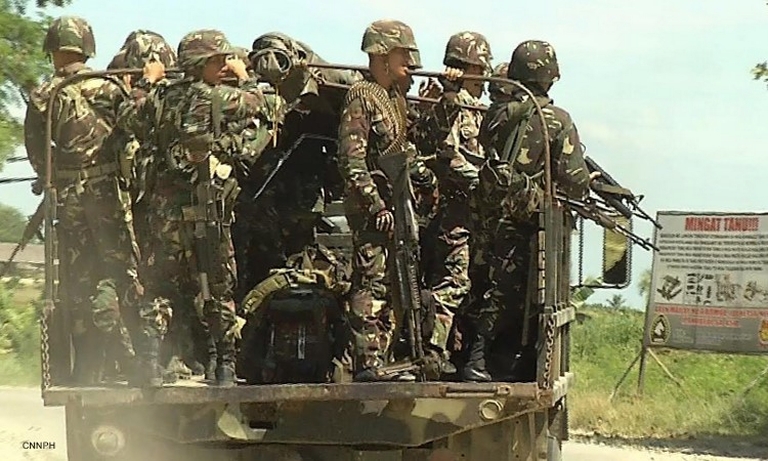
In June, the military said 40 foreign terrorists, composed of Indonesians, Malaysians, Saudi Arabians, Pakistanis, and Yemenis, are in the country. Several of them are fighting alongside ISIS-linked Maute group in the ongoing Marawi crisis.
Martial law spokesperson for Eastern Mindanao Brig. Gen. Gilbert Gapay added authorities are not discounting the possibility the terrorists have entered the country through airports and seaports, which is why there is a need to enhance the security of the country’s southern backdoor because “it’s very porous.”
The Armed Forces Chief-Of-Staff also raised the possibility of ISIS fighters heading to the Philippines.
“We expect na ‘yung mga madi-displace doon (sa Mosul), pupunta ng Asia. And because of the Marawi crisis, parang magnet itong Pilipinas. Yun ‘yung babantayan natin,” he said.
[Translation: We expect those displaced in Mosul will go to Asia. And because of the Marawi crisis, (terrorists) would be magnetized to the Philippines. That’s what we’re looking out for.]
Immigration officials are stepping up efforts to ward off foreign terrorists entering the country using backdoor routes.
CNN Philippines’ digital producers Lara Tan, Chad de Guzman, and senior correspondent Ruth Cabal contributed to this report.