
Metro Manila (CNN Philippines, July 6) — “Never again should we fall victim to a false narrative that a vague declaration of martial law is good for us no matter the circumstances.”
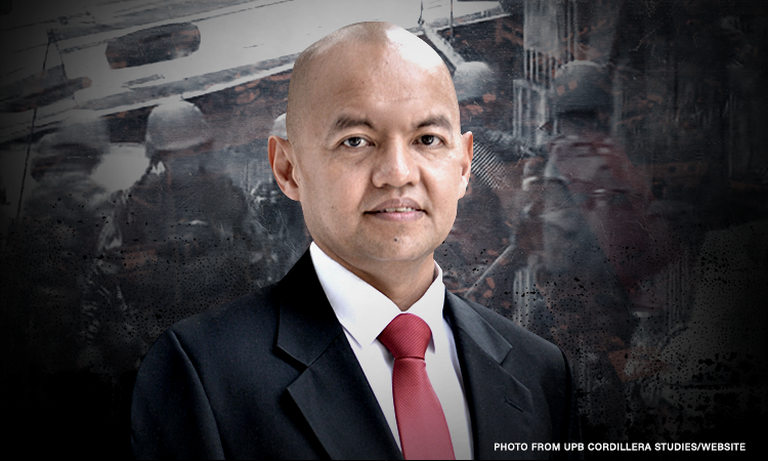
Associate Justice Marvic Leonen, in his dissenting opinion obtained by CNN Philippines on Wednesday, said Filipinos should resist the “farce” that implementing military rule is necessary.
Leonen was the lone justice who voted against the constitutionality of President Rodrigo Duterte’s declaration of martial law in Mindanao.
“History teaches us that to rely on the iron fist of an authoritarian backed up by the police and the military to solve our deep-seated social problems that spawn terrorism is fallacy,” he said.
Related: Supreme Court upholds martial law in Mindanao
It was the high court’s duty to ensure that the specter of martial law never resurfaces.
“The ghost of Marcos’ martial law lives within the words of our Constitution and rightly so. That ghost must be exorcised with passion by this Court whenever its resemblance reappears,” the justice added.
Leonen, an appointee of former President Benigno Aquino Jr., emphasized the cry of anti-Marcos protesters — “Never Again” — against the late strongman’s 20 years in office.
“Never again should this court allow itself to step aside when the powerful invoke vague powers that feed on fear but could potentially undermine our most cherished rights… We should have the courage to never again clothe / authoritarianism in any disguise with the mantle of constitutionality,” Leonen said.
Marcos’ nine-year military rule was rife with thousands of human rights abuses, including extrajudicial killing and torture. The Commission on Human Rights has recorded over 20,000 complaints of human rights abuses under the Marcos regime.
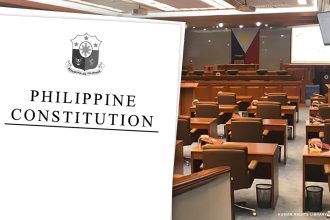
Thus the 1987 Constitution, created after the overthrow of the Marcos dictatorship, instituted safeguards such as a review by Congress of a President’s declaration of martial law and a 60-day limit on its imposition.

Martial law in Mindanao and the suspension of the writ of habeas corpus was declared by Duterte via Proclamation No. 216 on May 23 following the clash in Marawi City between government troops and local terror group Maute. The fighting continues into its 45th day with government taking control of most of Marawi City despite a protracted battle with dozens of Maute gunmen.
Eleven Supreme Court Justices on July 4 voted to junk the three consolidated petitions, three others voted to partially uphold the proclamation within a limited area of coverage, while Leonen was the only one who was in favor to grant the petition to lift martial law for lack of factual basis. At least eight votes were needed to nullify the martial law declaration.
Related: How Supreme Court Justices voted on martial law in Mindanao
Marawi crisis is terrorism, not rebellion
In the three hearings on oral arguments held by the Supreme Court in June, petitioners who sought the Supreme Court’s dismissal of Proclamation No. 216, insisted there is no actual rebellion happening in Marawi City.
Leonen said he cannot accept his fellow justices’ categorization that the Marawi crisis is an act of rebellion, he rather sees it as an act of terrorism.
“The military can quell the violence… Martial law is not the constitutionally allowed solution to terrorism,” he said.
He sees the Maute group as terrorists, not rebels, within the constitutional meaning of the terms.
“The difference between terrorists and rebels boils down to their intention. Terrorists use fear and violence to advance their agenda or ideology, which may or may not be political in nature. While rebels use violence as a form of strategy to obtain their goal of destabilizing or overthrowing the government in order to gain control over a part of or the entire national territory,” he said.
Vague and unconstitutional
Leonen argued that Proclamation No. 216 was vague, making it unconstitutional because it “expands with every new issuance from its administrators.”
He cited the Operational Directive for the Implementation of Martial Law issued by the Armed Forces of the Philippines, which orders the soldiers to “dismantle the NPA (New People’s Army), other terror-linked private armed groups, illegal drug syndicates, peace spoilers, and other lawless armed groups.”
“The factual basis for the declaration of martial law, as presented, do not cover these illegal acts as rationale for its proclamation. They are not acts falling within ‘rebellion’ and cannot serve as justification for arrests but are made possible because of a vague and overly broad Proclamation,” he said.
The petitioners can file a motion for reconsideration for the Supreme Court to decide with finality on the issue.
Below is the full dissenting opinion of Associate Justice Leonen:
CNN Philippines’ Anjo Alimario contributed to this report.