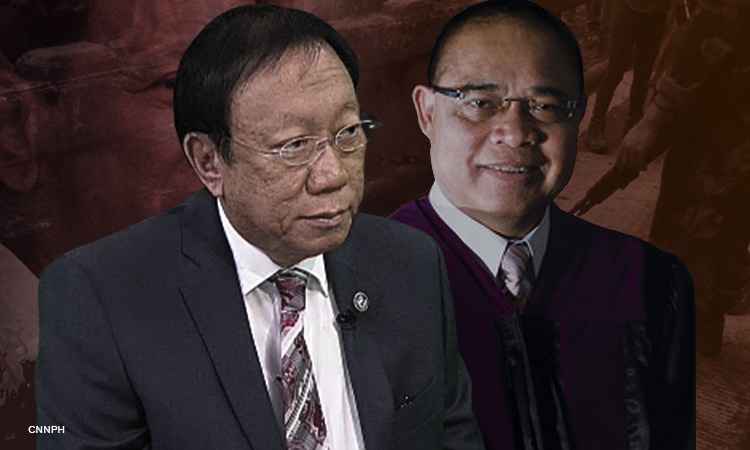

Metro Manila (CNN Philippines, June 14) — Solicitor General Jose Calida on Wednesday explained the justification for declaring martial law in the whole of Mindanao when a Supreme Court Justice expressed concern over the possibility of a nationwide military rule.
Calida, who defended President Rodrigo Duterte’s martial law proclamation during the second day of oral arguments, was asked by Supreme Court Associate Justice Mariano Del Castillo why martial law was declared in the entire region of Mindanao.
Del Castillo questioned why martial law should not be confined only in Marawi, where there is a firefight between government troops and terror group Maute.
“What we’re worried (about) is it might embolden the President to later on also include Manila, Visayas, then Luzon, then the entire Philippines. There’s this concern also. Why the entire Mindanao?” Del Castillo said.
Duterte, on May 24, said there’s a possibility of declaring a nationwide martial law because lawless elements could easily move from one region to another considering the geography of the Philippines.
Calida said martial law was declared in the south on May 23 via Proclamation 216 due to the rebellion by terror groups led by the Islamic State (ISIS) and the Abu Sayyaf, and not only because of the crisis in Marawi.
“When he (Duterte) saw the gravity of the rebellion, he had to act decisively and swiftly therefore he chose the martial law tool to save Marawi from total capture by the rebels,” Calida said.
ISIS flag as evidence
The Solicitor General brought an ISIS flag recovered by scout rangers in Marawi City as part of his evidence in support of declaring martial law.
But Associate Justice Marvic Leonen pointed out that the flag was also being used by other rebel groups, so it did not automatically link the group to ISIS.
Calida added four ISIS-linked groups, namely the Abu Sayyaf Group, Ansarul Khilafah Philippines, Maute Group, and the Bangsamoro Islamic Freedom Fighters (BIFF), were trying to set up a caliphate or an Islamic state in Mindanao, starting with Marawi City. He said the Marawi crisis is not an isolated incident, but a part of a bigger plot to establish ISIS in the country.
He said Marawi City is considered as the capital of Islam and is located at the heart of Mindanao.
The Solicitor General also allayed fears that Duterte’s martial law will have the same effect on Filipinos, as that during the time of President Ferdinand Marcos. The Commission on Human Rights has recorded over 20,000 cases of human rights violations during Marcos’ martial rule.
“President Duterte’s martial law is markedly different than that of President Marcos,” Calida argued.
Calida said there is sufficient factual basis for the declaration of martial law in Mindanao.
“All elements of rebellion were present. There is actual rebellion (on) the streets of Marawi….The goal is to take over the Philippine territory,” he said.
Failure of intelligence
Calida bared the ISIS-inspired local rebel group had intended to burn down the entire Marawi City on the day of Ramadan, May 26.
“The grand plan of Maute to take over Marawi and the rest of Mindanao was preempted due to the declaration of martial law in the region,” he said.
He said when the military got wind that Abu Sayyaf-Basilan leader Isnilon Hapilon was in Marawi City, the military and police officers were sent out to arrest the leader.
But Associate Justice del Castillo pointed out a failure of intelligence on the military’s side, as the Maute was “well-prepared” in the Marawi attack.
Government forces arrived in Marawi City on May 23 to serve a warrant of arrest on Hapilon, who was believed to be in the city. Maute members seized a hospital and key buildings in the city and took civilian hostages.
The Supreme Court also ordered martial law administrator and implementor Delfin Lorenzana and Gen. Eduardo Año to appear in Thursday’s oral arguments.
The Supreme Court will hear the three consolidated petitions until June 15.
CNN Philippines’ Correspondent Anjo Alimario contributed to this report.