


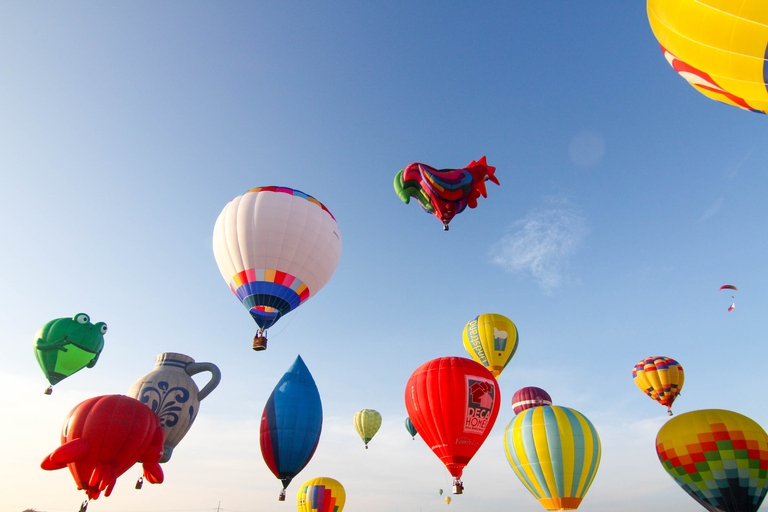
Manila (CNN Philippines Life) — Like any other vehicle, hot air balloons run on gas. But the hot air balloon is probably the happy-go-luckiest of them all — like a kite, it goes with the wind.
“When hot air balloons fly, they don’t really navigate, they just go where the wind blows,” explains Rambo Nuñez Ortega, the president of Forthinker Inc., the organizing group of the 2017 Lubao International Balloon and Music Festival. “What the pilots do is just either go up or go down, by blowing up the hot air.”
Hot air balloon pilots are early birds. On the first day of the festival, the participating balloonists were already setting up at 5 a.m., preparing their gas chambers, and laying their deflated balloons on the wide grasslands of Pradera Verde. Dawn is the best time for hot air balloon flights, since winds are lighter and cooler, and therefore easier to navigate through.
In Pampanga, open lands are wide and wind patterns are somewhat unique, according to balloon pilots. It’s the perfect place to fly a hot air balloon. The first balloon festival in the country was held in 1994 in Clark, a few years before the development of an international airport in the area. At the time, Pampanga was filled with three-year-old lahar and pyroplastic material from the eruption of Mt. Pinatubo. According to the festival organizers, which included the Department of Tourism (DOT), there needed to be something to regain and boost the morale of the communities of Central Luzon, then traumatized and covered with ashes. And they found it in the bright colors and charming shapes of the hot air balloon.


“The first balloon festival in Clark had 18 balloons. And then it was a hit, so we organized another one, and the rest is history,” narrates Noel Castro, the chairman of the Lubao International Balloon Festival Inc. (LIBF), the company that heads the festival.
When Clark started to house a more developed international airport and could no longer accommodate balloons, Castro and his team organized their own festival in Pradera Verde in 2013 in Lubao, a no-fly zone, safe from aircraft hazard. Besides the wide chunk of land that had more than enough space for balloons of various sizes, Lubao also had what pilots call a “box wind.”
“The pilots are always looking for box wind because you fly from one area, go this way and that way, [in different directions], and later on they will come back [to the same spot],” says Castro.
Capt. Jonathan Dyer, who brought his balloon from Great Britain, has flown in the Philippines for nine times now, and says, “This is my favorite country in the world to fly in.”
“The reason I come here is because this is one of the best places to fly,” says Dyer. “It’s unusual because we are so close to water. And normally, you wouldn’t go near a place where there’s water, [because] we can’t land in water. But as you go up higher [as the wind travels out towards the water], the wind bends to the [opposite direction, which] means you can fly in a box. It means you can go forward, come up, and almost land where you took off. Now, that’s very unusual. But it’s fantastic, and that’s why I love flying here. See the beautiful rice paddies, see the people, see the oxen.”


“It’s not everywhere that you find that kind of wind. And an open space, a venue that could accommodate a festival as big as this,” adds Ortega. But it’s not always a case of the box wind; sometimes, the balloons land on the other side of the field, but Ortega says that they’ve experienced the wind pattern a couple of times during the four years they’ve been organizing the festival. Every year, the pilots chase the box wind.
This year’s festival in Lubao has 37 participating balloon pilots from all over the world. (Castro says that this beats Thailand’s balloon festival record of 34 balloons.) “In terms of scale and the number of hot air balloons, we are actually the biggest hot air balloon festival in Southeast Asia,” says Ortega.
Besides this, the 2017 edition of the Lubao festival has grown bigger in terms of its addition of international music acts for the first time in its run. The festival’s last day featured live performances from Alex Aiono and LMFAO’s Redfoo. Ortega says, “This year is very monumental because we are making it an international balloon and music festival.”
The Lubao festival was the Philippines’ turn in enriching the global balloon community. “It became an initiative to go to other balloon festivals in Asia. Lubao has its own balloon,” explains Ortega. “We’ve gone to Japan, Malaysia, Thailand … It’s a ballooning community, so the more you get exposed, you become friends. You get to be invited [to other festivals], and then you get to invite them.”


Behind it all is a communal effort to promote Pampanga, and eventually, the country. “From my perspective,” says Dyer, “I’ve spent a lot of money here. I think the balloon festival highlights how great the Philippines is, and also encourages people to spend their money here … I only ever came to the Philippines because of the balloon festival. I wouldn’t have known what a great country it is.”
The balloon festival teaches us that when it comes to tourism, events that genuinely highlight the uniqueness of a certain place should be prioritized. Ortega discusses with the DOT: “In every place, if you want to promote tourism, you need an event that will generate tourists, because it will help you expose other tourist destinations in an area. What we do here is, we have an event, but we also give information on where else they can go in Lubao, the nearby hotels … The intention is not just to gain tourists for the event, it’s to gain tourists the whole year … ”
Ortega mentions that there are “places that got positive benefits from the event. There are places that have expanded. Because of the festival, people discovered the place.” The festival is a way for the Pampanga locals’ businesses to earn, with food stalls and entertainment booths installed to complement the festivities.

“The reason why we are doing this is because we want to promote Pampanga,” says Castro. “Another reason why we took over from the organizers of Clark in 2013, we didn’t want it to die down. There was a rumor that they were going to transfer the balloon festival from Clark to Cebu. Ballooning was introduced in Pampanga, we wanted it to stay in Pampanga. ‘Yung pinu-push namin is that Pampanga will be the balloon capital of the Philippines. That is what we are aiming at, na palakihin namin ito, and when they say Pampanga, you think of hot air balloon.”