
Manila (CNN Philippines Life) — Eisa Jocson doesn’t like being boxed in. Despite having a long and established career in performing arts, she slipped into mainstream consciousness last year by starring in Peaches’ music video for “How You Like My Cut.” In the video, Jocson recreates portions of her 2013 piece, “Macho Dancer,” which is an exploration of the male club culture in the Philippines. The piece was a response and a conscious departure from the success of her previous work called the “Death of the Pole Dancer” (2011) which was a study on the concepts of “voyeurism and restrain, vulnerability and violence, sexuality and power.”
The Tokyo Performing Arts Meeting (TPAM) in Yokohama was the platform for the sold-out Japan premiere of “Host” — which was also presented as part of the Yokohama Dance Collection 2017 — Jocson’s piece that takes the audience into the lives of Filipina entertainers (Japayukis) hired to perform in the red light districts of Japan. It completes her trilogy of works that tackle the central theme of the Filipino body in the service industry.
“This is an experience that is quite close to that,” Jocson says, “but somehow it exists on a different level.” That experience has been one of the more controversial shows during the performance art week — its first show caused a debate to erupt in a bar where all the artists, producers, and directors went to network after the shows of the day. The reactions varied from amazement, to boredom, to outrage, to confusion. Walking out of the theater, I overheard one man telling the producer that he “didn’t quite get the joke.”
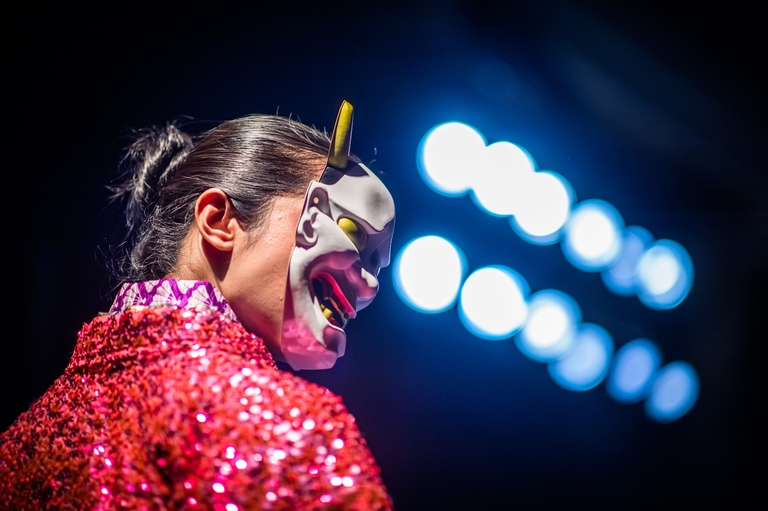
The audience walks into the theater to find Jocson waiting for them on stage like a good host. She stands very still as the audience piles in, hiding under an umbrella wearing a traditional Japanese kimono. She then goes into the performance of a traditional Japanese dance, stripping off layers of her clothing until a wall of red lights comes on. A Beyonce song starts playing, and Jocson goes into a confident chair dancing routine with movements she learned from the Sexbomb Dancers themselves.
The true highlight of the performance is when Jocson lets go of the recreation of the images and creates movements of her own — an exploration of her body and its limits, stripped of all the costumes, lights and music. Throughout the performance, you get the sense Jocson is in total control, like she has the audience eating off the palm of her hand. And just when you feel like you’re getting to know who she really is, like you’re about to share something intimate, she puts her sparkly dress back on and ends the show with a robotic performance of the hit and karaoke favorite, “Nobody But You.”
CNN Philippines Life sat with Jocson to talk about how she got started as a performing artist, the different audience reactions to her work, and her Peaches collaboration. Below are edited excerpts from the interview.

Can you tell us a bit about how you got into pole dancing and performing arts in general? How did you get into this line of work?
It definitely started as a hobby. Somehow my ballet background fit into it because it demanded a certain level of grace, but at the same time, it was challenging in the sense that it was quite athletic and acrobatic and pushes the boundaries on what your body can do. That was an interesting point, but at the same time, it was the community of women practicing it. I was the youngest in the class, and what was interesting was that my classmates were all women with a certain level of maturity. I got into it because my aunt invited me. So it was through her that I encountered pole dancing.
Pole dancing got me into this line of work. My background is in visual arts. I took it more as a focus in high school [Philippine High School for the Arts] and university in UP. Since I had a ballet background for a long time, there was an urge to perform at some point. But ballet was too singular and other dance forms were just not somehow interesting for me.
What was interesting is that I was experiencing pole dancing in a new social context, which was in a fitness studio and having my own kind of relation to the practice which is very different from inside the club. What has changed are the social and economic functions. In the pole dancing club, you’d have women getting paid for pole dancing or entertaining men. In the fitness studio, it’s the women paying to learn how to pole dance primary for themselves.
This shift in socio-economic function is obvious for me but not for people outside the situation. This was the friction that became kind of the fuel to bring this into an artistic discourse.
How do you go about choosing the character or people that you portray in your performances?
The choices of subject is immediate, meaning it’s around me or it’s something that concerns me, or something that comes from a personal motivation. So for example, the shift from pole to macho was specifically because of the fact that I was getting known as a pole dancing artist and I didn’t want to be categorized or boxed into a certain subject because this is exactly what I was trying to unpack and somehow it was packing me in. I’m more concerned about perception and the malleability of the body and how it shifts from one thing to another thing depending on the conditions surrounding it. This kind of statement or discourse came out of a long practice of works. It comes from the experience of shifting from one subject to another, which demands a certain level of embodiment.
Tell us about “Host.”
With “Host,” the beginning question was, what was the relationship between Philippines and Japan? It just so happened the issue of Filipino entertainers is quite present. Somehow that intrigued me, somehow the Japayukis, I mean “Japayuki” is a stigmatized term, but it’s quite interesting because they’re basically mediators, they become a gateway between these two places, and we don’t acknowledge it from that perspective. There’s a lot of different angles to it and not just one thing.
I try to focus on the fact that they are cultural repositories between these two places, which is not easy to define because it kind of exists in a sexual, sensual economy so that it is something that is hidden or tries to be ignored. But actually there’s something inherently precious, and we don’t acknowledge it.

What is it like performing “Host” in Japan as a complete work? Does it feel different performing it in the context where the piece takes place?
I think it’s really intense. It doesn’t take sides actually, this piece. It kind of unravels things, and it’s up to the audience how they will position themselves [in response] to what they’re seeing. It’s not exactly a statement, it doesn’t direct you. It provides an experience, a very direct experience, and based on that you conclude what you want to conclude based on how you experienced it. As opposed to giving a bigger statement on the issue, it’s putting the audience inside the issue.
You perform a lot of different dances throughout the duration of “Host,” how did you go about embodying each one?
So there are four different vocabularies inside. I have a spectrum of movement that goes in and out. I don’t make a difference from performing high tradition Japanese dance to Sexbomb dancing. I treat both materials seriously. It has to be performed well. The form has to speak for itself. Because inherently the form was made under those conditions. You can sense where the form comes from and that’s where you as an audience can establish a relation to what you’re seeing.
“Host” has toured many different places, including the Philippines. How has the reception differed between home and abroad?
It’s interesting because with the Western audience, there’s much more an issue of exploitation. With the Philippine audience, that’s not the case. With the Japanese audience, it’s a different discussion altogether, because it’s cultural appropriation and being uncomfortable with the fact that a Filipina is [dancing traditional dance]. It really depends on how they want to see it.
In your talk the other day, you mentioned that places are an important part of work creations. How do you think having all these residencies away from home affect your work? Is it a conscious decision to accomplish a part of the process back in the Philippines?
More than consciously, it’s more practical. Practical in the sense that there’s more support outside. They give you time and space and financial stability to actually work on the subject. Because there’s just no support, for example, for research, for a longer period of time. It just doesn’t exist in Manila or the Philippines as a system. I mean, you have pockets here and there, but as a kind of a continuing platform for makers, it doesn’t exist. So I guess it’s conscious in terms of a practical tool for creation. You have to find the funding and the funding is outside. It definitely affects the outcome of the work in terms of sensibilities and in terms of changing. If I make work in the Philippines, what is available will be how I will structure the work. If what is available is the living room, then it’s gonna be performed in the living room.
Do you feel a certain amount of pressure to represent women in a positive way given that there are very few Filipina artists who talk about the female body in their works?
What I’m interested in is the perception between what is being presented and how you receive it. It’s not my intention to show the female body as a powerful body. I don’t think that has ever been a goal. But I think, for me, it’s more of escaping definitions. I really don’t like it when people say “you can’t do this,” “you can’t do that.” “You look a certain way so you must be like this.” In a way, the embodiment of these different forms is kind of like a statement towards that or an active doing against this mode of boxing in. I believe that people are quite malleable, the human body is malleable. To ascribe certain assumptions, and judgments and perceptions, it limits the body. That’s what my work is about.
You cannot judge because you don’t know the actual conditions — social, cultural, economic, and historical formation of this body. You can only sense it from your context. In a way, this is what I’m doing with the work. I’m confronting people with their own perception of what they think they are looking at to a certain extreme sometimes. I can only push it.
What was it like to work with Peaches? How did that collaboration come about?
I’m a Peaches fan. We were at the same festival, and we were both going to Berlin, and we took the same train. This was a good one hour of having to calm my inner fangirl so I can actually have a proper conversation with Peaches. This train trip kind of normalized my being towards her, and somehow, we discussed the collaboration, and we did the video while I was performing “Host” in Berlin.
What can we expect next from you?
I just premiered “Princesses” which is a duet with Russ Ligtas. We premiered it in Frankfurt last weekend and it’s going to tour in the fall and hopefully in Manila soon. I’m not sure when but it has to go back at some point.
***
The member organizations of the Performing Arts Meeting in Yokohama (TPAM) 2017 Executive Committee are The Japan Foundation Asia Center, Kanagawa Arts Foundation, Yokohama Arts Foundation, and PARC – Japan Center, Pacific Basin Arts Communication. For more details about “Host,” check TPAM’s website.