
Manila (CNN Philippines Life) — New York in the mid-to-late ‘70s was gritty, jaded, and broke. A crippling recession that hit war-changed America during the Ford administration caused many symptoms of trauma in the city, among which were low rents, soaring crime rates, and therefore, an influx of transgressive artists. From all the destruction, the avant-garde lovechild of ‘60s New York ideals, the No Wave movement was born.
James Nares was in the middle of it all. Born in London, he moved to New York in 1974, when the world turned its attention to his town of origin as the British punk movement was brewing. He moved away from it, and made experiments in film and painting. Standing alongside the likes of Jim Jarmusch, Nares contributed to No Wave cinema, most notably with his “dark comedy” called “Rome 78,” a Super-8 film about Roman characters set in downtown Manhattan. Nares made many more experimental films, and went on to gain recognition from the Anthology Film Archives. He also pursued painting, where he became known for his single brush stroke pieces, which are now housed by the Paul Kasmin Gallery.
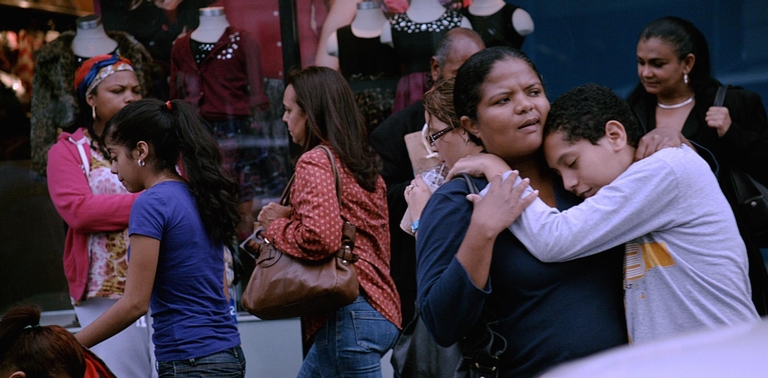
Nares’ latest film, “Street,” is an ode to his city, in the same way that all works of No Wave were odes to New York. But New York today is different. The film was shot around the tenth anniversary of 9/11, and clocks in at 61 minutes, showing the streets of Manhattan in slow motion. Shot with an HD Phantom Flex high-speed camera and recorded at 780 frames per second while mounted on an SUV driving at 30 to 40 miles per hour, “Street” shows people “frozen in time,” as Nares put it.
The film also stems from Nares’ fascination for actuality films, raw documentary footage pioneered by the Lumière Brothers and continued in offshoots by the likes of Andy Warhol, with his screen tests and other films. Nares’ approach is reflective of Warhol’s: “I’ve always liked to stand back with my camera, let things happen, in a long single take,” he says.

With scenes like a man furrowing his brow upon tying his shoelaces, a cigarette butt gliding through the air, a pigeon flying low, and a fly hovering past, “Street” shows the gravity and beauty of the mundane. Nares describes the film as showing “moments between moments.” He says, “It’s like you can see people’s thoughts.” In real time, the footage would only last two minutes.
The film is silent, with music scored by Nares’ longtime friend from the No Wave era, Thurston Moore of the noise rock band Sonic Youth. His sprawling, almost dissonant 12-string acoustic guitar accompaniment gives a certain tension to the film, giving a slow electric shock to people’s facial expressions as they turn their eyes toward the camera.
More than a time capsule of recent New York, “Street” is an evidence of our humanity, captured in the tiniest of gestures. It’s a testament to how fast our lives move — and it could only be apt that it was filmed in New York, arguably the fastest city in the world — and that despite a modern and gentrified New York, a beautiful chaos remains.
In line with the Manila premiere of the film, Nares talks about the making of “Street,” his fascination with the mundane, and the difference between him and Warhol. Below are edited excerpts from the interview.

How hard was it to condense 16 hours of raw footage into a one-hour film? How did you choose which moments to put in and which moments to take out?
The first thing is, half of that was [cut]. I didn’t look at the footage everyday, but when I got it back, I realized that when I had the lens zoomed out all the way, it went out of focus for a bit. So half of the footage was unusable, so I was reduced to 8 hours really. The [editing] decisions were like a process of reduction, and what I wanted was something happening, that was wonderful, and something … I wasn’t looking for anything in particular, but just a moment that really makes you wanna see it again. Something not high drama. I wasn’t looking for high drama, because there’s enough drama just in the way people look at each other, the way they turn their heads. That’s what I was looking for. So I just cut it down, cut it down, and cut it down again … Sometimes, there were beautiful shots, but they just didn’t fit in the film anywhere. I just couldn’t get it in.
How did your earlier Super-8 films and paintings influence “Street?” Do you think “Street” is a big jump from your earlier, grittier works?
I think it’s all connected. There are several threads that kind of weave all these things together. I’ve always used movie cameras and video cameras for one reason or another. It’s just been a part of my life since I was 17 years old. I think the first film I ever shot, well it wasn’t that good. But there’s something that connects.
The music sounds improvised and a bit dissonant in contrast to the consistency of the film in terms of speed especially. Sounds almost as if Thurston was playing an improvised guitar piece for a whole hour there.
What he did was, he gave me an album he made of solo 12-string acoustic. I told him how much I loved it, and I asked if he could do something [for the film] also with the 12-string, but with a kind of lolloping rhythm. Something as if you were riding a cowboy or something. That’s the only way I can think of it. You know how there are some songs that when you’re driving, they just kinda go, like they have a driving rhythm. I wanted something that’s relaxed, but has a driving rhythm. [Thurston] got it. He’s done live shows with the film. He doesn’t do the soundtrack, he just plays with the film.

You mentioned that artists eventually reduce their work to what is most important to them, like in the case of your paintings, the brush stroke. So with “Street,” do you place importance in people-watching, or rather, the mundane in general?
I think I was specifically thinking about my paintings when I said that. But it’s also true in relationship to the films as well … I’ve made so many different kinds of films. I’ve made a film of Roman costume drama in the streets of New York, with Roman outfits and stuff, in 1978. It’s kind of a great film. It’s kind of a comedy really, a dark comedy. I made a film about an IRA bomber … I did a retrospective a few years ago. I showed 35 films for seven days at the Anthology Film Archives in New York. That was the film that I got most out of watching. I’ve done many different kinds of films, but I tried to just show a few films that would be more easily relatable to “Street.”
I asked that because you also mentioned your interest for Andy Warhol and his almost voyeuristic approach in just letting the camera run without interfering with the subject. He has this fascination for the mundane.
I like the mundane too. Really, from most early films where they just let the camera run, nobody really did that until Andy Warhol did it again. But I think the difference between Andy and me, would be, he likes making people feel uncomfortable. He would say, “Okay, sit down there, I’m turning the camera on … Okay, see ya!” and walk out the room. He’s just gonna go and leave them [his subjects] groaning.
Right, the “Screen Tests.”
Yeah. They’re a bit mean sometimes. If you weren’t a strong personality, it could [go bad for you] … There was one girl who just breaks into tears. There’s a great book that has all of them categorized. And there are people whom you never knew did a Screen Test.

It’s both very appropriate and also a bit funny and ironic how “Street” is being screened here at Ayala Triangle on the street where people pass by, and there are some who don’t even look at the screen.
I know! How could you miss that?!
What’s the greatest thing you’ve learned from watching people?
I guess just what an incredibly varied race we are. The human race has so many different types, and then subtypes within the types, and we’re all the same. One of the things I love about “Street” is that there’s so many different kinds of people — ages, nationalities, color, sexes, genders, everything … There’s just so many people and yet you can identify with any one of them. And I find that very reassuring. There’s hope for us there.
“Street” is screening at the Ayala Triangle Gardens daily from noon to 2 p.m., and 5 p.m. to 9 p.m. until Feb. 19, as part of Art Fair Philippines 2017.