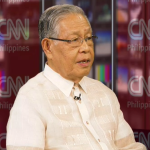
Metro Manila (CNN Philippines) — Judges can make mistakes and the innocent may be wrongly convicted, therefore the death penalty should not be restored, a former chief justice said Monday.
When asked what his thoughts were on innocent people being convicted, former Chief Justice Hilario Davide, Jr. said, “That could happen many times.”
“That is precisely one of things we must consider,” Davide told CNN Philippines’ The Source. “There is no guarantee that the one convicted is really guilty,” he added.
“There are instances of innocent people being convicted simply because [first], they cannot get a very good lawyer,” said Davide. “Because of extreme poverty, they would just practically leave everything to God.”
The reinstatement of the death penalty is being debated at the House of Representatives and the Senate after President Rodrigo Duterte championed the measure.
Duterte refers to capital punishment as a form of “retribution” in response to critics who say that it fails to act as a deterrent to crime.
“Hindi iyan to deter [It is not to deter (crime)]. Whether you like to commit a crime or not, that’s not my business,” Duterte said last year. “Iyong death penalty to me is the retribution. Magbayad ka sa ginawa mo sa buhay na ito.”
However, Davide said the Philippines has since “abandoned the philosophy of retribution” and now abides by “the principle of rehabilitation or reformation.”
He added that the policy also punishes the families of those who are accused, particularly children who must carry the stigma of having death row parents.
“Kill one, the entire family will be suffering a lot,” said Davide. “One of the effects would be to punish people who are not really the accused or the convicts.”
Davide served as Chief Justice from 1998 to 2005. He is also one of the 48 framers of the 1987 Constitution.
Constitutional leeway
Under the Bill of Rights in Section 3 of the Constitution, Article 19 stipulates that: “Excessive fines shall not be imposed, nor cruel, degrading or inhuman punishment inflicted. Neither shall death penalty be imposed, unless, for compelling reasons involving heinous crimes, the Congress hereafter provides for it. Any death penalty already imposed shall be reduced to reclusion perpetua.”
Proponents of the reinstatement of capital punishment are citing this provision in the bill to invoke their right to reinstate the policy as a means to curb heinous crimes.
Related: Death penalty debates to begin – House Majority Leader
Davide, a staunch critic of death penalty, said Section 3, Article 19 was a compromise among the 48 commissioners who framed the 1987 constitution, including himself
He added that beyond the Constitution, international agreements prevent the Philippines from resorting to capital punishment again.
“So while under the text of the Constitution, it may be [reinstated], because of our international obligations, we must not,” said Davide.
International agreements
Davide enumerated the international agreements which may prevent the Philippines from reinstating capital punishment.
He listed the United Nations charter, the Universal Declaration of Human Rights, and the International Covenant on Civil and Political Rights (ICCPR) and its Second Optional Protocol.
These documents enumerate and place a premium on fundamental human rights, including the right to life. Davide believes these take precedence over provisions in the Philippine constitution.
The ICCPR contained customized provisions for countries that have not yet abolished the death penalty. But its Second Optional Protocol, adopted in 1989, expressed an “international commitment to abolish the death penalty.”
Article 1 required that “no one within the jurisdiction of a State Party to the present Protocol shall be executed” and “each State Party shall take all necessary measures to abolish the death penalty within its jurisdiction.”
Article 2 noted that the only exception to death penalty would be “pursuant to a conviction for a most serious crime of a military nature committed during wartime.” It added that such a reservation must be made “during the time of ratification or accession.”
Fourteen senators filed on Monday Senate Resolution No. 289, which pushes that the Senate must vote on the termination and withdrawal of international treaties and agreements. It requires two-thirds of the vote before the agreement is dropped.
Those behind the resolution are Senate President Pro-Tempore Franklin Drilon, Senate Majority Leader Vicente Sotto III, Minority Leader Ralph Recto, Senators Benigno Aquino IV, Leila De Lima, Francis Pangilinan, Risa Hontiveros, Panfilo Lacson, Loren Legarda, Miguel Zuibiri, Gregorio Honasan, Joseph Victor Ejercito, Sonny Angara, and Joel Villanueva.
Davide also recalled that he participated in the passing of Resolution 62/149 in the United Nations.
“This is a resolution calling for a moratorium on the use of the death penalty, mandating that no country should reimpose the death penalty and if already reimposed, that somehow there must be a moratorium in its execution,” said Davide.
“The moment we reimpose the death penalty, it would be rather a shame on the part of the country, being signatories to these very important documents relating to human rights,” he added.