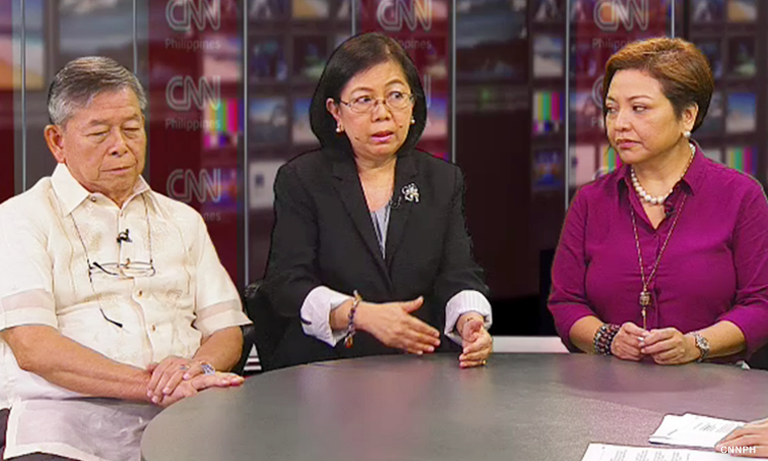

Metro Manila (CNN Philippines) — Officials of the Energy Regulatory Commission are seeking an audience with the President even after he asked them to step down, they said Wednesday.
“We just started to want to meet with the President after namin nalaman lahat nang nangyari,” ERC Commissioner Josefina Asirit told CNN Philippines. “Ito ang kinakareer namin ngayon.”
[Translation: We just started to want to meet the President after we found out all that happened. This is what we are aiming for now.]
Asirit said she and the other commissioners Alfredo Non, Gloria Yap-Taruc, and Geronimo Sta. Ana decided they wanted to speak with him in the “latter part of December.” This was when they learned more about allegations of corruption in the ERC.
The commissioners also wished to clarify that, given the structure of the commission, they were not involved in the procurement process that led to these allegations.
“Ibig sabihin lang [That just means], commissioners should be given due process before something is done,” Sta. Ana also told The Source.
In November, Duterte told the commissioners to resign following the suicide of their colleague, the late ERC Director Jun Villa in November last year.
Related: Duterte orders ERC commissioners to resign following officer’s death, alleged corruption
Villa had left suicide notes, where he wrote about corruption in the agency’s bidding process. He named ERC CEO and Chairman Jose Vicente Salazar, along with advertising executive Luis Morelos, in a supposedly rigged bidding of a project — an audio-visual presentation for the ERC.
On Tuesday, Congress opened its inquiry into these corruption allegations, where Salazar denied these claims.
In an emotional turn during the hearing, the four commissioners said Salazar had blocked an internal inquiry into Villa’s suicide. Salazar, however, said that such an inquiry would be “self-serving.”
Related: House committee investigates corruption claims that led to ERC official’s suicide
“I respectfully stated before the President that… there is no basis for me to resign,” Yap-Taruc told The Source. “Because firstly, I did not know what it was all about. I did not have any hand in it.”
According to the commissioners, they are structurally left out of the bidding process, which falls under administrative functions. Instead, they are only tasked with regulatory functions like facilitating the finding and release of documents.
Yap-Taruc said she does not blame the President for issuing such a strong statement, as he might not be aware of this set-up.
“I’m not sure if we’re in a position to appeal to the President, but I guess in the same manner that the President is really intent on coming up with good governance — Mister President, we would like to assure you we are in the same camp as you are,” said Asirit.
The Commission on Audit and the National Bureau of Investigation are conducting separate investigations into the issue.
“No checks and balances”
With commissioners left out of the bidding process, it is the dual position of the CEO and Chairman who must approve and supervise procurement plans.
Sta. Ana noted that “no one person should be in complete charge of the… transactions, otherwise he becomes too powerful.” They added that there were “no checks and balances” for the position of the Chairman.
Under R.A. 9184, or the Government Procurement Reform Act, the Bids and Awards Committee must craft a recommendation after processing the bids. The Chairman either approves or rejects the recommendation, based on circumstances allowed in the law.
Salazar claimed that there were two failed bidding processes, which is why he approached Morelos for assistance.
Villa, who was head of the Bids and Awards Committee, wrote in his suicide note that he feared “[their] mistakes may bring on COA observations and disallowances.”
The commissioners also said that the Chairman calls the shots as to who gets admitted and removed from the ERC on his own.
“When you hire personnel, or even in the firing, the entire commission has nothing to do with it,” Asirit explained. “We are just informed through a circular.”
The commissioners did not comment on whether or not they wanted Salazar removed from the dual post.
Possible legislation
The commissioners also discussed possible structures to put in place to prevent bids and appointments from being granted in the dark. Some of the measures would have to be stipulated in their Internal Rules and Regulation, not just in proposed laws from Senate and Congress.
Sta. Ana suggested that the Chairman of the ERC be kept separate from the commission’s CEO “because it can create a lot of conflict of interest.”
“I think it’s a better and more healthy setup if the… regulatory chairman of the ERC [is] a separate person from the CEO who administers and supervises the day to day management,” said Sta. Ana.
He also noted that the commissioners were not even informed of the ERC budget.
“It’s not presented to the commission,” he added. “The commission itself, the board members should know and approve that budget before it is implemented.”
Asirit also noted that they could look into the process of new hires, which is evaluated by a Personnel Selection Board but also subject to the Chairman’s discretion.
“But even that process… maybe can be looked into so that the commission as a whole, for certain levels, can be part of the choosing,” she said. “Because they will work for the commission eh, hindi lang naman for the chair.”
Yap-Taruc also suggested that being a lawyer should not necessarily be a prerequisite to heading the commission.